Applications
Will the Mobile Gantry Soon Allow Life on Mars?
Just recently, we illustrated what life in space could potentially look like, introducing various applications such as spacesuits, habitats and even patches. All of which can be 3D printed on the spot. Now, researchers from the Department of Physics and…
- 3 min read
- Applications
- Six more stories
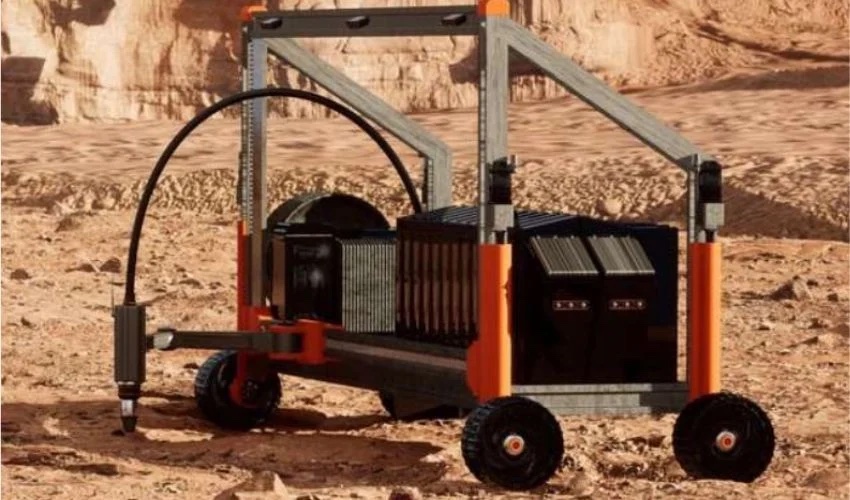
Just recently, we illustrated what life in space could potentially look like, introducing various applications such as spacesuits, habitats and even patches. All of which can be 3D printed on the spot. Now, researchers from the Department of Physics and Engineering at Taylor University in the United States have also developed a special mobile 3D printer which is also aiming towards broaching the final frontier. According to the research team, which consists of Peter J. Staritz, Caleb S. Miller, and Josiah C. McClurg, this printer will provide more flexibility for developing living space on Mars. A first test run with the prototype of their Mobile Gantry has already been successfully carried out.
With the ultimate goal of enabling human presence on Mars, researchers agreed that they needed to fully exploit the potential of additive manufacturing technologies. In order to do this, they developed a robotic approach to 3D printing habitats that is capable of producing larger, stronger and more powerful structures. Because certain obstacles have to be removed before the 3D printing can be executed successfully, the researchers created a combination of a mobile robot and gantry robots. The mobile gantry 3D printer benefits from the combination of various positive and profitable features of the two technologies, such as sequential assembly and parallel construction.
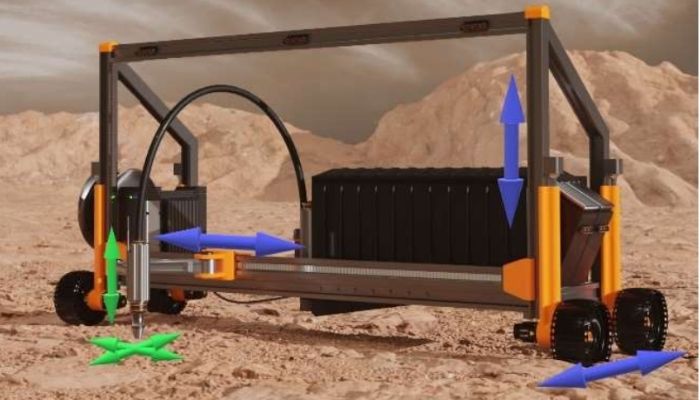
Will we soon be able to plan to build habitats on Mars, thanks to Mobile Gantry?
The Mobile Gantry combines two technologies
With the connected technologies, the researchers say that they are able to efficiently 3D print structures on Mars that are larger than the Mobile Gantry itself. No longer limited by its size, the robot can easily travel over uneven and unfamiliar planetary surfaces. Conversely, that means it can likewise travel on surfaces that it has printed itself. To be able to implement this, the robot prints structures with walls and inner partitions on which the wheels are aligned. To ensure that plans like Elon Musk’s dream to live on Mars might soon be realized, the Mobile Gantry enables special functions like parallel construction. In concrete terms, this means that efficient but less complex constructions of plants can be carried out – simultaneously! By having the robots work on the same structure parallel to each other, the time to complete the concrete 3D-printed habitat can be significantly reduced.
More from the desk
Six other notes from the rest of the bench.
 NewsArkad, Multi-Density 3D Printing for Orthopedic InsolesRodin4D, the world leader in computer-aided design and manufacturing (CAD/CAM) in the orthopedic sector, has launched a new solution dedicated to orthopedic insoles. Called Arkad, it is based on a 3-step process: data acquisition from a 3D scan, insole design…
 NewsWohlers Report 2026: Growth Continues, But Caution Defines the AM MarketThe renowned Wohlers Report is finally available: the 2026 edition marks its 31st anniversary and remains a key benchmark for the additive manufacturing market. More than 1,200 responses were collected from 570 companies worldwide. According to this international study, AM&hellip
 SoftwareCinema 4D for 3D Printing: What Do You Need to Know?Starting the journey to get a 3D printed part usually means creating a 3D model, which is the essential first step in the process. While pre-made models are readily accessible on platforms such as Thingiverse, Yeggi, Printables, MyMiniFactory, and others,…
 GuidesDressler Group on the Importance of Contract Grinding for Additive ManufacturingWhen it comes to the quality of additively manufactured components, one thing above all makes a difference: the material used. For binder jetting, HP’s Multi-Jet Fusion technology or selective laser sintering (SLS), this means that the powders used are critical…
 PrintersFuse 1+ 30W, the New SLS 3D Printer From FormlabsAmerican manufacturer Formlabs, mostly known for its resin solutions, entered the additive manufacturing powder-based technology market in 2021. Although the company had intended to do so since 2017, it did not happen until the launch of the Fuse 1, its…
 SoftwareCan Blender Be Used for 3D printing?Created in 1995, Blender is a complete 3D modeling software, very popular in the world of animation and video thanks to the many features it offers. The particularity of Blender is that it is 100% free, open source – which…