Guides
Why Is DLS 3D Printing Technology Ideal for Aerospace?
Protolabs has been making a name for itself in the manufacturing industry for many years. The company has not only mastered traditional production processes such as injection molding, but is also an expert in additive manufacturing, using a wide range…
- 3 min read
- Guides
- Six more stories
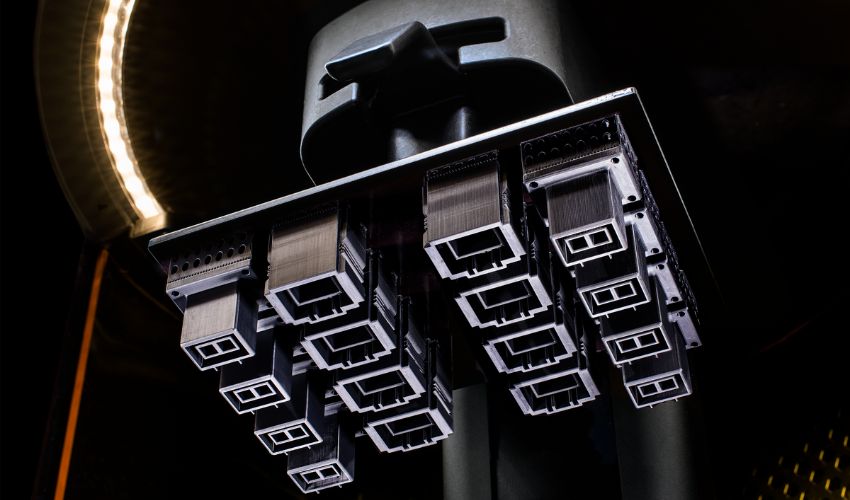
Protolabs has been making a name for itself in the manufacturing industry for many years. The company has not only mastered traditional production processes such as injection molding, but is also an expert in additive manufacturing, using a wide range of processes. From metals to polymers, it supports customers in a wide range of sectors, including aerospace, a key market for 3D technologies. While prototyping was one of the main applications for the latter, it has to be said that more and more end-use parts are being 3D printed. And Protolabs is an expert in this type of application, notably with Carbon’s resin process, Digital Light Synthesis (DLS). You might think that resin technology wouldn’t be the best option for aerospace, but the company proves differently. To find out why, we spoke to Dr. Philipp Amend, Director Operations PZB & Director Engineering 3DP.
3DN: Could you briefly introduce yourself and Protolabs?

Philipp Amend
Hello, my name is Philipp Amend and I am responsible for 3D printing production at the Protolabs site in Putzbrunn (PZB), Germany. We support our customers in their manufacturing projects, and together we choose the right production method, be it 3D printing, CNC machining or Injection Molding. This enables us to offer the best solution for every phase of the product life cycle in a customer and product-oriented manner. Among our manufacturing capabilities, we are equipped with Carbon solutions, including a large-scale Carbon L1 3D printer that enables us to print a large number of small parts, as well as larger ones – up to 300 mm.
While Carbon’s DLS technology has often been used for elastomer materials, we are now able to print rigid parts from small to large for production, which is unique on the market. This is of particular interest to the aerospace industry.
More from the desk
Six other notes from the rest of the bench.
 GuidesThe Most Surprising 3D Printing Applications at TCT Asia 2025TCT Asia 2025 has wrapped up, but there’s still plenty to talk about! As one of the biggest additive manufacturing events in Asia, this year’s edition showcased some of the industry’s most innovative 3D printing applications. Our team at 3Dnatives…
 NewsUS Air Force develops reinforced ceramics 3D printed sensorsThe US Air Force has been incorporating additive manufacturing technologies in its operations for quite a while now. For instance, it has already collaborated with GE Additive to facilitate the adoption of metal 3D printing. This time US Air Force…
 NewsThe 3D Printing Innovations at CES 2019On the 8th of January, the annual Consumer Electronic Show (CES) kicked off in Las Vegas. It gathered, as usual, thousands of people intrigued about the business of consumer technologies. The show has an essential role in providing a platform…
 NewsFungi Filament for Sustainable SoundproofingResearchers have developed sustainable soundproofing using the fungus-based material, mycelium, and 3D printing technologies. The majority of modern soundproofing panels are made of synthetic foams or mineral fibers. These are neither sustainable nor recyclable. Mycelium, however
 ApplicationsSatair produces the first certified 3D printed metal flying spare part for AirbusSatair, an Airbus services company, recently provided one of its airline customers with one of, if not the first, certified 3D printed metal flying spare part in the world. The part is actually a wingtip fence for an A320ceo aircraft…
 GuidesMiranda Marquez and her original vision of 3D printed clothingThe use of additive manufacturing in fashion is becoming increasingly popular. Many are the projects that use this technology to design unique pieces, from footwear to entire collections. In the world of fashion and design, 3D printing technology offers a great…