News
How to Unlock Additive for Industrial Applications with Vapor Smoothing
In any industry or sector, there are a number of necessary standards that must be met to ensure the proper functioning of certain parts, systems or services. The rise of additive manufacturing (AM) in many fields has led to the…
- 3 min read
- News
- Six more stories
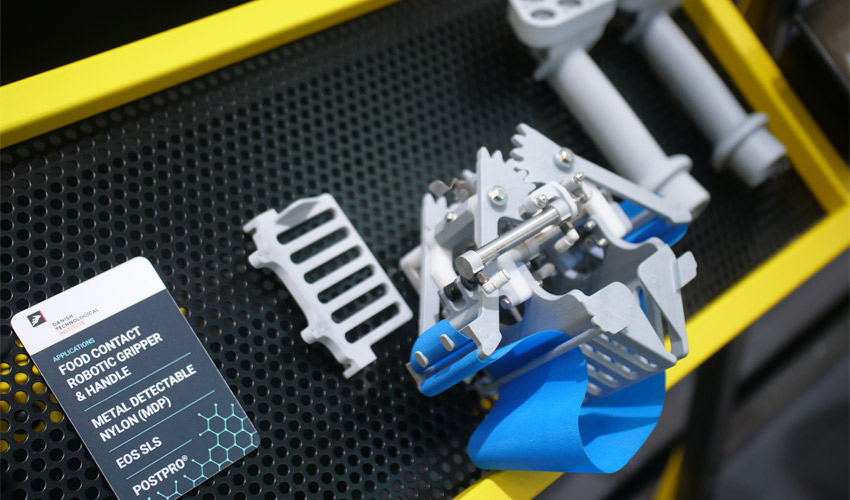
In any industry or sector, there are a number of necessary standards that must be met to ensure the proper functioning of certain parts, systems or services. The rise of additive manufacturing (AM) in many fields has led to the need to control the properties of 3D printed parts, both in terms of performance and biocompatibility. To meet these stringent requirements, post-processing of raw parts made using AM is crucial. This is because these steps eliminate imperfections and help users to obtain the desired, or even required, finish. Thus, different post-processing solutions have been emerging to help 3D printed parts to comply with the certifications for different applications, enabling them to compete directly with traditional processes such as injection molding.
Whether for the creation of prostheses, nasal swabs, dental aligners or medical helmets, the healthcare sector, among others, is one of the most demanding in terms of part quality, safety and performance. In the AM market, there are a number of post-processing methods that, at first glance, offer the necessary smooth finishes for these types of applications. However, the problem lies in the inner channels of the part, which are still exposed, potentially trapping bacteria and contaminating the production process. To provide a solution to this, AMT is offering an automated post-processing system, called Vapor Smoothing, which provides a smooth and sealed surface finish for 3D printed parts. Thanks to this post-processing method, it is possible for parts to pass different tests that prove that they meet the standards and regulations for industrial applications in a number of fields.
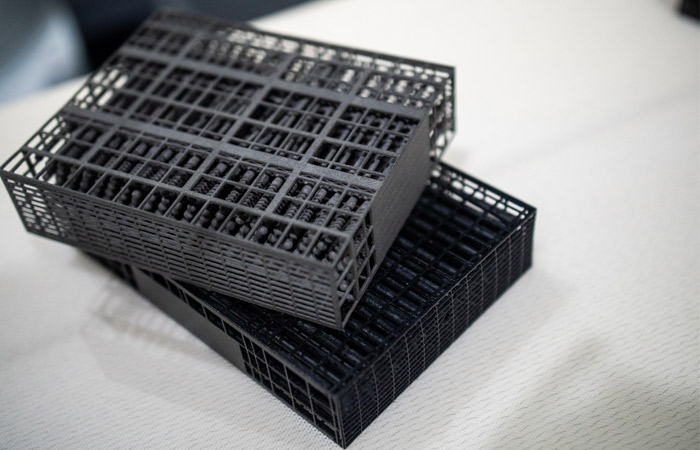
Photo Credits: AMT/ZiggZagg
How Does Vapor Smoothing Work?
To understand how standards could be achieved with 3D printed parts in the most demanding industries, such as medical, dental and automotive, with this process, it is first necessary to look at how the technology works. The vapor smoothing method developed by AMT suspends batches of parts in a sealed processing chamber into which a proprietary solvent blend is introduced as vapor in a closed-loop system. The vapor comes into contact with the parts, sealing them and eliminating their surface irregularities. By eliminating the crack initiation sites, the vapor smoothing process completely seals the surface of the part, resulting in an increase in elongation at break with no loss in ultimate tensile strength.
More from the desk
Six other notes from the rest of the bench.
 NewsFrom Trails to Tackle Boxes: How 3D Printing Is Reshaping Outdoor GearWhen it comes to spending time outdoors, preparation matters. Whether hiking, camping, fishing, or hunting, having the right equipment on hand can make a real difference. Because this gear must be carried (and often, over long distances), it needs to be lightweight,…
 ApplicationsWhat benefits do 3D printed drones bring to our society?A drone is an unmanned aerial vehicle (UAV), or in other words aircraft, without a human pilot on board. These days, getting a traditional drone can be a big investment if you do not need the advanced features they offer.…
 ApplicationsDaimler Buses is Allowing its Customers to 3D Print Spare PartsBefore long, bus companies Mercedes-Benz and Setra will be able to 3D print parts for their vehicles themselves. The news comes directly from an announcement by the component manufacturer Daimler Buses in a press release. With this initiative, the manufacturer…
 GuidesBoston Micro Fabrication Talks Micro-Scale Printing Using StereolithographyAdditive manufacturing continues to evolve, though rather than getting bigger, this time it’s getting smaller, microscopic even. Boston Micro Fabrication (BMF), based as the name suggests in Massachusetts in the United States, is known for their high precision micro 3D&hell
 NewsTop 5 Videos: 3D Printing With Neil Patrick HarrisThis week, tag along with actor Neil Patrick Harris and 3D printing YouTuber 3D Printing Nerd, on the 87-day 3D-printing adventure. Next, discover amorphous metals. 3D printer manufacturer Trumpf has notably developed a printer compatible with these metals, which are…
 NewsMaterialise Purchase Option to Buy Link3DThe additive manufacturing industry has seen an unprecedented number of mergers and acquisitions in the fiscal year so far. These have notably included Protolabs’ acquisition of 3D Hubs, Desktop Metal’s acquisition of EnvisionTec and Markforged’s merger with One. Now, Materialise