Materials
University of Toronto Researchers Create ‘Strong as Steel, Light as Foam’ Nano-Architected Materials Using 3D Printing
Thanks to machine learning and 3D printing, researchers at the University of Toronto have developed nano-architected materials that combine the strength of carbon steel with the lightness of polystyrene foam. 3D printing, which facilitates the creation of such innovative material
- 3 min read
- Materials
- Six more stories
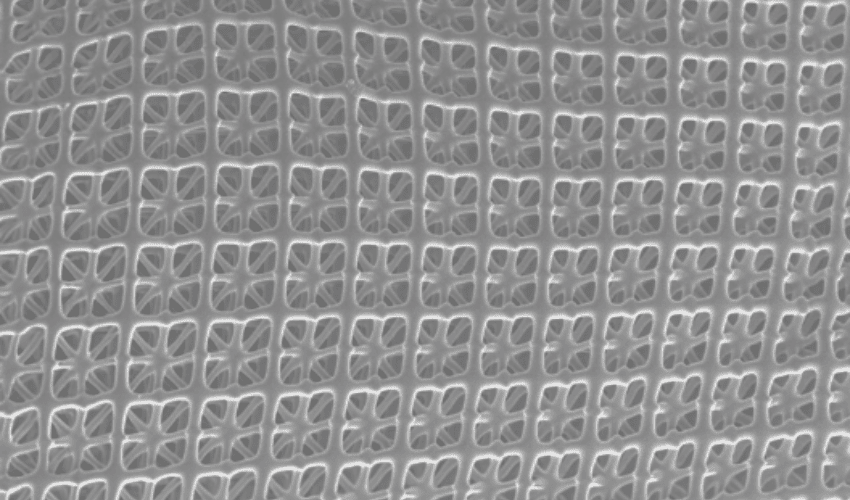
Thanks to machine learning and 3D printing, researchers at the University of Toronto have developed nano-architected materials that combine the strength of carbon steel with the lightness of polystyrene foam. 3D printing, which facilitates the creation of such innovative materials, is thus becoming an increasingly popular tool for designing materials with advantageous properties for a variety of fields. This development is not a first, as more and more new advances are emerging in this field, with a potential impact for many industries.
Under the direction of Professor Tobin Filleter, a team developed these nanomaterials with interesting characteristics, combining robustness, lightness and adaptability. This process could transform many sectors, from automotive to aerospace. But how was this material conceived, and what are its exact properties? Read on to find out more.

Nano-Architectured, 3D-Printed Materials for Ultra-Light, High-Strength Aerospace Applications
These materials are made up of small, repetitive units measuring just a few hundred nanometers. To reach the thickness of a human hair, more than 100 would have to be aligned. These units, mainly made of carbon, form complex 3D structures called nanolattices.
More from the desk
Six other notes from the rest of the bench.
 MaterialsThe High-Performance Polymer Market: An Opportunity for 3D Printing?Research and Markets recently released its latest report on the Global High-Performance Materials in Additive Manufacturing Market. Entitled ‘The Global 3D Printing High-Performance Plastic Market’, it analyzes the place and evolution of high-performance polymers such
 ApplicationsUS Troops 3D Print Drone Parts While Flying in Black HawkThe Indiana Army National Guard has achieved a technological first by successfully demonstrating 3D printing aboard a UH-60 Black Hawk helicopter. This marks a considerable milestone in military innovation, showcasing the shift towards additive manufacturing within the defense se
 PrintersMIT Engineers make a 10X Faster FDM 3D Printer!Engineers at the Massachusetts Institute of Technology (MIT) have developed an FDM 3D printer that, with the help of a laser, prints 10 times faster than normal office machines. Though it uses a laser, it is still considered a fused deposition…
 News3Dnatives Lab: Testing the UltiMaker S8UltiMaker S8 test: a logical update, a natural progression. Two years after testing the S7, it’s the UltiMaker S8’s turn to go through our test. If you haven’t yet read our review of the S7, we invite you to take…
 ApplicationsICON’s 3D Printed Simulated Mars Surface Habitat Will Help Pave the Way for Space ExplorationNASA is once again using 3D printing in its work to bring humanity closer to space exploration. Not long after after announcing that Redwire Regolith Study, which will test whether 3D printing of regolith (loose soil) can be used to…
 NewsWEBINAR: Low-Volume Rapid Injection Molding with 3D Printed MoldsInjection molding is a manufacturing process that allows for the design of large volumes of parts. The majority of plastic components that exist today are made using this technique. However, the production of a mold – most often metal –…