News
Isotropy in 3D Printing: What Is It and How Does It Affect the Final Parts?
If you are part of the 3D printing industry or at least somewhat familiar with the technology, you will have heard of the concept of isotropy, which is defined as uniformity in all orientations. Thus, if we apply it to…
- 3 min read
- News
- Six more stories
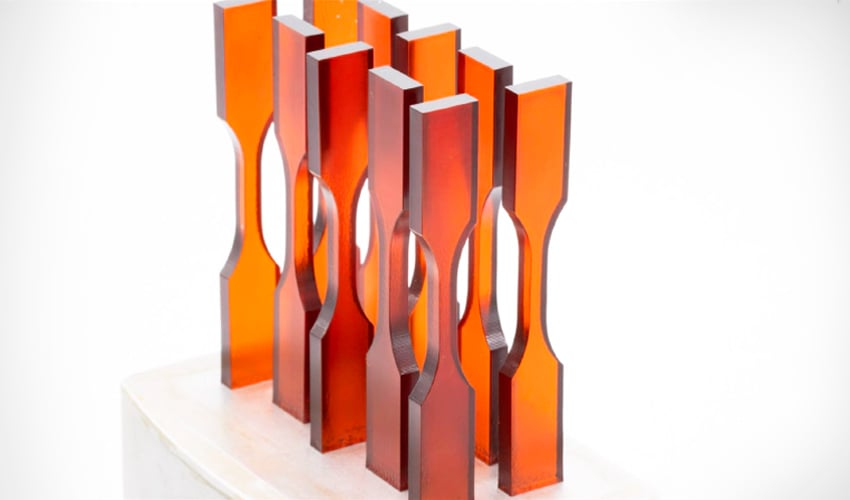
If you are part of the 3D printing industry or at least somewhat familiar with the technology, you will have heard of the concept of isotropy, which is defined as uniformity in all orientations. Thus, if we apply it to additive manufacturing, it refers specifically to uniformity in 3D printed parts. We can interpret this term from many different angles, whether it is the color, surface finish, shape of the model, etc. However, the property that most often interests experts, and to which the concept of isotropy is generally associated, is strength. In other words, an isotropic part is one that has the same strength in all the physical parts that make it up. But why is it so important to understand the meaning of this concept, and how does it affect the final 3D printed parts?
As 3D printing is an increasingly democratized manufacturing method, many companies are implementing it for the creation of final parts. It is therefore essential to understand the different technologies available and the performance of the material to be used. In general, most thermoplastic polymers are considered isotropic. This is mainly due to their nature and the fact that the cohesion between their component polymer chains is uniform in all directions. However, this does not mean that parts made from these materials maintain this quality level.
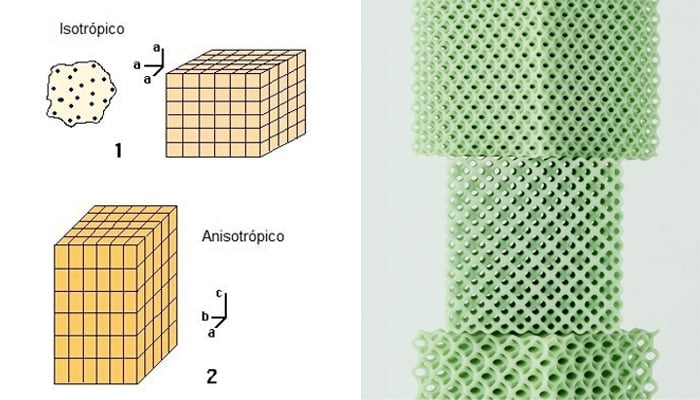
The difference between an isotropic and anisotropic model (Photo credits: IMA / Carbon)
In fact, sometimes the manufacturing method can cause anisotropy in the parts even though their raw material has isotropy. When this happens and anisotropic parts are obtained, it means that they have physical properties that are different depending on the direction in which they are measured. Let us now look at some techniques to maintain this degree of isotropy in 3D printing, focusing only on methods that work with polymers.
More from the desk
Six other notes from the rest of the bench.
 NewsWEBINAR: Mass Production in Additive ManufacturingAdditive manufacturing applications are rapidly evolving. Manufacturers are moving from rapid prototyping to small or even large series production. Their objective is to leverage the benefits of additive manufacturing such as the ability to design custom-made, complex and durable
 ApplicationsCORAL: A 3D Printed Ingestible Capsule to Sample Your Gut MicrobiomeThe gut microbiome is a complex ecosystem of bacteria, viruses, fungi and parasites that resides in the intestines. Shaped by both diet and environment, each person’s microbiome is unique. This ecosystem interacts with the digestive, immune, nervous and endocrine systems,…
 SoftwareHow to Choose the Best Computer for 3D Modeling and CADCAD, or computer-aided design, is the process of creating, modifying and optimizing designs using specialized software. It is widely used in a number of industries, including architecture, engineering, manufacturing (including additive manufacturing) and entertainment. CAD softwa
 NewsHubs and its Online Manufacturing Platform at Formnext 2019To enable additive manufacturing users to get instant quotes and produce parts quickly, Hubs, formerly 3DHubs, offers an online manufacturing platform where it is possible to connect with professionals. Through a network of highly qualified manufacturing partners, the company con
 PrintersUltimaker unveils their new S5 3D printerUltimaker, the Dutch manufacturer of desktop 3D printers, has revealed their new machine, the Ultimaker S5. Presented at the Hannover Fair, the S5 includes a larger build volume, a touch screen, resealable windows, a mobile application and the capability of…
 NewsU.S. Air Force Announces Contracts with Inkbit and BotFactoryThe U.S. Air Force (USAF) has just announced separate contracts with two companies, both specialising in 3D printing, Inkbit and BotFactory. While still of interest, the news comes as no surprise as the U.S. Air Force has already demonstrated their…