Guides
The Top 3D Printed Pavilions Around the World
A pavilion is defined by the the Merriam-Webster dictionary as an “a usually open sometimes ornamental structure in a garden, park, or place of recreation that is used for entertainment or shelter.”. In recent years, there has been an increasing…
- 3 min read
- Guides
- Six more stories
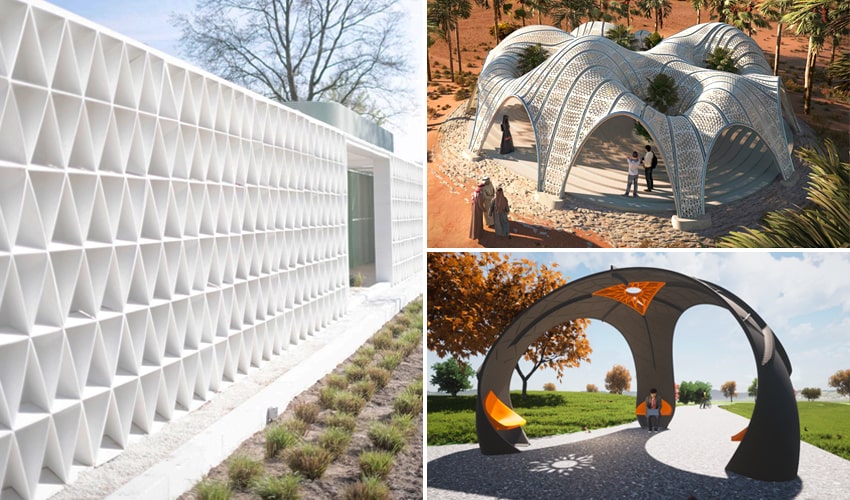
A pavilion is defined by the the Merriam-Webster dictionary as an “a usually open sometimes ornamental structure in a garden, park, or place of recreation that is used for entertainment or shelter.”. In recent years, there has been an increasing trend towards using additive manufacturing to create pavilions. With the help of 3D technologies, it is possible to design buildings more efficiently, at a reduced cost, and with a minimized amount of materials while still allowing for the creation of more complex geometries. Some 3D-printed pavilions feature designs that would have been impossible to accomplish with traditional manufacturing techniques, such as honeycomb structures constructed using topological optimization. These 3D-printed pavilions can now be found worldwide, showcasing the possibilities of 3D printing. While most are constructed with concrete, it’s worth noting that other materials have been used with an environmental concern in mind. We took a closer look at some of the top examples.
The All-Weather Pavilion
The design studio Nagami and architecture firm Hassell have joined forces to produce a sleek and transportable 3D-printed pavilion prototype that can be customized to meet specific requirements. The pavilion is engineered to withstand harsh weather conditions and is optimized for extreme environments, such as deserts, snowy areas, or war zones. The structure was created using a robotic arm fitted with a nozzle capable of depositing recycled plastic filaments, demonstrating the project’s eco-friendly commitment. The collective to.org, which devoted to tackling global warming, inequality, and ocean pollution, supported the project. The pavilion’s complex and futuristic architecture, inspired by indigenous shelters, highlights the diverse design possibilities afforded by 3D printing technology.
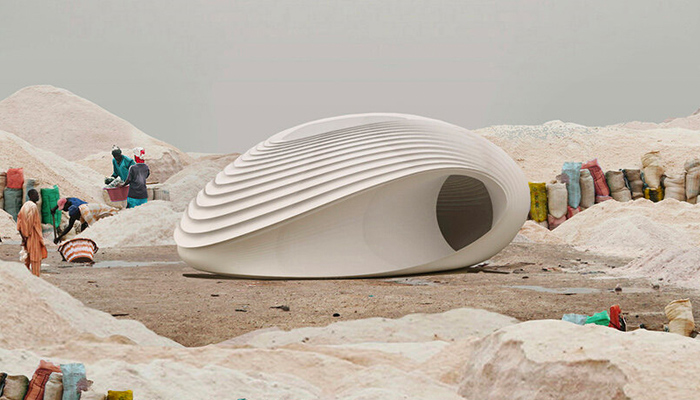
Photo credits: Hassel
A 3D Printed Pavilion in Mexico
Named “Sueños con Fiber/Timber, Earth/Concrete” (Dreams with Fiber/Timber, Earth/Concrete), this 3D printed pavilion was created in Mexico to showcase the city’s stories and raise awareness about preserving our planet. The team behind it, consisting of Structures MIT Digital Engineering, the international organization New Story, and Échale, a Mexican social enterprise, aimed to combine three key elements: innovative technology, traditional craftsmanship, and sustainable materials. The pavilion’s horizontal roof structure maximizes the existing joist-and-vault system, reducing the need for precast reinforced concrete beams and enhancing its environmental sustainability. The clay 3D printed blocks are placed between the beams, allowing for the pouring of a top slab. By using locally-sourced materials and recycling, the pavilion not only becomes more affordable, but it also significantly reduces its carbon footprint.
Tiny House, the Pavilion without Frames or Custom-Made Formwork
The De Huizenprinters consortium in the Netherlands is responsible for creating a 3D-printed concrete pavilion called Tiny House. This collaborative effort involves several companies, including Heilijgers construction firm, Van der Kamp BV concrete supplier, innovation experts Blueways, creative innovators community De WAR, and 3D concrete printing company Vertico. According to the creators, designing the roof was the most difficult part of the process. The print head orientation and various end heights had to be carefully considered, requiring significant time and energy. The pavilion is constructed entirely from concrete, including recycled concrete aggregates, eliminating the need for frames or formwork. It is composed of eight sections and was created using parametric design to test its ability to withstand changes in the weather. This sustainable project is an excellent example of the possibilities offered by additive manufacturing and offers new construction methods for future structures.
More from the desk
Six other notes from the rest of the bench.
 ApplicationsThe E-Miles L7e: A Revolutionary 3D Printed Electric CarThe automotive industry is experiencing a significant transformation propelled by 3D printing technology. This innovative approach is unlocking numerous opportunities in electric vehicle manufacturing. For instance, it facilitates the creation of tailored prototypes and the fabri
 NewsBCN3D’s successful year reflects on a larger trend of growth in the 3D printing sectorFor the additive manufacturing industry, 2020 has been a year of great change, both positive and negative. Many companies have taken advantage of their capabilities to grow in the sector, while others have not been able to withstand the impact…
 NewsWhy combine artificial intelligence and 3D printing?Nowadays, we’ve noticed buzzwords such as Artificial Intelligence (AI), Blockchain or Industry 4.0 being increasingly used and thrown around. In themselves, these technologies can have and are having a huge impact on today’s economy and existing production systems. But what
 NewsHow Can We Make Metal 3D Printing More Reliable and Encourage Its Adoption?One of the most persistent challenges in additive manufacturing is undoubtedly process reliability. How can we guarantee that 3D-printed parts will meet the desired requirements? Will they withstand the effects of time? Can we successfully reproduce the same conditions for&hellip
 GuidesInterview with Hargurdeep Singh about his role at CAD MicroSolutionsCAD MicroSolutions is dedicated to helping mechanical and electronic customers ensure they are realizing the greatest value from their technology investment. The company offers design automation software, training, and consulting to help clients innovate, disrupt, design, and suc
 ApplicationsTISSIUM receives FDA approval for its polymerizable vascular sealantTISSIUM was founded in 2013 to address one of the most persistent medical challenges since the inception of medical procedures: to reconstruct damaged tissue. The medtech company developed a proprietary technology, called biomorphic programmable polymers, to transform the way tis