Printers
The Top Glass 3D Printers on the Market
Glass is one of the oldest materials on Earth, worked by humans more than 100,000 years ago. It was used to make tools and weapons, and over time, its applications multiplied. Looking around us today, glass is everywhere and exists…
- 3 min read
- Printers
- Six more stories
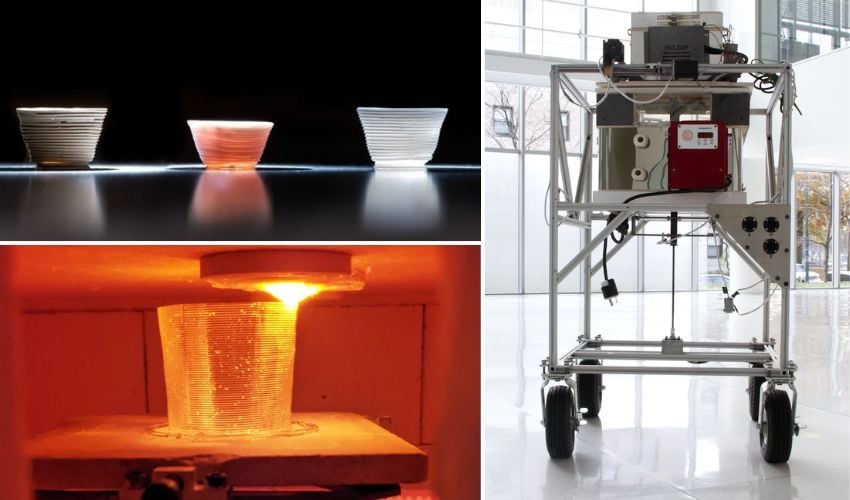
Glass is one of the oldest materials on Earth, worked by humans more than 100,000 years ago. It was used to make tools and weapons, and over time, its applications multiplied. Looking around us today, glass is everywhere and exists in many forms. There are also many different variations that offer different properties and characteristics. But if glass is so present in our lives, what about additive manufacturing? Can glass be 3D printed? The answer is yes, but it is a complex material to work with. Indeed, working with glass requires very high melting temperatures (around 1,000°C) and an extremely controlled, precise thermal environment. Despite these constraints, some players have developed glass 3D printers capable of producing all kinds of parts. While some are now commercially available, most remain research projects. Here’s more!
The Maple 4 by Maple Glass Printing
The Maple 4 is a desktop glass 3D printer that combines simplicity with advanced performance. Unlike traditional glass fabrication, which requires extreme heat and specialized equipment, this system makes the process more accessible and efficient. Compact at 736 x 600 x 985 mm and weighing approximately 100 kg, it operates on a standard 220–240V outlet, achieving nozzle temperatures of nearly 1000 °C. It has a 200 × 200 × 300 mm build volume and can manage high flow rate printing. It can also produce detailed glass parts in just under an hour. Its features include one-click printing, automatic mesh bed leveling, and a magnetic print bed, which help to ease use and ensure consistent results.
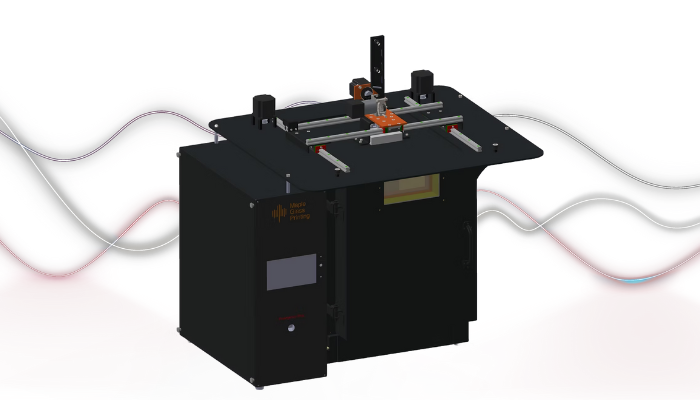
(Photo Credit: Maple Glass Printing)
Glass 3D Printer from Nobula
The Nobula Glass 3D Printer introduces Direct Glass Laser Deposition (DGLD), a technology that the company says “makes printing glass as straightforward as printing plastic.” The printer is capable of reaching up to 2200 °C with non-contact laser heating. It is high-precision and energy-effective while eliminating the need for post-processing. The device is around 100 × 40 × 60 cm and weighs just over 50 kg. The system offers a resolution of 100–250 μm and supports infills from 0 to 100 percent. With print speeds ranging from 5 to 200 mm per minute, users can produce free-standing structures with fine detail and great performance. The device is optimized for silica glass and compatible with both Nobula and commercial slicing software. This Glass 3D Printer from Nobula opens the door to complex, high-quality glass components across research, design, and advanced manufacturing applications.
More from the desk
Six other notes from the rest of the bench.
 ApplicationsCreating vascular networks to sustain 3D printed organs is becoming possibleThe generative design studio Nervous System has collaborated on new 3D printed organ research and has just made the cover of Science Magazine. The studio has always worked at the intersection of science, art and technology. Three fields that have…
 Guides#3DStartup: How AM3L Uses Metal AM for High Performance Porous ArchitecturesWe end this year with a startup coming from the CEA, the French Alternative Energies and Atomic Energy Commission: AM3L. The company is a starup that specializes in porous metamaterials produced by metal 3D printing. Its goal is to use…
 ApplicationsInfographic: 3D Printing in the Automotive SectorThe automotive sector was one of the first industries to use 3D printing. Indeed, it was the first to use the technologies to create prototypes as well as to gradually move towards integrating end-use parts. And the importance of additive…
 NewsStrengthening Metal Through Oxidation – A Radical Research Approach With Great Potential?Metal 3D printing is used in numerous fields and possibilities for expanding its potential are constantly being discussed in the aerospace, automotive and shipbuilding industries. Large-format parts are now being produced from metals using 3D processes and the technologies are&he
 MaterialsMoving to a more sustainable and responsible economy with 4D PioneersThe additive manufacturing sector has seen the supply of materials explode in recent years: market players are constantly innovating and looking for solutions to meet the needs and constraints of manufacturers. It is well known that the materials that are…
 GuidesStartup of the month, Aspect Biosystems: bioprinting human tissuesOur startup of the month is Aspect Biosystems, a Canadian specialist in bioprinting. Aspect Biosystems has developed a unique technology that allows the creation of customized human tissues for different applications such as drug development, regenerative medicine, disease unders