Applications
Creating vascular networks to sustain 3D printed organs is becoming possible
The generative design studio Nervous System has collaborated on new 3D printed organ research and has just made the cover of Science Magazine. The studio has always worked at the intersection of science, art and technology. Three fields that have…
- 3 min read
- Applications
- Six more stories
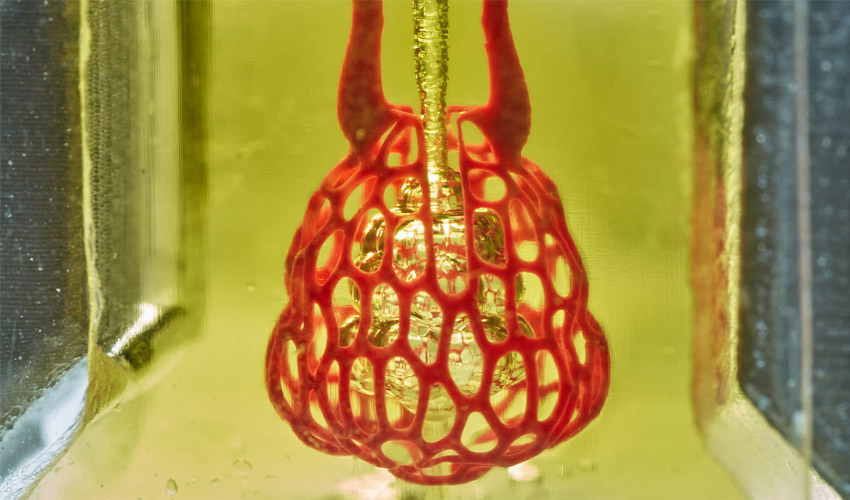
The generative design studio Nervous System has collaborated on new 3D printed organ research and has just made the cover of Science Magazine. The studio has always worked at the intersection of science, art and technology. Three fields that have a deep relationship. In fact, they use computer simulation to generate designs from nature that they then produce through digital fabrication. They reveal on their blog that for the past three years they have been working with Jordan Miller, a bioengineer at Rice University on creating vascular networks for 3D printed organs. The work, published in Science Magazine, was led by Jordan Miller at Rice and Kelly Stevens at the University of Washington; it also included collaboration from 13 others.

Science, 03 May 2019: Vol. 364, Issue 6439, pp. 458-464 | Credits: Science Magazine
The partnership started in 2016, Jordan Miller was captivated by Nervous System’s ‘growing objects’ exhibit that showcased a series of branching sculptures. The skills needed to create such structures could be applied to a completely different field, Nervous System explains, “He [Jordan Miller] proposed that our skills could be put to an epic task: ‘Perhaps we could work together to make open-source software that the world could use to design synthetic living tissues and organ replacements for human patients’ ”. The idea was born to use the studio’s generative design capabilities to make living things.
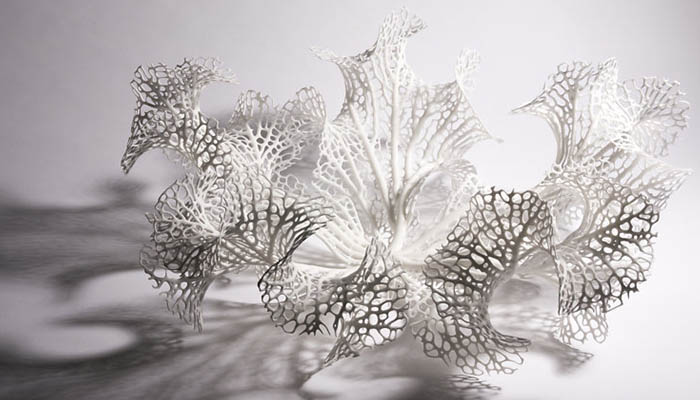
The hyphae crispata 1 from the ‘Growing Objects’ exhibition that inspired Jordan Miller | Credits: Nervous System
The design studio explains that while there are many labs creating artificial tissues, the problem is keeping them alive. The issue is feeding the billions of cells that need support from intricate vascular networks. These provide nutrients and oxygen whilst removing waste and without them the artificial tissues soon die. Taking this into account, Nervous System seeks to create software that will enable scientists to design customised multi-vascular structures for 3D printed organs. For the first time, the design studio in collaboration with the Miller Lab successfully designed and created complex multi-vascular networks that were materialised in soft hydrogels.
More from the desk
Six other notes from the rest of the bench.
 NewsBCN3D’s successful year reflects on a larger trend of growth in the 3D printing sectorFor the additive manufacturing industry, 2020 has been a year of great change, both positive and negative. Many companies have taken advantage of their capabilities to grow in the sector, while others have not been able to withstand the impact…
 Guides#3DStartup: Shapeshift 3D & Its Customization Platform for 3D PrintingHailing from Canada, Shapeshift 3D is a startup that has developed an integrated platform to customize medical and sports equipment. The company facilitates digital transformation, scanning, and 3D printing. The company’s software solution is optimized by artificial intelli
 PrintersMETHOD Carbon Fiber Edition, the carbon fiber 3D printer from MakerBotThe manufacturer MakerBot has just launched a new professional machine capable of printing carbon fiber reinforced nylon, also developed by the manufacturer. Named METHOD Carbon Fiber Edition, this solution is based on the METHOD platform developed in December 2018 but…
 NewsTOP 5 videos of the week: the world’s fastest cycle and much more!We found the TOP 5 videos of the week related to 3D printing and collected the additive manufacturing here. Share your videos and comment on the article below or on the 3Dnatives’ Facebook or Twitter account. Hope you’ll enjoy and…
 MaterialsNew materials for additive manufacturing from 3D Systems, Evonik, Desktop Metal and Liberty3D Systems 3D Systems from South Carolina has launched a new rubber-like material for its desktop FabPro 1000 3D printer. The new material is called FabPro Elastic BLK and it is incredibly flexible and strong. Apparently, the new elastomer will…
 NewsTop 5 Videos: Dubai’s 3D Printed Martian City in the DesertThis week, discover the Mars Science City project in Dubai! Outside of Dubai, in the desert, the United Arab Emirates wants to build a 177,000 square meter city that will replicate living conditions on Mars. To build the houses, the…