News
The Printed Origami That Can Form 3D Objects in Mere Moments
3D printing can be a process that requires patience. Large, complex builds often take a number of hours before completion while industrial 3D printing may take even longer still. That said, the convenience and automation of 3D printing often make…
- 3 min read
- News
- Six more stories
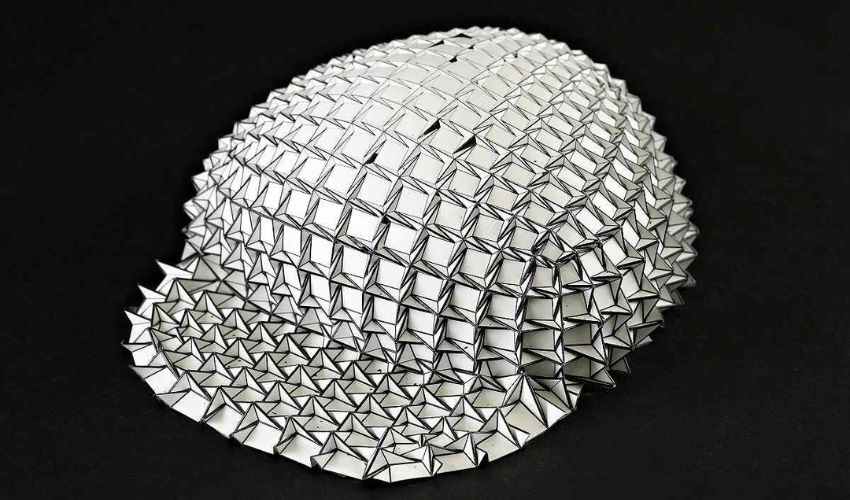
3D printing can be a process that requires patience. Large, complex builds often take a number of hours before completion while industrial 3D printing may take even longer still. That said, the convenience and automation of 3D printing often make it the most advantageous solution. While there are continual studies and tests underway that aim to speed the efficiency of 3D printing machines, one group of researchers from the University of Tokyo in Japan has made a rather unique breakthrough in the material in the form of a harmonious clash between tradition and progress: 3D printed origami. Although not the first time origami and 3D printing have crossed paths, this new development is highlighting the not-to-be-overlooked creativity and utility potential of origami constructions.
The research team has dubbed their new creation process “4D printing” because the 4th dimension, often attributed to time, is drastically reduced after printing. Indeed, the final creation can self-fold into its desired shape almost instantaneously. “Essentially, we’re creating flat sheets with origami patterns on them, and these patterns can be complex, taking even a skilled origami artist hours to form. But thanks to our special process, you can pour hot water over these flat sheets and watch as they spring into complex 3D shapes in a matter of seconds,” explains Professor Koya Narumi, part of the University of Tokyo research team and Department of Electrical Engineering and Information Systems.
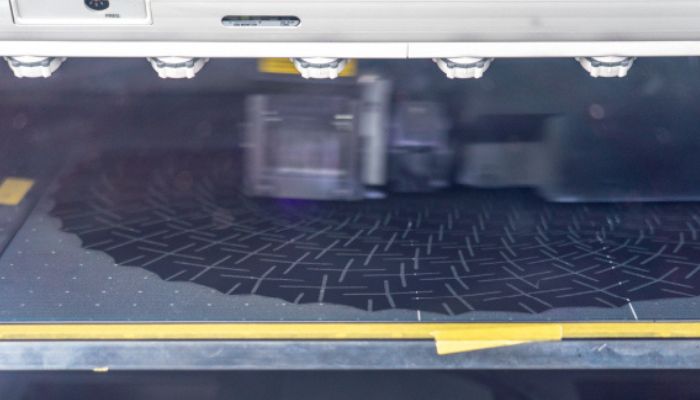
The design layers are printed onto a heat-sensitive plastic sheet which is treated by UV light. (Photo credits: Koya Narumi)
From Polygons to Paper to Product
The process begins as a digital creation, mapped out thanks to an algorithm created by the research team. It then enters production as a flat, 2D printed sheet that can later be bent into the desired shape similar to paper being folded into origami shapes. The designs are printed on a heat-sensitive plastic sheet in a process akin to material jetting. The process laid out in their research paper as ‘Inkjet UV Printing’ possesses similar qualities to 3D printing’s material jetting, as the materials that are printed react to UV light. Additionally, the print consists of multiple material layers including a primer, the base ink layer, and a clear protective top layer which is waterproof.
More from the desk
Six other notes from the rest of the bench.
 Guides#Working3D: Six Questions for a Footwear EngineerWe have seen in numerous projects how 3D printing is being used to make shoes. This is especially the case for the consumer goods sector, where we are seeing particularly fashionable examples, but also sports shoes, which enable greater performance…
 NewsThe 3D Printers That Stood Out at TCT Asia 2025TCT Asia 2025 ended last week! And what a show it was. While there, we saw some incredible applications while also learning about the most important trends in additive manufacturing in China. But that was not all! We also had…
 ApplicationsThe Unveiling of Michelin’s 3D printed tire prototypeFrench tire manufacturer, Michelin, has unveiled a concept 3D printed tire that just may revolutionize the way we drive. The tire, which is airless, has a biomimetic structure and could have the ability to reprint its tread, depending on the…
 NewsAdditive Manufacturing Plays A Growing Role in the Jewelry IndustrySmarTech Analysis has published a new study dedicated to the additive manufacturing market, this time focusing on the jewelry sector. According to the report, the 3D printed jewelry market is expected to reach a value of $989 million by 2031,…
 News#TOP5 Videos: the dental 3D printer NextDent 5100, 3D printed sushi…We found the TOP 5 videos of the week about 3D printing and the way additive manufacturing is shaping and changing our society. This week we touch on the dental 3D printer NextDent 5100, 3D printed sushi and much more! If…
 NewsTop 5 Videos: Celebrate 3D Printing Day!Happy 3D Printing Day! Yes, you heard right! Coined back in 2013 by GE with the catchy line “going 3D on D3,” the third day of December has become a time to reflect on the additive manufacturing industry and marvel…