News
What is the Future of Metal Additive Manufacturing?
Earlier this year, research firm IDTechEx published a report on metal additive manufacturing, estimating that its value would reach $18.5 billion within 10 years, showing a gradual recovery of the market. As part of this study, the firm conducted an…
- 3 min read
- News
- Six more stories
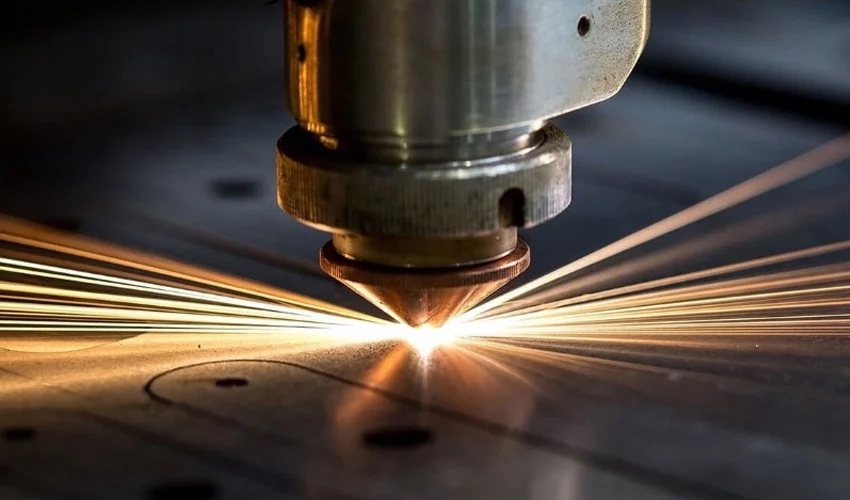
Earlier this year, research firm IDTechEx published a report on metal additive manufacturing, estimating that its value would reach $18.5 billion within 10 years, showing a gradual recovery of the market. As part of this study, the firm conducted an analysis of the future of the metal additive manufacturing market by comparing the different processes that exist, seeking to understand the major trends in the sector but also possible future sources of revenue. Powder bed processes, concentrated energy deposition (CED), wire extrusion: which technology should you focus on? Where does the future of metal 3D printing lie?
Fourteen 3D printing processes were analyzed and compared in the IDTechEx study. Among them, there are of course the most well-known technologies such as Binder Jetting, DED, extrusion (whether with granules, paste or even filaments), laser powder bed fusion, but also less popular processes such as electrochemical deposition or cold spray. For each process, criteria such as print volume, accuracy, price of the machine and material, and necessary post-processing steps were compared, with the aim of evaluating strengths and weaknesses.
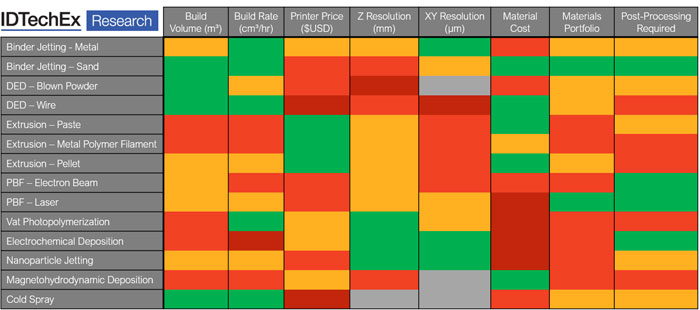
IDTechEx compared 14 metal 3D printing processes according to specific criteria (photo credits: IDTechEx)
Current Market Trends
As with many other technologies, price and build volume are two key factors to which users are particularly sensitive. Starting with the former, you probably know that metal powder is expensive, especially when it comes to uniform powder. This is a major barrier to entry for many companies, preventing them therefore from turning to powder processes, even though there are many on the market today. This is where we see a trend emerging: the development of extrusion technologies, more specifically the deposition of metal filaments – or rods – and granules. One example is manufacturers such as Meltio, who has developed a machine that combines two types of raw materials to lower the cost of a 3D printed part. More and more players specialized in FDM/FFF have also presented extruders capable of supporting metallic materials.
More from the desk
Six other notes from the rest of the bench.
 NewsFirst 3D Printed Seawalls Placed in Florida to Fight Against Rising SeasAs climate change accelerates and sea levels surge, coastal communities worldwide confront an unprecedented threat. Compounding this challenge is the alarming decline of coral reefs. While 3D printing has previously addressed these issues individually, Miami-based tech company Ki
 GuidesWhich Additive Manufacturing Companies are Publicly Traded?It is no secret that additive manufacturing has been growing rapidly over the past few years, especially since it proved its resiliency during the COVID-19 crisis. Though one sign of this of course has been the significant investment in the…
 ApplicationsCadillac Has Turned to 3D Printing for its New Luxury SedansThe American manufacturer of high-end, luxury vehicles, Cadillac, recently unveiled the Cadillac Celestiq 2024. The company notes that this latest car, which is priced starting at $300,000, is expected to be leagues apart from many of their other models. This…
 GuidesThe Top Wash and Cure Stations of 2024What are the cleaning and curing solutions for 3D printed resin parts? Printing a 3D part is not as simple as pressing the button on your 2D printer. You need to prepare the model, make sure the printer is set…
 NewsRethinking Mobility Thanks to 3D PrintingSooner or later, self-driving vehicles will become part of our everyday lives, and it’s not just the carmakers themselves who have realized this. Well-known automotive giants like Volkswagen, Audi and Daimler are increasingly facing competition from tech giants like Google&
 SoftwareMyMiniFactory, The Platform For Guaranteed Printable Free STL FilesWhether hobbyist or professional, anyone using a 3D printer is very likely to be using an STL file to print their project. An STL file, along with a 3D slicer, transmits data from a computer to 3D printer hardware. But…