Materials
The Complete Guide To Glass 3D Printing
Glass or crystal is a hard, brittle, transparent and amorphous inorganic material found in nature, although it can also be man-made. In additive manufacturing, it is an unusual material, but one that can be processed to create original glass parts,…
- 3 min read
- Materials
- Six more stories
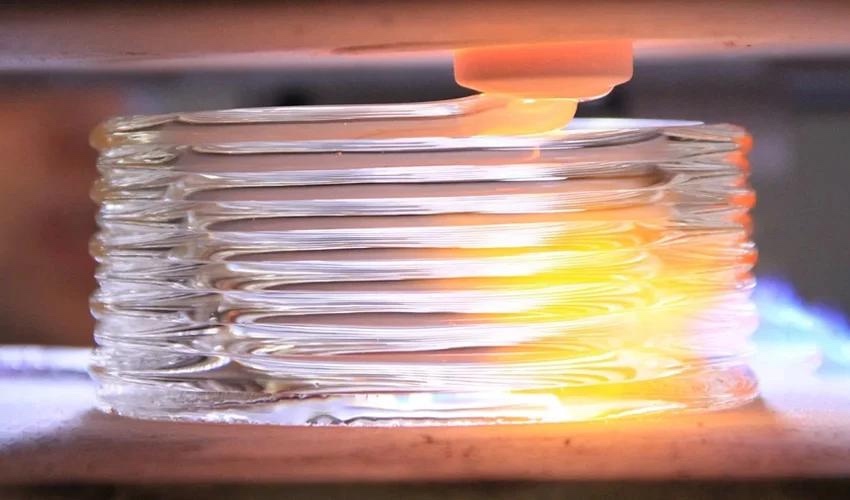
Glass or crystal is a hard, brittle, transparent and amorphous inorganic material found in nature, although it can also be man-made. In additive manufacturing, it is an unusual material, but one that can be processed to create original glass parts, layer by layer. Thanks to emerging research into this manufacturing method, 3D glass printing is gaining in popularity, prompting more and more companies to develop their own solutions.
What’s more? The technology is attracting the attention of scientists and artists alike, as it opens up new avenues for glass manufacturing. To better understand this material, we have developed a comprehensive guide on glass 3D printing, including its characteristics, benefits, limitations and most notable applications.
Glass 3D Printing Characteristics
Before diving into the manufacturing process itself, let’s take a look at the material. Glass generally occurs naturally in the form of obsidian, generated when volcanic lava with a high silica content cools rapidly, without forming crystals. The type of glass that most are familiar with is highly versatile, coming in many color and with different properties.
More from the desk
Six other notes from the rest of the bench.
 NewsThe First 3D-Printed Military Barracks Unveiled in TexasOnce again, Austin-based, ICON, is in the news. This time however, it is for something that once again has brought them down to Earth. The company has partnered with the Texas Military Department, Logan Architecture and Fort Structures to create…
 ApplicationsRICOH’s 3D Printed Breast Cancer Surgical Models at RAPID + TCT: The Future of Patient-Specific Healthcare?One in eight women in the United States has or has had breast cancer, making it the most common cancer in women in the country after skin cancer. Yet, despite its predominance, there still needs to be significant innovation in…
 NewsTPM3D Demonstrates the Potential of Large-Format SLS 3D Printing at Formnext 2024Chinese manufacturer TPM3D has been making quite a name for itself. Starting as a selective laser sintering (SLS) 3D printing service provider back in 1991, it grew quickly, and in 2018 the company began selling SLS solutions independently. Already well…
 PrintersWhat is the outlook for 3D printer sales in 2020?The research firm CONTEXT recently published a report on 3D printer sales in 2020. Given the current health crisis, these have already decreased compared to last year, even though the last quarter of 2019 was not very conclusive. In recent…
 ApplicationsCollPlant and United Therapeutics accelerate kidney bioprintingWhat if you could 3D print your kidney? This is what CollPlant Biotechnologies and United Therapeutics Corporation are looking to do: they have just expanded their current partnership to produce and use a human collagen-based bioink to accelerate human kidney…
 GuidesThe Top Projects Combining AI and 3D PrintingWhen it comes to innovative technologies, artificial intelligence and 3D printing are always at the top of the list. Both of these so-called “disruptive” technologies have the potential to completely reinvent the way we manufacture in numerous industries. But what…