News
Everything You Need To Know About Support Structures In 3D Printing
One of the features of additive manufacturing is that it offers great design freedom to create complex and truly impressive parts. However, creating perfect models can require intermediate steps, such as the use of supports. In 3D printing, supports, as…
- 3 min read
- News
- Six more stories
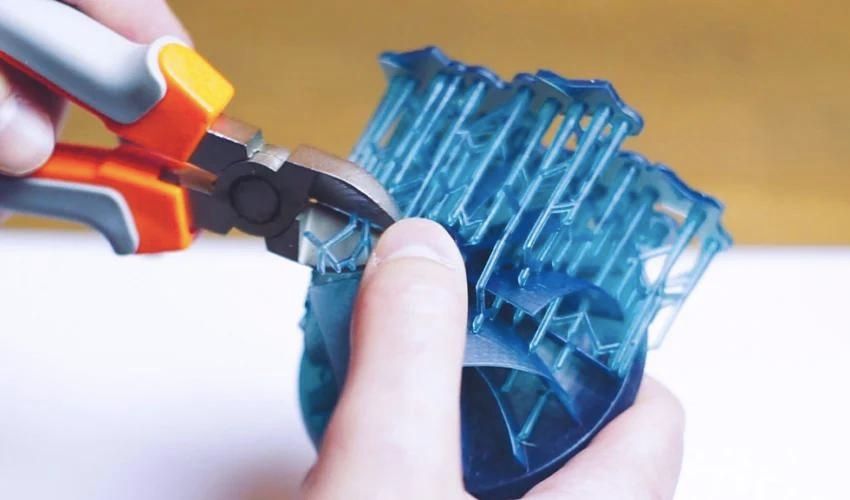
One of the features of additive manufacturing is that it offers great design freedom to create complex and truly impressive parts. However, creating perfect models can require intermediate steps, such as the use of supports. In 3D printing, supports, as the name suggests, are structures that support the unsupported areas of a part. Although at first glance it seems like a simple concept, it can be difficult, especially when it comes to configuring 3D printing supports for your part. Users may have questions such as when they are really necessary, how they can be removed, and what disadvantages their use can have. To answer these questions, we took a deep dive into the effective use of supports in additive manufacturing.
The Choice of Support Structures Depends On the Technology
If you are considering using these supports, the first thing to keep in mind is that depending on the 3D printing technology you use and the complexity of your design, the type of support and function will vary. In FDM 3D printing, for example, there are two general rules you need to know for support structures: the 45-degree rule and the 5-millimeter rule. The first refers to the 3D printer’s horizontal offset between successive layers. So if an overhang of the part tilts at an angle less than 45 degrees from vertical, you can print that overhang without supports. However, if the angle is greater, the machine will not stack the layers properly and the overhang will require support structures. On the other hand, the 5 mm rule states that supports are not required if a bridge (distance between two parallel points on the part) is less than 5 mm, but if it is larger than that then printing problems occur. To connect the two parallel dots without supports, the printer uses a technique called bridging. In this method, the hot material is stretched over short distances to make the connection with minimal sag.
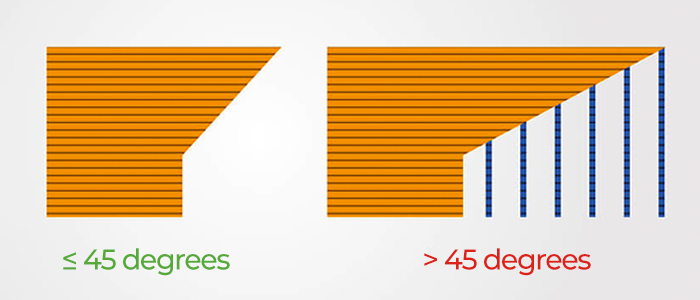
The 45 degree rule applies to 3D extrusion printing.
In contrast, resin 3D printing using processes such as SLA or DLP to produce the final part by photopolymerizing the liquid material using a light source. This technology is one of the most precise, capable of producing the smallest and most complex objects with exact details. It is characterized by the fact that it works in the opposite direction than extrusion, thus the pressure shell is on top rather than the bottom. For this reason, and to ensure that the prints adhere to the platform, these machines almost always require supports. These structures look like thin columns with only a few small points of contact with the model to save on both material and manufacturing time. In this case, the appropriate software can calculate the number of supports, their position, where they touch the part; these factors depend on the complexity of the part in question. With proper post-processing, 3D printing resin with support structures should not affect the quality of the finished part.
More from the desk
Six other notes from the rest of the bench.
 PrintersMeet Photocentric’s JENI: A Serious Challenge to Injection Molding at Industrial VolumesJENI doesn’t look like a 3D printer. It’s a tower, lit from within by a deep red glow, modular sections stacked and racked like server infrastructure. Add a module and it grows. Reconfigure a node and it takes on a…
 News3D printed costumes used in Black PantherBlack Panther the recent Marvel hit movie has reached a new milestone by being the latest movie to gross more than billion dollars at the world wide box office. The success of the film has brought so much scope and inspiration…
 SoftwareThe Best FDM Slicer Software For All Levels3D printing a part is a process involving several stages – modeling, file preparation, post-processing and so on. One of these is called slicing: it involves cutting your 3D model into a series of layers, and tells the 3D printer…
 MaterialsVictrex: accelerating 3D printed PAEK & PEEK for functional partsThe Dutch 3D printer and software developer, Bond 3D should receive investment from Victrex, the performance plastics developer. Victrex confirmed its intention to invest millions of Euros into the company not too long ago. The UK-headquartered company is specialised in…
 PrintersThe Best DIY 3D Printer KitsMost 3D printers today are sold as ‘plug-and-play’ systems—either fully assembled or semi-assembled and ready to print out of the box. However, this wasn’t always the standard. The industry’s roots can be traced back to the RepRap project, launched by&hell
 ApplicationsBMW M Visionary Materials Seat Wins Sustainability Prize Thanks to 3D PrintingThe automotive industry is steadily moving towards greater sustainability and 3D printing is playing a crucial role in this transition. This is because additive manufacturing enables companies to produce more environmentally friendly, lighter and more efficient components. This i