News
Sandvik Has Developed 3D Printable Cemented Carbide
Swedish materials manufacturer Sandvik has been developing cemented carbide for the manufacturing industry for several years now. Recently, the company announced that it has been working on a range designed for additive manufacturing. Manufacturers can then 3D print parts that&he
- 3 min read
- News
- Six more stories
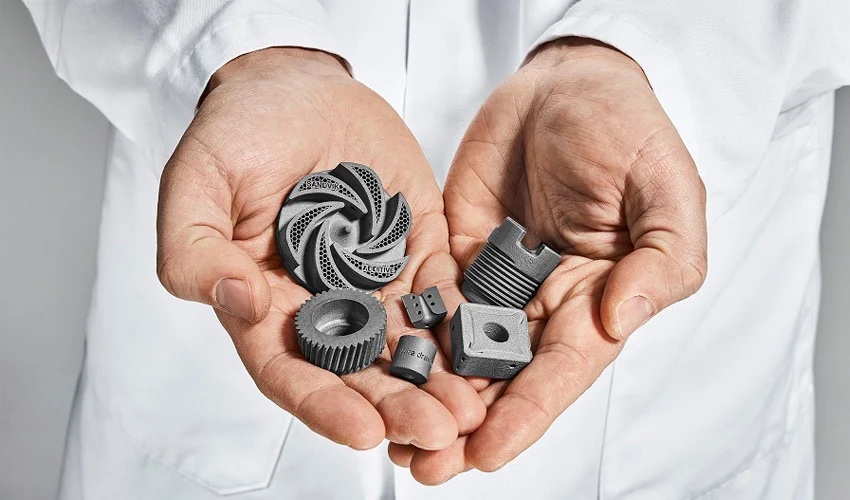
Swedish materials manufacturer Sandvik has been developing cemented carbide for the manufacturing industry for several years now. Recently, the company announced that it has been working on a range designed for additive manufacturing. Manufacturers can then 3D print parts that are highly resistant to wear and have a very high hardness, even under extreme thermal conditions. Sandvik thus proposes to offer one of the hardest 3D printing materials on the market, expanding the range of possibilities for users.
If you’re familiar with the company Sandvik, it’s because it has already been the subject of several very interesting material developments for the additive manufacturing market. Indeed, in 2019, it had unveiled a 3D printed diamond composite, a first for the market. This time, it is interested in cemented carbide, a composite made from a hard material and a metal binder. It has excellent electrical and thermal conductivity as well as high hot hardness. As they are particularly hard, their machining is very complex, especially when it comes to obtaining complex geometries. This is why the Swedish company wanted to develop a material compatible with 3D printing, which, as we all know, offers more freedom in terms of design.
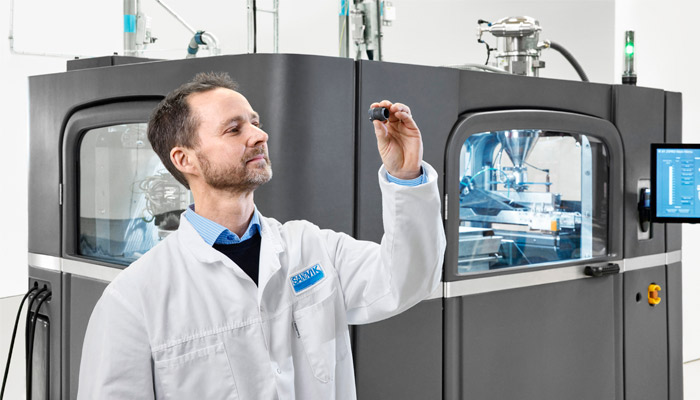
Photo Credits: Sandvik
What are the characteristics of this cemented carbide?
Sandvik therefore came up with a cemented carbide optimized for powder bed printing processes. Anders Ohlsson, product manager at Sandvik Additive Manufacturing, explains, “The most critical component in our process is to work with powders that have the right properties. Above all, high density brings a whole range of benefits regarding the kind of materials we can produce, and crucially impacts the quality achievable in terms of material properties and geometry. Sandvik has developed both a powder and a process that are unique. With our powders, we can print components that look great, work well, and are fit for use in actual applications and serial production.”
More from the desk
Six other notes from the rest of the bench.
 SoftwareMIRA3D Simplifies and Optimizes Additive Manufacturing WorkflowIndia is one of the fastest-growing countries in the world for 3D printing. It is in this context that MIRA3D was born, a company that has developed innovative solutions to simplify and optimize the 3D printing workflow, particularly in industries…
 GuidesANTINSKY’s Approach to Simplifying Desktop 3D Printing for UsersAs desktop 3D printing continues to expand across fields such as design, education, dentistry, and small-scale manufacturing, users are increasingly looking for solutions that go beyond hardware alone, with materials, reliability, and workflow simplicity becoming just as importan
 News9T Labs raises $4.3 million to advance carbon fiber 3D printingZurich-based startup, 9T Labs has successfully closed a $4.3 million funding round to finish the development of their industrial 3D printing solution. We told you before about the company’s activities in the 3D printing sector and their solution for composite…
 NewsTop 5 Videos: The Smart Cabinet from BCN3DThis week, discover BCN3D’s solution for storing your 3D printing materials. The Smart Cabinet allows, according to BCN3D, users to store their filaments in optimal conditions. Next, we go to the Netherlands, in Rotterdam, where the organizers of the Eurovision…
 NewsDEWA Files Patent for Device to Enhance Metal 3D PrintingOne of the most intriguing aspects of 3D printing is that the technologies are constantly evolving. Even those that have been around the longest, notably FDM and SLA which originated in the 80s, are subject to new innovations, improving experience…
 ApplicationsAdvancing Additive Manufacturing in Aerospace and Defense: Industry Leaders Convene for Panel DiscussionIf you’re looking for game-changing Additive Manufacturing (AM) materials for Aerospace and Defense (AeroDef) applications or need to upgrade to AM materials that offer high performance, connectivity, and cybersecurity, SPE’s online Between the Layers: Panel Discussion – Ad