Guides
Ricoh’s use of additive manufacturing to fight COVID-19
We have already seen how the additive manufacturing industry responded to the health crisis caused by COVID-19, and how it played a key role in stopping the spread of the virus. Ricoh has also contributed to this global mobilization, using…
- 3 min read
- Guides
- Six more stories
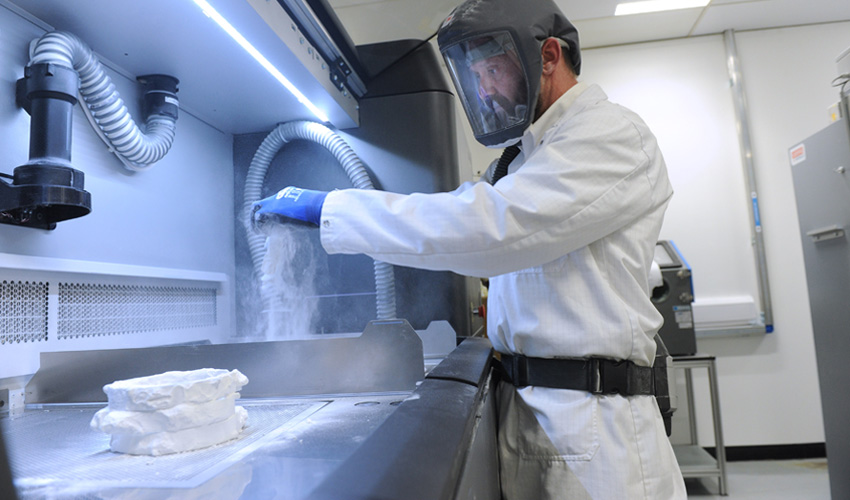
We have already seen how the additive manufacturing industry responded to the health crisis caused by COVID-19, and how it played a key role in stopping the spread of the virus. Ricoh has also contributed to this global mobilization, using its machinery to provide concrete solutions for healthcare workers and all those exposed. According to the company, 3D printing is a practical solution for industries such as dental, medical and industrial, especially when it comes to speeding up the design and production of models. To find out more about Ricoh’s technologies and what they have done to fight the spread of COVID-19, we met with some of its team members.
3DN: Could you introduce Ricoh and its relationship with 3D printing?
As a leader in 2D production printing since 1936, innovations in 3D technology was the natural next step for the Ricoh group. Ricoh is a global provider of technology that transforms business processes and information management, so was already using additive manufacturing in the development of its own production printers and industrial systems. The company moved into a new dimension of printing with the release of Ricoh’s own AM S5500P Selective Laser Sintering system in 2015. It was then that the 3D print business was established in Europe to offer sales support and produce benchmark parts for customers.
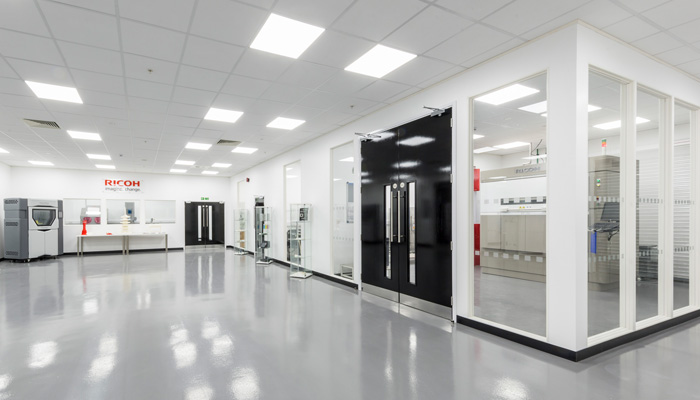
Ricoh started in 2D printing in 1936 | Credits: Ricoh
3DN: How did Ricoh integrate AM technologies and why?
Today, Ricoh 3D is in control of its own destiny from a European point of view although still part of a huge global network. That’s what makes us different from other service bureaus – we have our own team of design engineers, material scientists and production experts to enable customers to develop and innovate. The business transitioned to a printing service in 2016 when the gap in the market was recognised for Ricoh’s own Polypropylene material given its superior purity, flexibility and durability. It is also lightweight, completely watertight and chemically resistant. The same properties that made it the ideal solution for comfortable, yet resilient PPE for healthcare workers battling the COVID-19 crisis. Today, the UK-based marketplace factory offers a full suite of SLS, MJF and FDM systems and facilities including material testing, design services and metrology. With a 828m² injection moulding plant on site too, the team also understand that 3D printing is not the right technology for every application so work with customers to scale up effectively.
More from the desk
Six other notes from the rest of the bench.
 NewsTOP 5 videos of the week: Robots, Glasses and more!A new selection of the best 3D printing videos of the week, just for you! Find our TOP 5 videos of the week below and tell us what your favorite video is in a comment or on our Facebook and Twitter page.…
 Applications3D Printed Implants for Tumor Treatment in ChildrenOsteosarcomas are malignant bone tumors, and there are two to three new cases per million people per year. It is the most common primary malignant bone tumor, and 50 percent of cases occur in children and adolescents. The treatment of…
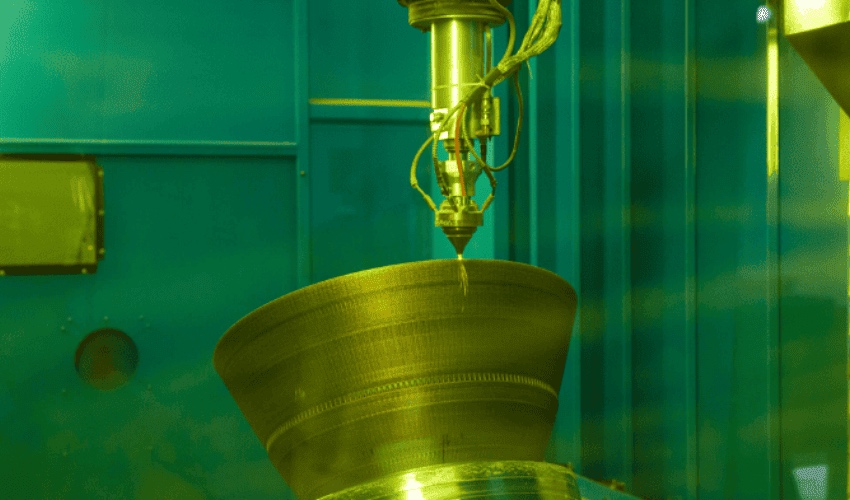 ApplicationsApplication of the Month: 3D-Printed Rocket Nozzles Made Using DEDAdditive manufacturing has profoundly changed the design, testing and production process for parts used in the aerospace sector. This industry benefits not only from reduced production times, but also from improved characteristics of the parts manufactured. In this context, SAB&h
 NewsTop 5 Videos: 3D Printer Helps Children With DiabilitiesAnother hot summer week has come to an end and once again we present to you our top 5 list of videos about 3D printing! We start this week’s top 5 with a video about a non-profit organization that uses…
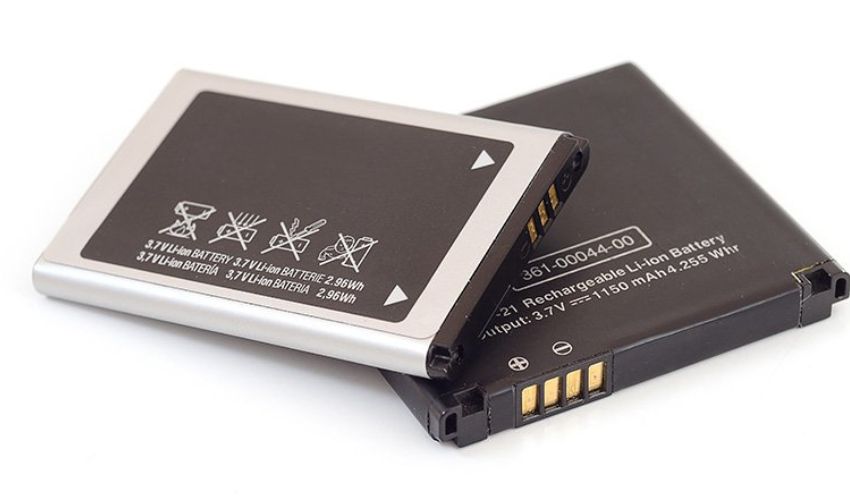 NewsJapanese Researchers Develop New 3D Printed Elecrodes For BatteriesResearchers from the Tohoku University in Sendai, Japan, recently announced the discovery of a new procedure, in which high-performance carbon micro lattice electrodes could be 3D printed for batteries. The newly introduced method that was published as a research article…
 NewsTop 5 Videos: All You Need to Know About Binder Jetting 3D Printing in 3 MinutesIt is Sunday so that means, beyond looking forward to a new week, it’s time for the top 5 videos of the week! Let’s start it off with a video from our very own Elliot who takes you through all…