Materials
Researchers Design An Environmentally-Friendly, Living Material Using Bioprinting
At the Delft University of Technology (TU Delft), a team of researchers has created a new photosynthetic and ecological living material using bioprinting and algae. By depositing living algae on a bacterial cellulose, the researchers have found that the combination…
- 3 min read
- Materials
- Six more stories

At the Delft University of Technology (TU Delft), a team of researchers has created a new photosynthetic and ecological living material using bioprinting and algae. By depositing living algae on a bacterial cellulose, the researchers have found that the combination of these two organic compounds creates a living material, able to carry out a photosynthesis i.e. that it is able to “feed” itself and to regenerate itself thanks to the light. A small sample of this new 3D printed material could therefore be used for various applications, including the creation of artificial leaves, particularly interesting in places where vegetation has difficulty growing, such as in space.
Research into 3D printing materials is becoming more and more advanced: these are the materials that will make a real difference in terms of the mechanical, chemical and aesthetic properties of the final part. Some actors are looking at living materials, aware that nature has a lot to teach us. Recently, we covered a recyclable and edible foam that was used to print several components for Thomas Pesquet’s mission. This one was made from a naturally occurring polymer synthesized by bacteria and proved to be very resistant to vibrations. This time, researchers have turned to algae to create a robust and durable material. This project is just another example of how bioprinting can be used to create living material for a variety of important applications.
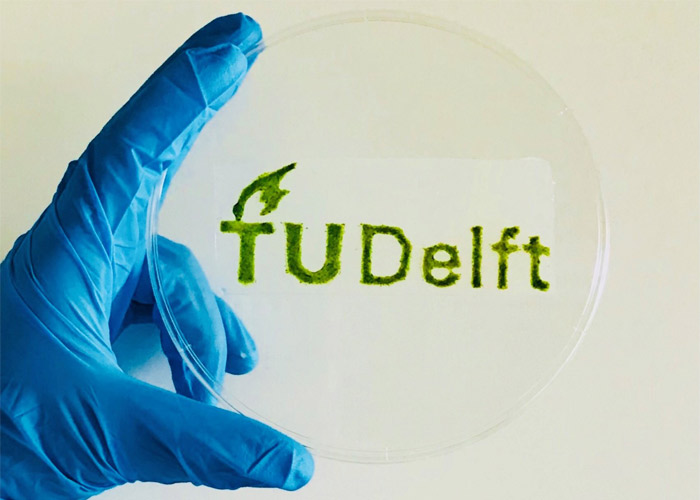
A sample of the bio-printed material (photo credits: TU Delft)
The team explains that they used a non-living bacterial cellulose: it is a compound produced and released by bacteria. It is particularly interesting because it is flexible, resistant and retains its shape under any circumstances. This cellulose served as an envelope for the algae deposited layer by layer: thanks to an FDM 3D printer, the researchers deposited a bio-ink composed of microalgae (thus living materials) on the bacterial cellulose. And it is the reaction between these two materials that is particularly interesting.
More from the desk
Six other notes from the rest of the bench.
 ApplicationsThe Aether Concept Car Pushes the Boundaries of Automotive Design With 3D PrintingThe automotive industry is increasingly moving towards sustainable solutions, with 3D printing playing a key role in this transition. The Aether concept car was created with this in mind. This next-generation electric vehicle incorporates advanced technologies, such as digital mo
 NewsSolving the Housing Crisis, One Print at a Time: Inside ICON’s Initiative 99ICON, the industry pioneer in large-scale 3D printing for construction, announced its new project, ‘Initiative 99’, during the 2023 annual SXSW festival in Austin, Texas, this March. ICON, alongside nonprofit housing partners New Story and architecture firm Big-Bjarke
 MaterialsNew glass 3D printing technique developed at ETH ZurichToday, additive manufacturing works with multiple different materials, yet glass is one of those materials that remains difficult to work with. Only a few groups of researchers around the world have attempted to produce glass objects using 3D printing technologies.…
 NewsThe First Industrial Automation System for Customized 3D Printing, Roboze AutomateRoboze, an Italian-American manufacturer of industrial 3D printing technology, announced the launch of Roboze Automate earlier this week. Claimed to be the first industrial automation system bring customized 3D printing with super polymers and composites into the production workf
 News3D Printing Show: AM Trends and Innovations at Formnext 2023The 3D Printing Show is here! With our team back in Frankfurt, Germany for Formnext 2023, we are excited to once again share with you all the latest innovations direct from the show. This time, we are exploring the 3D…
 NewsFully 3D printed rocket engine unveiled by Skyroot AerospaceThe Indian startup Skyroot Aerospace has just unveiled its first fully 3D printed rocket engine. Named Dhawan-I after the famous engineer Dr. Satish Dhawan, it is a cryogenic engine – it uses gases kept in a liquid state at low…