News
Fully 3D printed rocket engine unveiled by Skyroot Aerospace
The Indian startup Skyroot Aerospace has just unveiled its first fully 3D printed rocket engine. Named Dhawan-I after the famous engineer Dr. Satish Dhawan, it is a cryogenic engine – it uses gases kept in a liquid state at low…
- 3 min read
- News
- Six more stories
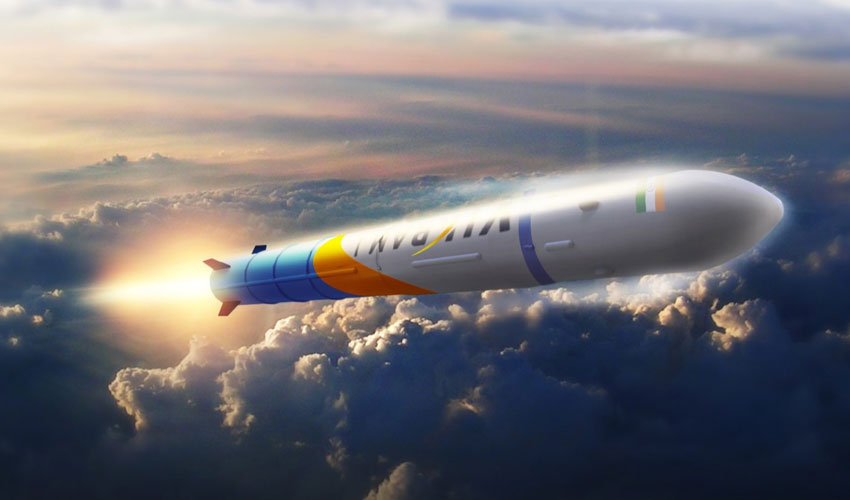
The Indian startup Skyroot Aerospace has just unveiled its first fully 3D printed rocket engine. Named Dhawan-I after the famous engineer Dr. Satish Dhawan, it is a cryogenic engine – it uses gases kept in a liquid state at low temperature; such liquid gases are usually more difficult to control. Several different models were created, and if all tests show positive results, the first take-off will take place as soon as in 2021 with the Vikram-I model, the one with the smallest capacity. However, the 3D printed engine is expected to conquer space later, on the Vikram-II.
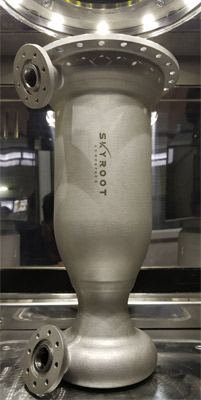
The 3D printed rocket engine.
In the aerospace sector, additive manufacturing has been used for quite a while now, be it in aircrafts or rockets. When it comes to space exploration, 3D printing technologies allow manufacturers to design lighter and more efficient components such as nozzles or the combustion chamber. Ultimately, the goal is to reduce costs and offer solutions that are as accessible and reliable as air flights, thus opening up space travel. This is the ambition of the Skyroot Aerospace startup, which has created the 3D printed cryogenic engine.
The development of a cryogenic engine is significantly more complex than a conventional engine because it must be able to be maintained at temperatures of -150° Celsius. It uses a liquid fuel and an oxidizer that must be maintained at extremely cold temperatures. In the case of Dhawan-I, the startup explains that it relies on Liquid Natural Gas (LNG) as fuel and liquid oxygen as oxidizer. According to the company, this engine is India’s first fully cryogenic engine running on the futuristic LNG fuel. It contains more than 90 percent methane, making it extremely clean and efficient. In addition to the innovative fuel, the startup relied on metal additive manufacturing to design the engine. It remains very discreet about the process and materials used, probably because it has yet to test everything.
More from the desk
Six other notes from the rest of the bench.
 ApplicationsSkyroot Aerospace and Dhawan-II’s More Powerful 3D Printed Cryogenic EngineBack in 2020, we introduced you to Dhawan-I, a 3D printed cryogenic engine made by Skyroot Aerospace. Three years later, the Indian company has been working on a more powerful model, unveiling to the public the new and improved Dhawan-II,…
 Applications3D-Printed Pipe Segment Combines Heating and SensorsMost of the heat control systems in use today are heavy, bulky and require many connecting cables. The EU project AHEAD (Advanced Heat Exchange Devices) aims to optimize these systems, and now a promising result has been presented: a 3D-printed…
 PrintersEverything You Need To Know About Cold Metal FusionToday, the manufacturing industry is increasingly moving towards metal additive manufacturing solutions. However, these machines are often expensive for companies entering this field. Consequently, the cost of metal 3D printers can be a major barrier to market entry. Luckily, the
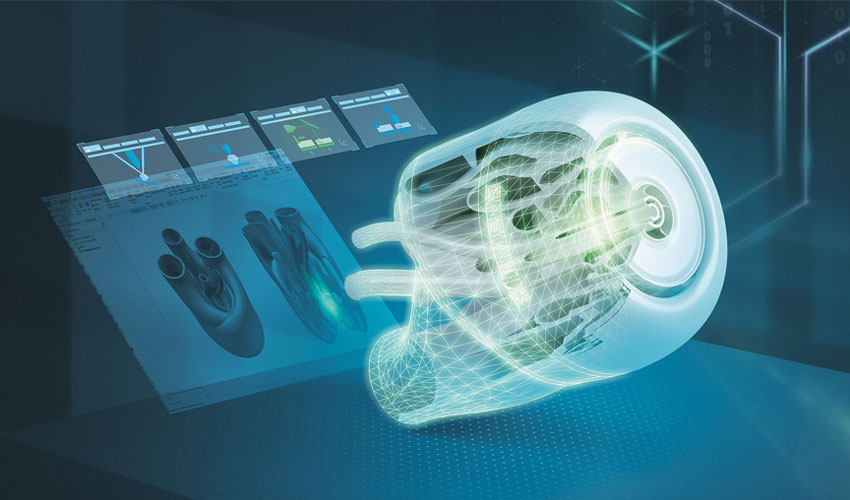 GuidesSiemens’ AM Network helps companies adopt AM for industrial productionAdopting 3D printing in an industrial setting, specifically for mass production, is growing considerably. Nevertheless, some companies are still hesitant to invest in 3D printing technologies, as they can be unsure about the steps to adopt it successfully in their…
 News#TOP5 videos: 3D Printed Skaterbot and much more!We found the TOP 5 videos of the week about 3D printing and the way additive manufacturing is shaping and changing our society. 3D printed skaterbot, micro structures, biomedical implants, metallic dental parts and more! If you enjoy these, you can…
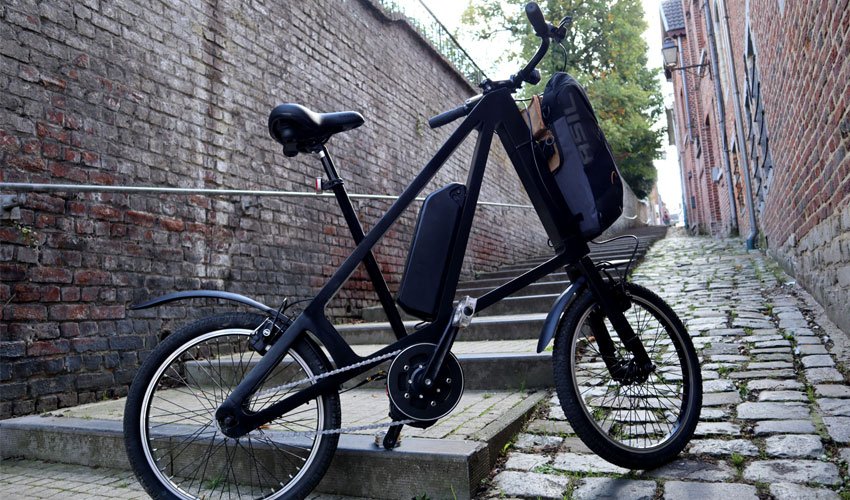 NewsShadow M1: The Eco-Friendly 3D Printed Electric BikeShadow is a Belgian start-up that has just launched its first 3D printed electric bike. The Shadow M1 integrates a 3D printed frame made of CO2 neutral and biodegradable biopolymers, on a large format FFF machine. The objective is to…