Applications
Researchers Develop Personalized Bone Grafts Using 3D Printing
3D printing is gradually transforming the medical field, offering increasingly sophisticated solutions. Most recently, a team of researchers at the University of Waterloo developed a material that reproduces the mechanical characteristics of human bone. Thanks to its ability to b
- 3 min read
- Applications
- Six more stories
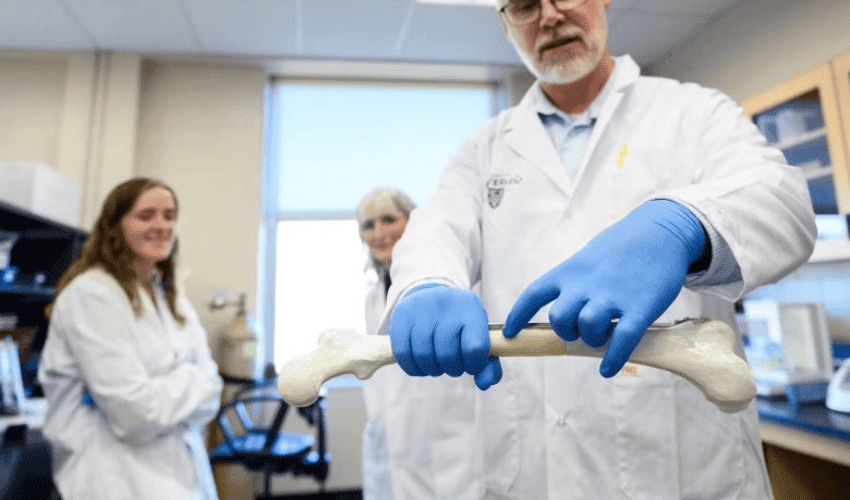
3D printing is gradually transforming the medical field, offering increasingly sophisticated solutions. Most recently, a team of researchers at the University of Waterloo developed a material that reproduces the mechanical characteristics of human bone. Thanks to its ability to be 3D printed with high precision, this material could, in time, make it possible to design tailor-made bone grafts, offering patients personalized treatment.
Through his collaborations with orthopedic surgeons at Toronto’s Mount Sinai Hospital, systems design specialist Professor Thomas Willett became aware of the complexity of current bone reconstruction techniques. Faced with cumbersome and technically demanding procedures, he envisioned a radically new approach: harnessing the potential of 3D printing to create more accessible, precise and customizable bone substitutes.
An Innovative Material for Bone Grafts Made to Each Patient
In many cases, reconstructive surgery requires the restoration of damaged bone segments. Traditionally, this task has relied on the use of metal parts or grafts from human donors to promote bone regeneration. However, this approach poses a major challenge: finding a bone fragment that is sufficiently compatible, both in shape and structure, with that of the patient often proves complex, if not impossible, sometimes compromising the effectiveness of the treatment.
More from the desk
Six other notes from the rest of the bench.
 ApplicationsInfographic: 3D Printing in the Medical SectorOne of the main advantages of additive manufacturing is its ability to design custom parts. And what could be more important than customization in the healthcare industry, where doctors treat patients who are all unique and different? From hospitals to…
 NewsHubs Report 2023: What Do We Know About the State of AM Over the Past Year?We all know that 3D printing just keeps growing. Now we have seen it once again in the Hubs Report 2023, which took a close look at the additive manufacturing market over the past year. The report includes exciting metrics…
 GuidesInvolve Space is Using AM to Make Space More AccessibleAdditive manufacturing is used in many industrial sectors, especially those that continually seek innovations in terms of technologies, processes and materials. Chief among them is undoubtedly the aerospace sector, for which R&D is crucial. In this context, the use of…
 NewsTop 5 Videos: NASA Integrates A.I With 3D Printing to Design Space PartsToday is Sunday, meaning it is time for the week’s top 5 3D printing videos! First up, don’t miss this video on NBC discussing the Artemis II moon launch, which will see humans on the moon for the first time…
 PrintersNew clay 3D printer from 3D Potter extends current capabilitiesThe 3D printer manufacturer and ceramic studio based in Florida 3D Potter, has just unveiled their newest compact size clay 3D printer – the Scara Mini V1. The company already supplies its real clay 3D printers to over 200 universities,…
 News3D Printed Smart Glasses to Help Dyslexic ChildrenAbeye is a young French company supported by Atol Les Opticiens. The medtech startup manufactures electronic glasses intended to improve everyone’s well-being. After the success of its first pair, Spectalert, which detects falls in the elderly, Abeye is now launching&hellip