News
Top 5 Videos: NASA Integrates A.I With 3D Printing to Design Space Parts
Today is Sunday, meaning it is time for the week’s top 5 3D printing videos! First up, don’t miss this video on NBC discussing the Artemis II moon launch, which will see humans on the moon for the first time…
- 3 min read
- News
- Six more stories
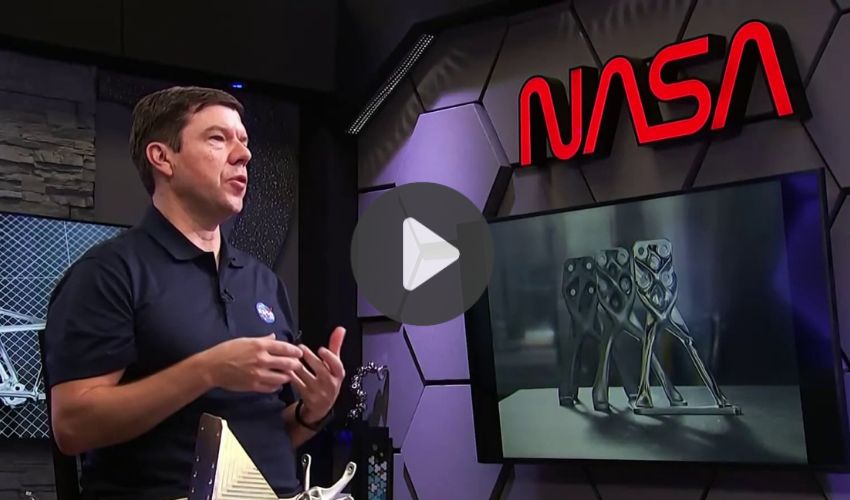
Today is Sunday, meaning it is time for the week’s top 5 3D printing videos! First up, don’t miss this video on NBC discussing the Artemis II moon launch, which will see humans on the moon for the first time since 1969 which also delves into how NASA integrates AI to design 3D printed parts for space! Next, a blueprint of the world’s largest underwater coral reef structure which will be 3D printed using ceramic materials. Then, we ramp up the holiday spirit with a behind-the-scenes tutorial on creating an Easter egg gift decoration for those who want to buy something special this Easter holiday. Lastly, enjoy two informative guides: One on everything you need to know about Greyscale resin and the other on designing for 3D printing. Happy Sunday, and as always, happy watching!
Top 1: NASA Engineers use A.I to Design Space Parts
Three Americans and one Canadian are set to land on the moon for the first time since 1969 as part of NASA’s Artemis II mission that blasts off on November 2024. However, a surprise combination of Artificial Intelligence and 3D printing has allowed NASA’s engineering team to accelerate the design process, improve the reliability and performance of space parts, and ultimately advance our ability to explore and understand the universe. By analyzing large amounts of data from past rocket engines, the AI system can predict which designs are most likely to succeed, allowing engineers to focus on the most promising options. “As engineers, we like to think that we’re designing the best possible part, but with this toolset, we can validate that we actually are”, said Ryan McClelland, materials engineer at NASA. With 3D printing, physical models of their AI-generated designs can be quickly produced and tested for fit, form, and function. This rapid prototyping enables engineers to identify design flaws and make improvements much faster and more cost-effectively. The integration of AI and 3D printing in NASA’s space mission design process represents a significant leap forward in space exploration technology – we can expect even greater future advancements as AI and 3D printing continue to evolve.
Top 2: Leviathan 3D Printed Ceramic Reef
Our second pick is a fascinating video showcasing a concept piece of the world’s largest 3D printed ceramic structure, the Leviathan Ceramic Reef, an underwater artificial 3D printed reef designed to promote marine life growth. The project is part of an exhibition that illustrates an attempt to build an entire reef from ceramics. The project is a part of the design biennale that can be seen at the Eretz Museum in Israel. 3D printing has revolutionized how we imagine objects and how we create them, and the creation of such large-scale structures, like the Leviathan Reef, is a great example. The reef was made via a process that involves printing individual ceramic modules that are then assembled to form the final structure. The significance of this project is not only in the impressive scale of the final design but also in the potential for 3D printing to transform the way we create objects and structures in the future. With its ability to create complex shapes and forms, 3D printing has the potential to unlock new possibilities for art, architecture, and engineering. The Leviathan Reef is an inspiring example of what can be achieved through the intersection of technology, art, and design.
More from the desk
Six other notes from the rest of the bench.
 NewsMontserrat Unveils 3D Printed SunglassesIn the fashion industry, additive manufacturing is becoming increasingly popular. No matter if shoes, handbags, or dresses – the technology can be used to design all kinds of accessories. As summer approaches, the Montserrat company has partnered with design studio…
 NewsWill 3D printed houses be the new norm in the Netherlands?Exciting 3D printing news brings the focus back to the Netherlands as 3D printed houses could be built by next year in the city of Eindhoven. An additional initiative in the construction field that confirms the benefits of additive manufacturing…
 GuidesTop Last Minute 3D Printed Valentine’s Day Gift IdeasOnce again, Valentine’s Day has come! But what if you don’t yet have a gift? Don’t panic or run to the supermarket – it’s not too late to give your partner an amazing Valentine gift. If you own a 3D…
 NewsOpen-source 3D Printing Measures the Impact of Cannabis on LungsScientists at Canadian McMaster University and the University of Waterloo recently used 3D printing to look at the impact of cannabis on human lungs. In order to do this, they created an open-source 3D printed device that “breathes” like a…
 NewsTop 5 Videos of the Week: 3D printing replacement tissues for humansThis week we found the top 5 videos about 3D printing and the way additive manufacturing is shaping our society. The technology has infiltrated many sectors, from medical to automotive! Check out our selection of the week to keep up with the innovations! This week we…
 NewsDesktop Metal and Stratasys to Combine in Move to “Reshape the AM Industry”If you have been following along with us, you will know that consolidation has been a hot topic for the 3D printing market for some time now. After years of expansion and more and more players coming to the market,…