Applications
NASA’s Perseverance rover carries 11 3D printed parts to Mars
The National Aeronautics and Space Administration, NASA, has been investing in 3D printing technologies for several years, by both manufacturing parts in-house and awarding contracts worth millions of dollars to external companies and institutions. Some of the examples include th
- 3 min read
- Applications
- Six more stories
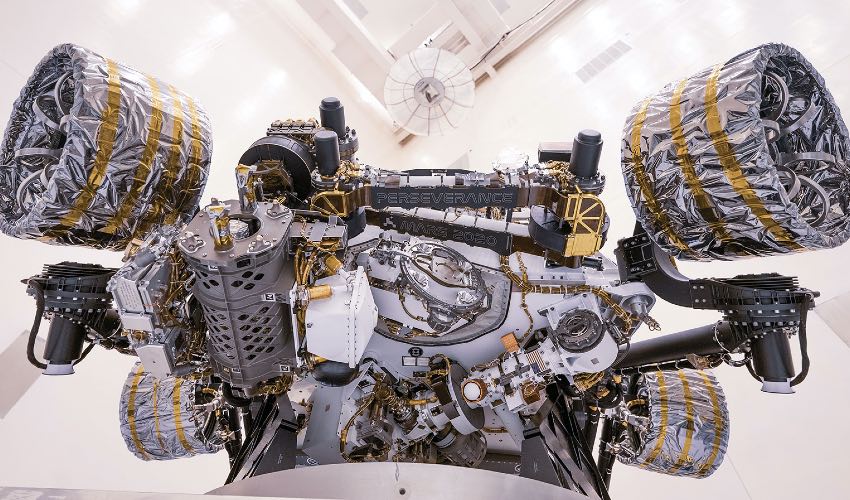
The National Aeronautics and Space Administration, NASA, has been investing in 3D printing technologies for several years, by both manufacturing parts in-house and awarding contracts worth millions of dollars to external companies and institutions. Some of the examples include the rocket engine with 3D printed parts, using Relativity Space‘s 3D printed rocket as launch vehicle for the Artemis exploration program, or financing ICON to additively manufacture infrastructure on the Moon. Recently, NASA has revealed that its Perseverance rover carries as many as eleven 3D printed metal parts on its mission to Mars. To develop the 3D printed components, NASA worked with its Jet Propulsion Lab (JPL) at California Institute of Technology.
Interestingly, Perseverance is not the first rover bound for Mars that features 3D printed parts. The first one was called Curiosity: back in 2012, it landed on Mars with a 3D printed ceramic part inside its Sample Analysis at Mars (SAM) instrument. NASA has since continued to test 3D printing for use in spacecraft to make sure the reliability of the parts is well understood. While eight years later, in 2020, the number of 3D printed parts on NASA’s Mars-bound rover has increased from 1 to 11, they are still secondary structures, which means that these parts wouldn’t jeopardize the mission if they didn’t work as planned. Yet, as Andre Pate, the group lead for additive manufacturing at NASA’s JPL said, “Flying these parts to Mars is a huge milestone that opens the door a little more for additive manufacturing in the space industry.“
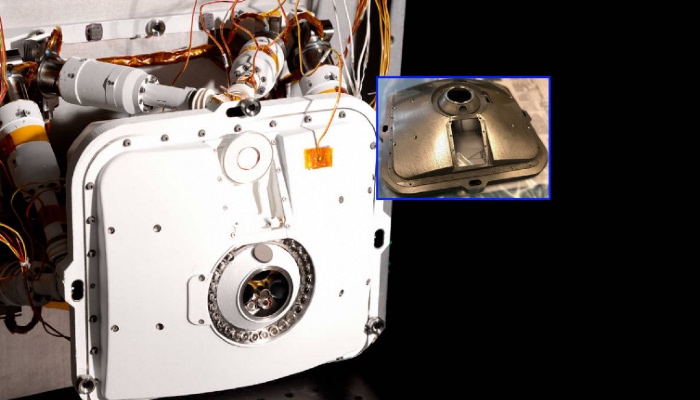
The outer shell of PIXL, one of the instruments aboard NASA’s Perseverance Mars rover, includes several parts that were made of 3D printed titanium. (Image credits: NASA/JPL-Caltech)
PIXL and Moxie feature 3D printed parts
Of the 11 3D printed parts going to Mars, five are in Perseverance’s PIXL instrument. Short for the Planetary Instrument for X-ray Lithochemistry, the device will help the rover seek out signs of fossilized microbial life by shooting X-ray beams at rock surfaces to analyze them. To make the instrument as light as possible, the JPL team designed PIXL’s two-piece titanium shell, a mounting frame, and two support struts that secure the shell to the end of the arm to be hollow and extremely thin. In fact, the parts, which were 3D printed by a vendor called Carpenter Additive, have three or four times less mass than if they’d been produced conventionally! “In a very real sense, 3D printing made this instrument possible,” said Michael Schein, PIXL’s lead mechanical engineer at JPL. “These techniques allowed us to achieve a low mass and high-precision pointing that could not be made with conventional fabrication.”
More from the desk
Six other notes from the rest of the bench.
 NewsThe impact of 3D printing on supply chainsToday, many industries are hugely reliant on production and supplies from China and Southeast Asia, particularly in sectors like manufacturing and logistics. During the global health pandemic, broken supply chains affected the activities of companies in many industrial sectors. M
 NewsTop 5 Videos of the Week: creating a 3D model of the Super BowlThis week we found the top 5 videos about 3D printing and the way additive manufacturing is shaping our society. The technology has infiltrated many sectors, from medical to automotive! Check out our selection of the week to keep up with the innovations! This week we…
 NewsTree-Root Inspired Template-Constrained Additive Technique Creates Durable Electronic CircuitsConformal electronics are stretchable, flexible electronic devices often used for applications like smart skins and robotics. While 3D printing conformal electronics is possible, the process can come with challenges. Often, conformal electronics have significant mechanical and th
 NewsTop 5 Videos: 3D printing turbines and much more!This week we found the top 5 videos about 3D printing and the way additive manufacturing is changing production. The technology has infiltrated many sectors, from medical to automotive – check our selection of the week to keep up with the innovations! If you enjoy these, you&hell
 MaterialsResearchers use PEKK implants to accelerate bone regenerationWe have often reported on the advantages of high-performance materials such as PEEK, ULTEM or PEKK. Particularly in the medical field, some of these materials offer many benefits due to their biocompatibility. A while ago we reported on the first…
 NewsImproving Safety and Sustainability in the Oil and Gas Sector With 3D ScanningThe oil & gas industry faces many challenges, notably a growing need to reduce emissions. Companies in the sector have set themselves ambitious targets for 2025, at a time when environmental concerns are becoming increasingly evident. To contribute to this…