Materials
All You Need to Know About PEKK for 3D Printing
Polyetherketoneketone, better known by its acronym PEKK, is a semi-crystalline thermoplastic that is increasingly used in the additive manufacturing market. Often compared to PEEK, it belongs to the same family – the PAEK family – known for its mechanical and…
- 3 min read
- Materials
- Six more stories
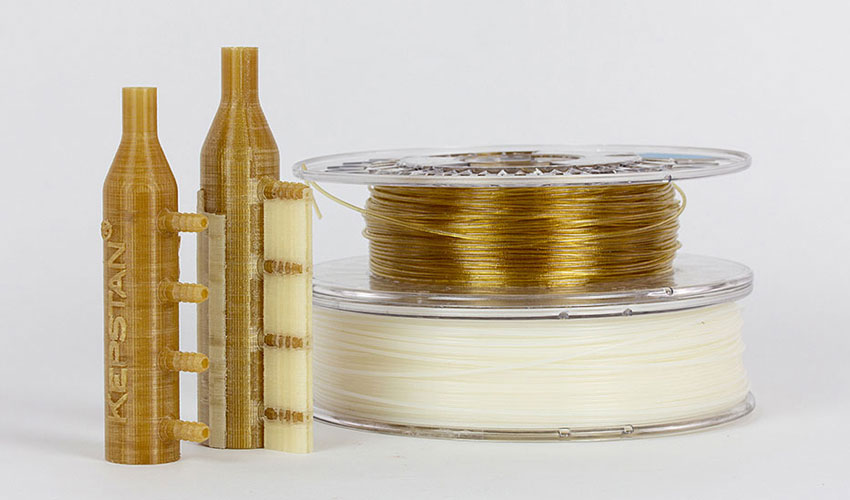
Polyetherketoneketone, better known by its acronym PEKK, is a semi-crystalline thermoplastic that is increasingly used in the additive manufacturing market. Often compared to PEEK, it belongs to the same family – the PAEK family – known for its mechanical and chemical properties. Easier to print than PEEK, in particular thanks to its lower crystallisation rate, PEKK is mainly found in the form of filament, but can also be found in powder form for a very limited number of SLS 3D printers.
PEKK was first developed and marketed in 1988 by the company Dupont for the aerospace sector. Then, in the early 2000s, its composition was improved by Oxford Performance Materials (which was itself acquired by Arkema in 2009). Its composition is very close to that of PEEK, mainly made of ketone and ether. But how and why is PEKK used today? Which manufacturers are offering the material and in what form? What are the applications? We give you the answers to these questions and more in our complete guide.
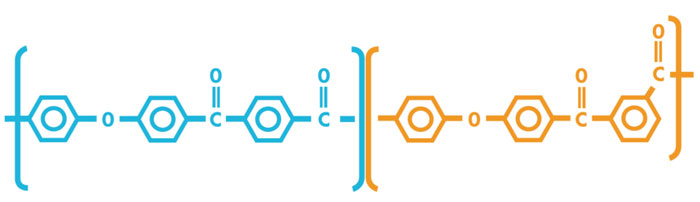
The position of the ketone bonds can be modified (photo credits: Arkema)
Production and Characteristics of PEKK
As already mentioned, PEKK is often associated with PEEK, which belongs to the same group. PEKK is similar to PEEK not only in name, but also in its components. For example, both contain ketone and ether. The main difference between these two high-performance materials lies in the ether/ketone ratio: PEKK has more ketone bonds, which are more flexible than ether bonds. In particular, this increases the rigidity of the polymer chains, thus raising the glass transition temperature (temperature at which the polymer starts to soften) and the melting temperature. Note also that this ratio is not the only difference. Indeed, the position of the ketone bonds in its aromatic ring can vary, which makes it possible to modify the melting temperature and the crystallization rate.
More from the desk
Six other notes from the rest of the bench.
 PrintersThe Paper Pulp Printer replaces plastic with paper wasteThe market for Additive manufacturing is constantly growing in everything from the automotive industry to ceramics. However the biggest part is still in more traditional areas like prototyping using plastics. While 3D printing do bring advantages such as being faster and…
 NewsECO 3D October: The latest economic news in 3D PrintingEvery month, 3Dnatives summarised the major economic and business news in the 3D printing world. The last month had some very important events occur, from Ultimaker investments to record-breaking performances by Renishaw, and Amazon buying 3D software firm Body Labs.…
 GuidesCombining Recycling and 3D Printing: Projects for the Health of Our PlanetToday is the international day of recycling! As such, we wanted to take a look back at some recent projects that rely on additive manufacturing to help promote recycling. As you know, 3D technologies currently allow us to reduce the…
 NewsORNL 3D Prints Nesting Structures for Endangered BatsAdditive manufacturing has been playing an increasingly important role in endangered animal conservation. Earlier this fall, 3Dnatives reported on 3D printed bird decoys to encourage nesting among endangered seabirds, and now, just last week, the Oak Ridge National Laboratory rev
 MaterialsGREENFILL3D on Transforming Production Waste into 3D Printing MaterialsWe have previously told you about GREENFILL3D, a Polish startup that develops ecological and biodegradable materials for 3D printing. Notably, it developed a wheat bran-based filament, GF3D Branfill3D. This material was created in accordance with modern concepts of zero waste&hel
 PrintersTop 3D Software For Beginners3D modeling is a critical step in the 3D printing value chain, allowing the user to imagine the geometry of the part and its functionality. But when you are a beginner, finding your way through the many software solutions available…