News
PBF vs. DED: Which Metal 3D Printing Process Should You Choose?
Metal is one of the most widely used materials, along with plastic, in additive manufacturing. The properties of this material make it suitable for the most demanding markets including for high-performance applications. In this article, we are comparing two of…
- 3 min read
- News
- Six more stories
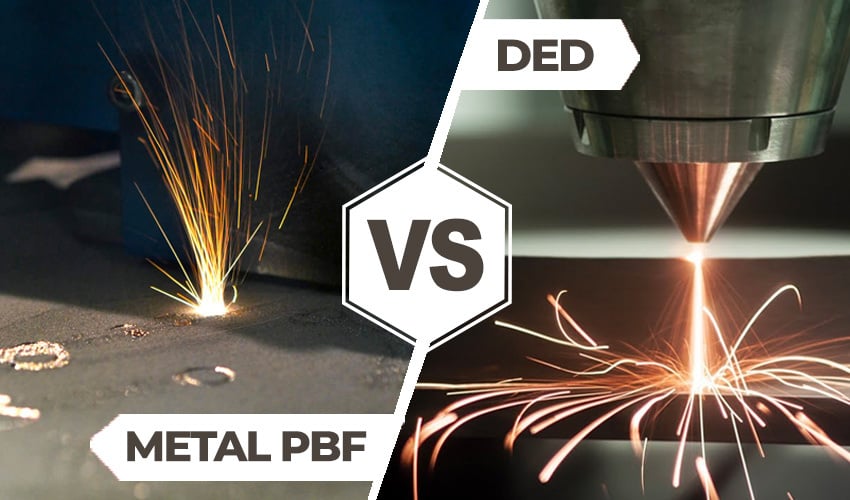
Metal is one of the most widely used materials, along with plastic, in additive manufacturing. The properties of this material make it suitable for the most demanding markets including for high-performance applications. In this article, we are comparing two of the main metal printing processes: Laser-Powder Bed Fusion (L-PBF) and Directed Energy Deposition (DED). We will be examining the characteristics, most common applications and leading manufacturers of each technology, highlighting their similarities and differences.
To begin with a brief introduction, PBF encompasses several additive manufacturing processes that involve the use of a powder bed, be it plastic, ceramic or metal. As you may have guessed, today we will be focusing on metals. This process can use a laser or an electron beam as an energy source, for example electron beam melting (EBM), introduced by the manufacturer Arcam in 2002. However, in order to compare more directly, we will only be focusing on the process that uses a laser as a heat source. The process is also known by other names, depending on the designations of the various manufacturers, such as DMLS, a term patented in 1994 by EOS, a leader in metal 3D printing. The acronym comes from the German “Direkt Metall Laser Schmelzen” which translates into English as Direct Metal Laser Melting. It can also be called SLM for Selective Laser Melting, a term introduced by the Fraunhofer Institute in 1995.
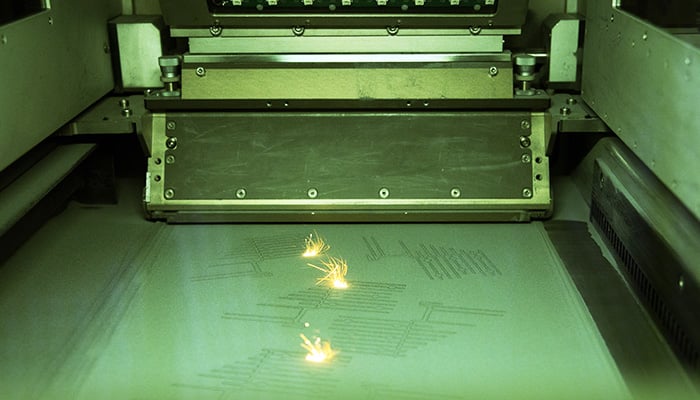
The PBF process
In contrast, DED is a more recent method than other metal powder bed technologies. It has been known for longer, but has only become truly effective in the last decade. The process uses a material, in powder or wire form, that is melted by a direct energy source while being deposited directly onto the part. The process is best known for its ability to repair and/or coat large metal objects. DED technology can use different energy sources such as laser, plasma or electron beam. For example, WAAM (Wire Arc Additive Manufacturing) technology falls into this category. It is therefore not easy to compare PBF and DED processes, as they are two very different technologies. We will therefore try to understand how they work, how they differ and how they can be complementary.
More from the desk
Six other notes from the rest of the bench.
 Materials9T Labs: 3D printing industrial grade carbon composites9T Labs is a young Swiss startup that has developed a 3D printing method to create structures with carbon composites. From the design of the part to its post-treatment, they optimize the entire process to allow professionals to obtain industrial…
 NewsThe Next Generation of Timepieces: Panerai’s 3D Printed Submersible WatchAdvancements within the watchmaking industry continue to captivate enthusiasts, pushing the boundaries of tradition and embracing technological innovations. Panerai, a company with a rich history dating back to 1860, showcased their commitment to embracing change at the recent Sa
 SoftwareThe Top Free 3D Modeling Software ProgramsNowadays, if you want to get started with the critical step of 3D modeling, there is no longer a need to invest significant money in software! Free solutions exist on the market to get started with modeling your objects or…
 NewsLuxembourg Welcomes its First Ever 3D Printed HouseLuxembourg recently welcomed its newest innovation, a 3D printed house, located in the Niederanven commune. This particular project was done by a Czech company, ICE Industrial Services, and showcases the growing role of additive manufacturing in addressing Europe’s current
  MaterialsCould Flame-Retardant Bioplastics Soon Be Used in AM?Materials used in electrical engineering or electronics must conform to high demands. This is especially the case since these materials must have properties such as flame resistance. It is well known that in this case plastics meet the necessary flame…
 NewsFormlabs is Now a Multi-Billion Dollar CompanyAfter raising $150 million in a round of Series E funding led by SoftBank Group Corp’s Vision Fund 2, Formlabs is now officially a multi-billion dollar company. At present, the company offers 3D printers, filaments, software and 3D printing services…