Applications
A New 3D Bioprinting Technique to Create Vascularized Human Tissue
A research team from the Jacobs School at the University of California, San Diego, are developing a new method of 3D bioprinting based on digital light processing (DLP). The project aims to create vascularized 3D-engineered tissues that, although produced in…
- 3 min read
- Applications
- Six more stories

A research team from the Jacobs School at the University of California, San Diego, are developing a new method of 3D bioprinting based on digital light processing (DLP). The project aims to create vascularized 3D-engineered tissues that, although produced in a lab, function as human-like living cells with biomaterial structures. The experimental study was published in Science Advances and explained in detail how the researchers successfully discovered one of the most promising types of 3D printing with biocompatible materials.
DLP 3D printing is one of the most widely used technologies in the medical sector. The implementation of this manufacturing method has great potential for biomedical applications. Some of these applications include drug development, organ transplantation, and regenerative and personalized medicine, among others. For some time now, this health sector branch has been limited by practical and technical aspects of additive manufacturing. These challenges include, for example, printing tissues with finely resolved structures and high cell densities. However, the Jacobs School team has opted for a different approach.
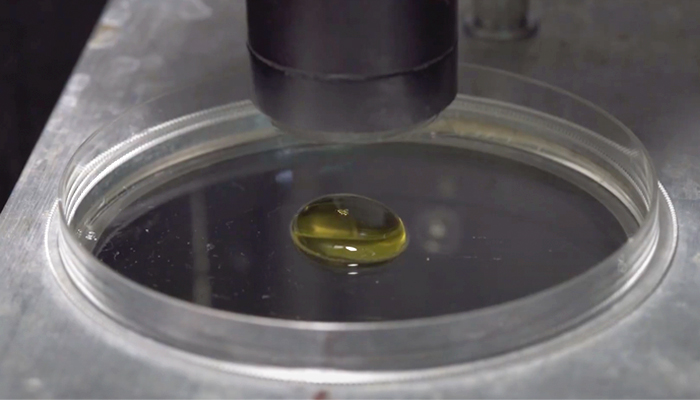
By reducing bio-ink density, light scattering is avoided (Credits: UC San Diego / David Baillot)
Creation of Vascularized Human Tissues
The nanoengineering team realized a 3D bioprinting system for vascularized human tissues. The patented technology is based on additive layering using cells and biopolymers to create biological structures and tissues. Generally, the higher the density of the bio-ink, the more light is scattered, which hinders the resolution of the print. To do this, the researchers obtained a biocompatible polymer for high-resolution DLP 3D printing. In this way, they reduced the light scattering effect tenfold and were able to print with high cell densities and high resolution, thanks to the contrast agent ‘iodixanol’ (a new ingredient in bio-ink).
More from the desk
Six other notes from the rest of the bench.
 PrintersBenefits of an SLS 3D Printer: with Natural RoboticsThe technology of selective laser sintering involves creating objects via a powder material. It was developed in the 80s, but in its early years it was inaccessible to most because of its high price. In 2014 the patent expired, opening…
 NewsBQ and 3D printing bringing blind people closer to cultural heritage3D printing technologies have revolutionised many sectors, and opened many doors to help integrate people with disabilities. A few weeks ago, researcher Néstor F. Marqués, with the help of the company BQ and 3D printing, managed to recreate some historical…
 PrintersWhat Is LiDAR and How Is It Used for 3D Printing?LiDAR, which stands for Light Detection and Ranging or Laser Imaging Detection and Ranging, is a cutting-edge remote sensing technique that can generate accurate 3D models of environments or objects. Thanks to its ability to collect three-dimensional data with great…
 MaterialsResearchers Develop Lunar Regolith Composites for Sustainable Manufacturing on the MoonEfforts to establish a permanent human presence on the Moon are moving forward. One of the major projects aiming to accomplish this feat is, for example, NASA’s Artemis program. As you can imagine, this goal brings with it countless challenges,…
 NewsTop 5 Videos: From Formnext Highlights to 3D Printed SoundCheck out the Top 5 Videos of the Month! We begin with 3Dnatives uncovering the most surprising and innovative discoveries from Formnext 2025. Next, 3D Monotech showcases how large scale additive manufacturing is redefining sustainability and safety in the marine…
 ApplicationsSandia Labs Uses 3D Printing for Weapons SystemsWhether for tanks, propulsion systems, helmets, or on-ship printing, additive manufacturing is slowly but surely gaining a foothold in the defense industry. And new applications are being discovered nearly every month. For example, Sandia National Labs has announced that it&helli