News
New 3D Bioprinting Helps Create Dysphagia-Friendly Meals
The global population is aging rapidly. In France, people over 65 already made up 20% of the population in 2020, and that number is expected to reach 30% by 2050, a trend also seen in Japan. As people age, even…
- 3 min read
- News
- Six more stories

The global population is aging rapidly. In France, people over 65 already made up 20% of the population in 2020, and that number is expected to reach 30% by 2050, a trend also seen in Japan. As people age, even simple actions like swallowing can become difficult. This condition, known as dysphagia, affects millions and can significantly reduce quality of life.
To support those affected, modified-texture foods such as purées are often used. However, it is challenging to tailor textures to all levels of dysphagia. Some patients can handle foods that are slightly firmer, while others require very soft preparations. Researchers at Kyushu University and Cardiff University have developed a 3D bioprinting method capable of creating custom protein-based gels. By using precise radio frequency and microwave control, they can adjust the texture, stickiness, and water retention of food to meet the specific needs of each individual.
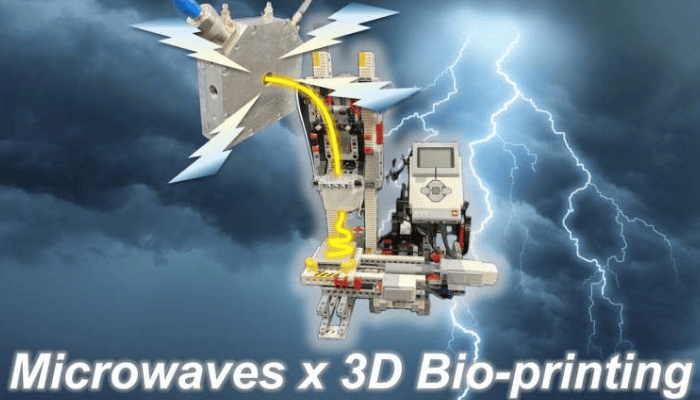
A combination machine with a microwave and 3D BioPrinter (Image Credit: Scientific Reports)
3D Bioprinting for Personalized Foods
For people with dysphagia, eating can become monotonous since they are often limited to very soft or gel-like foods. Researchers want to change that by developing meals that are both nutritious and enjoyable to eat. To achieve this, they created a special “ink” for 3D food printing. It combines an oil-in-water emulsion with a solution of proteins and stabilizers. A small amount of magnesium chloride allows the mixture to heat efficiently in a microwave, transforming the liquid preparation into a ready-to-eat gel.
More from the desk
Six other notes from the rest of the bench.
 News#3DExpress: 3D Printed Headrests in the New Sports Car FromAlpineThis week in our new 3DExpress, we bring you the new 3D-printed headrests produced by ERPRO for carmaker Alpine. They are made from a bio-elastomer. We’ll also take a look at the MASSIF project announced by AddUp and its partners:…
 NewsCan 3D Printing Reduce the Carbon Footprint of Footwear Production?Did you know that 3D technologies could also be used to reduce the carbon footprint of sports footwear? The idea of doing just that was recently realized thanks to a collaboration between the companies Covestro, Huafeng and Cyclone. Specifically, they…
 ApplicationsImproved Surgical Times at University Hospital Birmingham Thanks to 3D PrintingOne area in which we have rapidly seen the growth of 3D printing is the medical field due to its ability to design solutions tailored to each patient while reducing lead times. This has been particularly remarkably at Birmingham University…
 NewsNanoscribe showcases its nano 3D printing capabilitiesNanoscribe set out to rethink microfabrication when it integrated its two-photon polymerization (2PP) technology in 3D printers to enable nano, micro and mesoscale fabrication back in 2007. Today, it counts customers in over 30 countries worldwide, in science and in…
 NewsSolvay, L’Oréal and Ultimaker Join Forces For 3D Printing Design CompetitionFor Solvay’s 3rd Annual Additive Manufacturing Cup, the company is joining forces with L’Oréal, the world’s beauty leader, and Ultimaker, a global leader in professional 3D printing, to challenge students, engineers, and creators from around the world to create innovative…
 NewsFormnext 2024 Showcases Australia and its Growing Importance in AMEvery year, Formnext chooses an official partner country with a dedicated pavilion where exhibitors can present themselves to the international AM community. This year, the honor has gone to Australia. More specifically, Formnext 2024 has partnered with the Victorian Government&h