News
Can 3D Printing Reduce the Carbon Footprint of Footwear Production?
Did you know that 3D technologies could also be used to reduce the carbon footprint of sports footwear? The idea of doing just that was recently realized thanks to a collaboration between the companies Covestro, Huafeng and Cyclone. Specifically, they…
- 3 min read
- News
- Six more stories
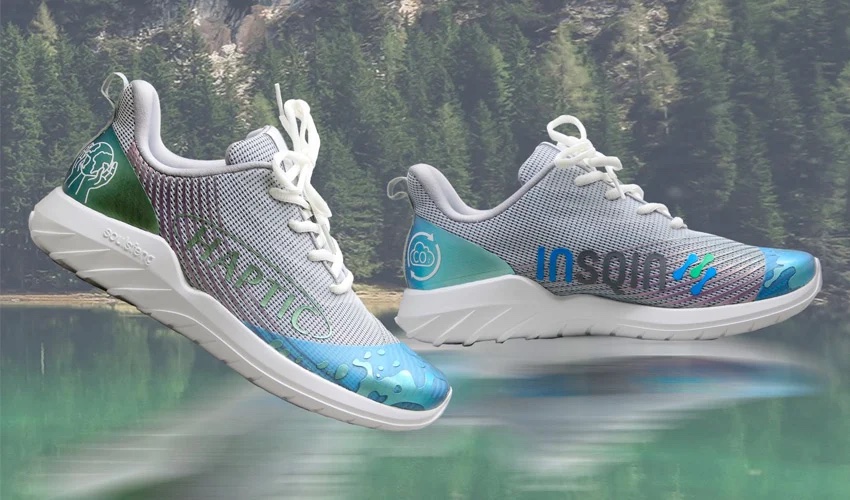
Did you know that 3D technologies could also be used to reduce the carbon footprint of sports footwear? The idea of doing just that was recently realized thanks to a collaboration between the companies Covestro, Huafeng and Cyclone. Specifically, they have developed a solution to produce footwear in a more sustainable way. Using recycled polyester-based fabric (rPET) and the HAPTIC® 3D manufacturing system, the initiative has been a success and has resulted in creating these original sneakers, which are more environmentally friendly.
Nowadays, the combination of additive manufacturing and footwear is nothing new. Many of the projects we have already highlighted seek to offer original shoes quickly and optimally. Companies such as Adidas, New Balance or even Reebok are already relying on this new manufacturing method that offers customized solutions, at a lower cost and locally. Another one of the great advantages offered by the process is the reduction of wasted material, as well as the possibility of using recycled materials, which is the key aspect that makes the difference in the Covestro, Huafeng, and Cyclone project.
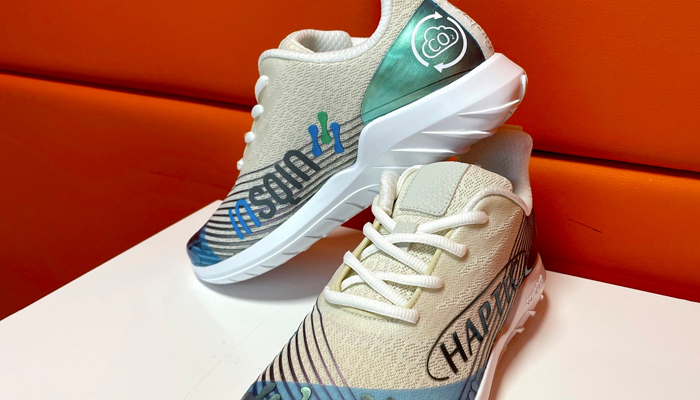
Photo Credits: Covestro
The 3D HAPTIC® Technology
To manufacture the shoe and reduce its carbon footprint, the teams used CYCLONE® recycled polyester for the upper area of the shoe, which is selectively coated using Huafeng’s HAPTIC® technology. This process is based on the dispersion of polyurethane. Half of its carbon content comes from bio-based raw materials. Thanks to that, greenhouse gas emissions are significantly reduced compared to other production systems. “This is good news for anyone who wants to maintain an athletically active and healthy lifestyle in the most environmentally friendly way possible,” says Tony Wu, Global Marketing Manager, at Covestro.
More from the desk
Six other notes from the rest of the bench.
 ApplicationsTop 5: Using Cold Spray Additive Manufacturing at ‘America’s Shipyard’Now that Sunday is finally here, we are taking a look back at the best 3D printing videos from the past week. Starting with the Norfolk Naval Shipyard, affectionately referred to as ‘America’s Shipyard,’ where we go behind the scenes…
 NewsDesktop Metal goes public, becoming the only listed pure-play AM 2.0 companyDesktop Metal is a leader in mass production additive manufacturing solutions, offering the fastest metal 3D printing technology on the market – up to 100x the speed of legacy technologies. Yesterday, Desktop Metal announced it will become a publicly listed…
 NewsTop 5 Videos: ‘Airless’ – Wilson’s 3D Printed Basketball Is a Slam Dunk in InnovationGet ready for the top 5 videos of the week that will take you on an exhilarating journey through the world of 3D printing! First up, we learn about the fascinating story behind the world’s first 3D printed basketball and…
 ApplicationsADDITIV Medical World Is Tomorrow!ADDITIV Medical World is tomorrow! As you know, this half-day event is dedicated to exploring the intersection of medical 3D printing and healthcare in a series of panel discussions and workshops. Join us on June 6th from 7:30 AM to…
 News3D Printed Robots to Be Used in Search-and-Rescue OperationsIn Search-and-Rescue operations, timing and flexibility is often key to successful results. It is often integral not only that rescue efforts happen as quickly as possible to guarantee the maximum number of survivors in a crisis, but that responses be…
 NewsP-Rouette, the 3D printed ballet slippersP-Rouette is the new invention of Hadar Neeman that should interest more than one ballet dancer. He has created 3D printed ballet slippers. This young graduate of the Academy of Art and Design of Bezalel has found the solution to most…