News
Nadarra, the 3D Printed Wall of Sand on Display in Dubai
When people think of materials for 3D printing, they primarily think of polymers, resins or even metals, which have been on the rise in recent years. But ceramics are also becoming increasingly popular and one must not forget about the…
- 3 min read
- News
- Six more stories
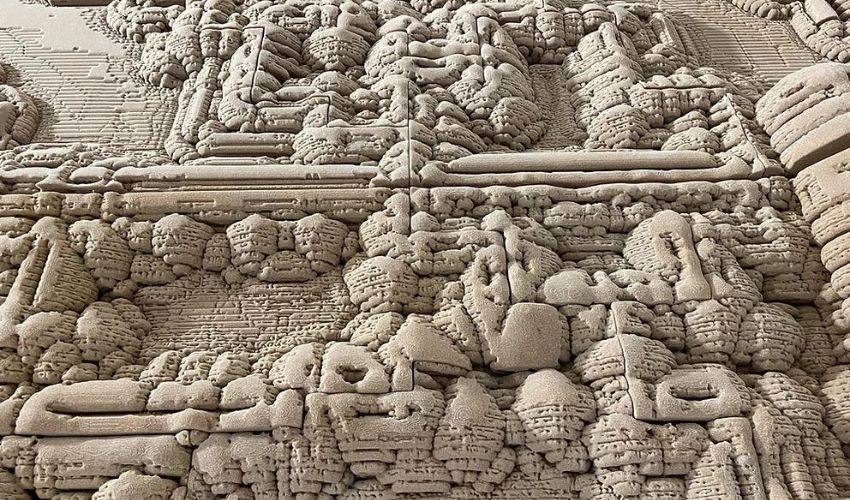
When people think of materials for 3D printing, they primarily think of polymers, resins or even metals, which have been on the rise in recent years. But ceramics are also becoming increasingly popular and one must not forget about the often overlooked sand! In fact, additive manufacturing with sand is already an established practice in the automotive industry and is becoming increasingly popular in the construction industry, especially in design. Artists and designers are experimenting with this natural material to create a wide range of applications. Among them is Barry Wark, architect and designer, who exhibited an impressive 3D-printed wall made of sand at the opening of the temporary exhibition “Tomorrow Today” at the Museum of the Future in Dubai in February 2022. Now the wall of sand, named Nadarra, has been enlarged to complement the museum’s permanent collection.
Barry Wark frequently works with international companies to realize projects around the globe. Wark founded his design studio in 2017, having worked in London and now teaches and researches at the University of Pennsylvania at the Weitzman School of Design. There is always an ecological leitmotif in his projects, the topic of sustainability is omnipresent in all projects as a comprehensive aesthetic. To achieve this overall look, Wark relies on computer-aided design options and modern, technological production methods. For the implementation of the latter, he enlists the support of international industry pioneers. Wark has already worked together with the Rotterdam-based 3D printing company CONCR3DE and also created artifacts in this collaboration that were presented at the last Formnext. There also appears to be a profitable collaboration with the German company Sandhelden, as Nadarra was built in cooperation with Sandhelden alongside other projects in the past. The Bavarian company is one of the pioneers in 3D printing with sand and the necessary post-processing steps. For example, it has made a name for itself with its 3D-printed bathroom furniture made from sand.
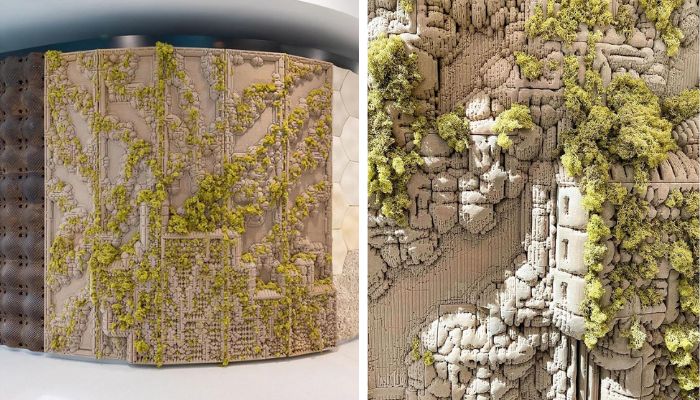
The opening exhibition featured a small first version of Nadarra, which was still overgrown with moss at the time. Now a larger version is being added to the Museum of the Future’s collection. (Photo credits: Sandhelden)
The expertise of Sandhelden was a must for Barry Wark to produce the “most complicated 3D-printed wall of all time”. In contrast to its 2022 iteration, the new version of Nadarra has no greenery, but is all the more impressive in size. It has been enlarged to 6×3 meters (almost 20’x10′) and is now part of the museum’s permanent collection. The wall has many intricate details, resulting in a unique visual design. To achieve this, 3D printing was key, as it makes it possible to create almost unlimited geometric shapes.
More from the desk
Six other notes from the rest of the bench.
 NewsUniversity of Alberta Researchers Improve 3D Printability of Pea Protein3D printing can be used to overcome some of the key challenges facing the food industry. For example, specific shapes, flavors and consistencies can create special foods for children or people with swallowing problems, or to achieve an individual nutrient…
 GuidesLiq Eyewear on the Benefits of Creating Personalized Sunglasses With 3D PrintingAccording to a study by Mckinsey & Company, 71 percent of consumers expect companies to deliver personalized interactions, and consumer goods represent a growing sector where 3D printing is gaining significant importance. Additive manufacturing brings several notable advantag
 NewsECO 3D: The latest economic news in 3D printing for September3D printing is growing rapidly, and in a variety of industries too. This disruptive technology is opening the door for so many possible changes to manufacturing processes, prototypes, and more. Therefore we have summarised the most important economic news of…
 MaterialsNASA’s 3D Printed GRX-810 Superalloy Could Make Stronger Parts for Airplanes and SpacecraftA year ago, NASA unveiled a new alloy that it claimed was more resistant and durable, potentially making it perfect for demanding aerospace applications. Called GRX-810, it was created through 3D printing and oxide dispersion, which would significantly improve its…
 GuidesSoliquid is the startup doing large-scale 3D printing in suspensionSoliquid is a French startup that has developed a unique 3D printing technology. Instead of depositing the material layer by layer on a tray, it extrudes it into a durable and reusable gel matrix using a 6-axis robot. The young…
 ApplicationsLyten Aims to Transform Motorsports with 3D Printed Parts3D printing continues to gain ground in the world of motor racing. In recent years, its use has become widespread, particularly in Formula 1 and other motorsport disciplines, where it enables parts to be produced more quickly, optimizing performance and…