Applications
MIT & ETH Zurich Demonstrate Soft Robotics Potential With 3D Printed Robotic Hand
The research and development of robotics is growing in line with its respective areas of application and requirements. In particular, soft robotics is on the rise as robots made of soft materials enable elastic deformations and minimize hazards that often…
- 3 min read
- Applications
- Six more stories
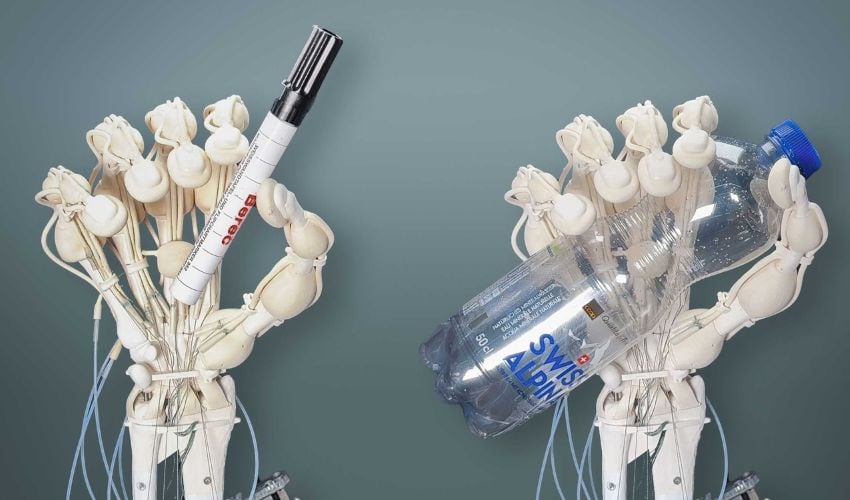
The research and development of robotics is growing in line with its respective areas of application and requirements. In particular, soft robotics is on the rise as robots made of soft materials enable elastic deformations and minimize hazards that often exist with conventional robots made of rigid materials such as steel or aluminum. The advantages of soft robotics are in demand in a wide variety of fields such as healthcare, where human-machine interactions and gripping fragile or complex objects is being tested.
Growth driven by new applications is also a parameter that applies to the development of 3D printing. Robotics and additive manufacturing share this commonality so it is no wonder that the technologies are merging and robots are increasingly being manufactured using 3D printing. Until now, additive manufacturing has been limited to processing only quick-curing plastics. However, an advanced, expanding portfolio of compatible materials is also bringing new developments and new application potential. In this context, a study by the Massachusets Institute of Technology (MIT) and ETH Zurich in Switzerland, focused on a special role for a 3D-printed robotic hand.
For the first time, researchers across the Atlantic have succeeded in processing slow-curing plastics in 3D printing. These plastics are elastic, more durable, and enable a handheld robot to print them in a single pass. This was made possible by the cooperation with the US start-up Inkbit and its technology. They worked together on the study “Vision-controlled jetting for composite systems and robots” with the aim of producing high-resolution, complex structures with different material properties and recreating the functions of natural organisms in a synthetic form. They combined 3D printing with laser scanners and a feedback mechanism.
More from the desk
Six other notes from the rest of the bench.
 MaterialsAll You Need to Know About PESU in 3D PrintingBelonging to the sulfone family, polyethersulfone, or PESU, is a high performance material which has a unique thermal profile in the world of thermoplastics. Very heat resistant, it is an amorphous polymer which, while displaying interesting properties for many industries,&hellip
 Materials3D Printing Plastics: Complete Materials Guide 20263D printer plastic is the most widely used material category in additive manufacturing, available in filament, powder, and resin form across a range of technologies. The 3D printing plastics market is projected to grow from USD $2.36 billion in 2025…
 PrintersLithoz Premieres CeraFab S320 at Formnext: Ready for the Series Production of Medium-Sized Ceramic PartsLithoz is committed to delivering high-performance solutions for technical ceramics. The company’s innovative developments – including powerful ceramic materials, LCM technology and the CeraFab System series – are proof that Lithoz is living up to these promises. Now,
 GuidesHow 3D Printing Allows for Customizable Consumer GoodsIt is not easy today to provide a universal definition of a consumer good: from basic necessities such as food that we purchase more regularly, to durable products such as cars or electronic devices, the list is long. One thing…
 ApplicationsMotion Capture Technology Used to 3D Print onto Expanding OrgansResearchers at the University of Minnesota have made a ground-breaking advancement in 3D printing for medical purposes – they have used motion-capture technology to 3D print directly onto expanding organs! This technology is usually used in film making to create…
 MaterialsNew Heat-Resistant Alloys: In Japan, 3D Printing Pushes the Limits of AluminumAluminum is considered a highly versatile material, mainly due to its characteristics of being both lightweight and strong. However, when subjected to high temperatures, its mechanical performance decreases significantly. This limitation presents disadvantages in the field of aer