News
Military 3D Printing Sector Expected to be Worth $1.7 Billion by 2027
If you have been following for a while, you have probably seen that additive manufacturing is increasingly finding its place within the defence sector. And now this has been confirmed as according to a market report published by Stratview Research,…
- 3 min read
- News
- Six more stories
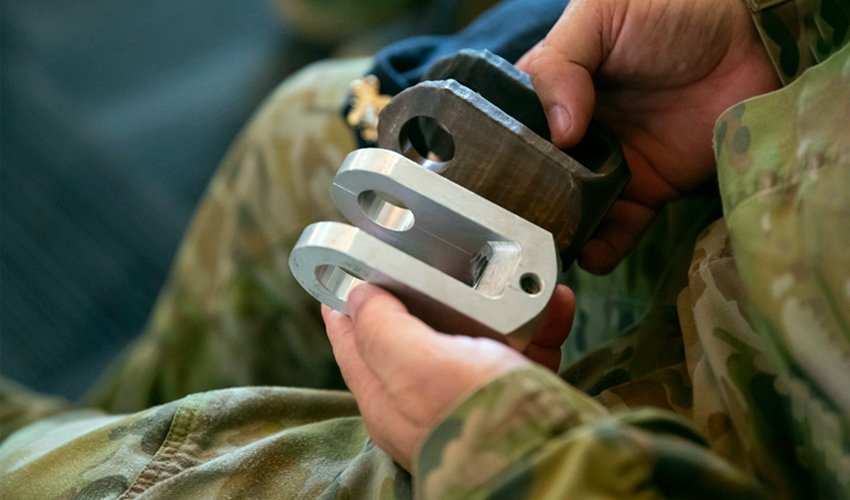
If you have been following for a while, you have probably seen that additive manufacturing is increasingly finding its place within the defence sector. And now this has been confirmed as according to a market report published by Stratview Research, 3D printing in the military is to keep growing over the next five years. Indeed, the market is expected to generate a total value of $1.7 billion by 2027. This will certainly be welcomed as this sector was heavily hurt in 2020 by the Covid-19 health crisis, with a -3.8% decline that came to affect market dynamics, competition and the global supply chain. However, last year the industry started to recover again and, in fact, the increase in value is expected to be exponential in the coming years.
3D printing technologies in the military play a key role, not only because they enable parts to be manufactured quickly and locally, but also because they support military readiness on the battlefield. Even so, this production method is still in the introductory phase, mainly still used for prototyping and conducting analysis for suitability for the military rather than being implemented in real operations. Despite the negative impact of the pandemic, in 2021 the industry began to rebound with the resumption of manufacturing facilities, the availability of materials, the continuation of pending projects, and much more. And it is precisely thanks to these actions that the industry’s growth is being supported and is expected to reach a compound annual growth rate (CAGR) of 14.8%.
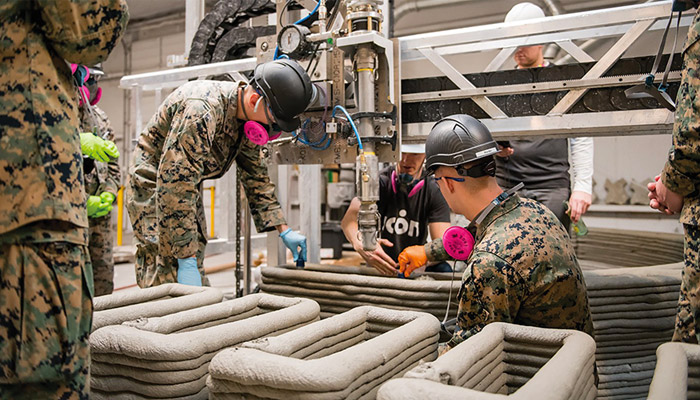
Military 3D printing expected to reach 14.8% annual growth (photo credits: ICON)
Stratview Research’s market report specifically gives a breakdown of how additive manufacturing is being used in the military. They have segmented it into a number of “types” including platform which includes land, naval and air, with the latter being the strongest due to the growing demand for 3D printing for aircraft spare parts. Regarding the type of supply, the study distinguishes between printers, materials, software and services, and 3D printers are expected to remain the dominant offering type in the forecast period. Another interesting point is the different types of application in the military sector, including prototyping, parts and tooling manufacturing, all boosted by investment in R&D for the creation of equipment and products. Finally, the report classifies technology types between extrusion, powder bed fusion, photopolymerization, binder injection and DED. By 2027, the leading method is expected to remain material extrusion due to its ease of use and cost efficiency.
More from the desk
Six other notes from the rest of the bench.
 MaterialsEssentium and LEHVOSS Group develop engineering-grade materials for AMFor a long time additive manufacturing was considered a technology for rapid prototyping. However, AM technologies have been increasingly employed for series production of parts that need to be customized or require designs impossible to manufacture using traditional methods. In&
 SoftwarePhotogrammetry: What is it and How is it Used in 3D Printing?Photogrammetry is a technique for obtaining reliable data from real-world objects in the their natural state by creating 3D models from photographs. 2D and 3D data is extracted from an image and, thanks to overlapping photos of the object, building…
 NewsTwo Weeks Until ADDITIV’s New Virtual Event on AM in AerospaceAfter the success of previous events, including ADDITIV medical France and ADDITIV digital World, ADDITIV is organizing a new 100% virtual event, this time dedicated to additive manufacturing in Aerospace. Over the course of one day, participants will be able…
 NewsUS Bobsled Team (USABS) Turns to 3D Printing Before the 2026 OlympicsBobsled is an incredible sport that has been increasingly winning over adrenaline junkies worldwide. Though in the USA, most people’s exposure to the sport is through the 1990s hit movie “Cool Runnings,” it is now a popular winter event. And…
 NewsRapid Liquid Print Brings Gravity Free 3D Printing to RAPID + TCTInnovation more than anything is the cornerstone of the additive manufacturing industry. Which is why, in the lead up to RAPID + TCT 2025, taking place in Detroit, Michigan on April 8-10, we are highlighting some of the most exciting…
 NewsHow Does Personalized 3D Printed Food Work?The general consumer behavior has changed almost completely within the last decades, whether it is in the fashion, automotive, or even the food sector. Trends such as veganism or the idea of eating more sustainable and healthy food products altogether…