Printers
What affects metal powder reusability in AM?
In the last ten years, metal additive manufacturing has taken hold in the industrial sector. Still largely used for prototyping, the technology is slowly reaching a state of maturity that will enable series production of end-use parts. Metal AM processes…
- 3 min read
- Printers
- Six more stories

In the last ten years, metal additive manufacturing has taken hold in the industrial sector. Still largely used for prototyping, the technology is slowly reaching a state of maturity that will enable series production of end-use parts. Metal AM processes often rely on powders (sometimes metal wires) to manufacture parts. As explained by Canadian Metalworking, at the beginning of metal AM, manufacturers did not have access to metal powder specifically designed for 3D printing. Therefore, they had to work with leftovers and scrap with general specifications. Today, purchasing powders with the correct specifications for 3D printing is relatively easy. The question is can manufacturers reuse leftover metal powders effectively?
In an article published by Canadian Metalworking, the question of metal powders’ reusability is explored. As many of you may know, one of the benefits of additive manufacturing over conventional manufacturing techniques is that materials can be recycled. The key is keeping the powder under the correct specifications for the process of AM. In the most popular metal 3D printing process, also known as Laser Powder Bed Fusion (LPBF), only a small amount of material is fused to create an object, the rest is left untouched.
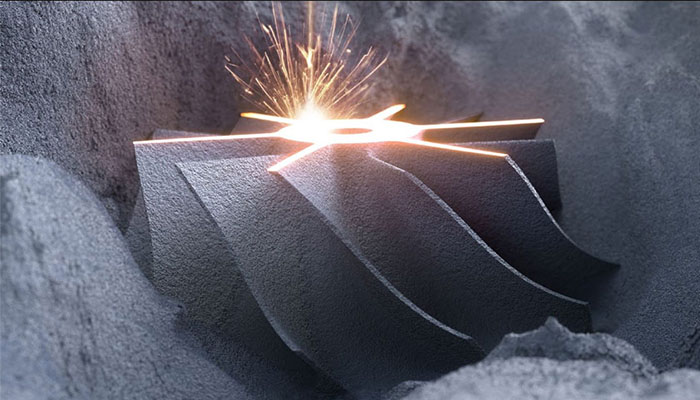
The Laser Powder Bed Fusion process
Therefore, recyclability depends largely on the material used – given that every material ages differently. Lucy Grainger, senior applications engineer at Renishaw told Canadian Metalworking: “Various steels are not as susceptible to degrading in terms of the chemical properties as titanium or aluminum alloys. Generally, the distribution of the powder size needs to be like a bell curve-type distribution. The powder needs to be generally spherical rather than angular, making it easier to flow. So when we are dosing the layers, it’s consistent and repeatable every time.” Essentially, the number of reuse cycles is limited by how much the material degrades before it is out of specification.
More from the desk
Six other notes from the rest of the bench.
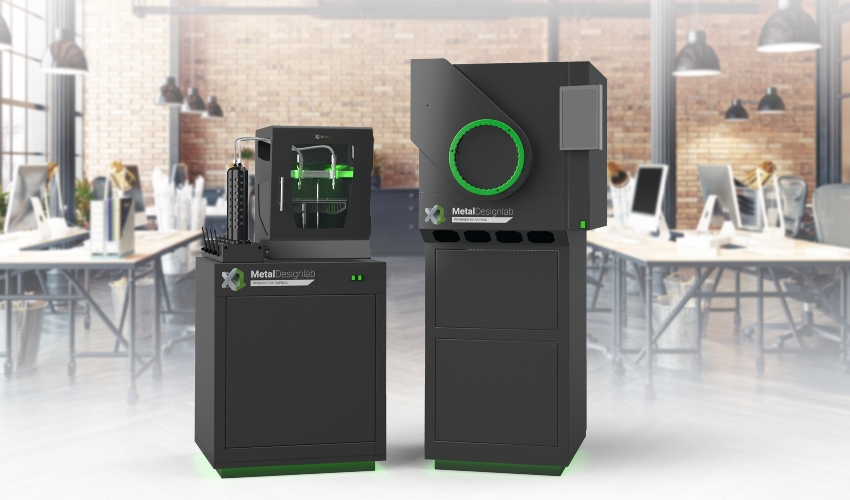 NewsExOne and Rapidia launch the world’s fastest, office-safe, metal 3D PrinterPartnering with Rapidia, ExOne has just launched the world’s fastest, office-safe, metal 3D printer. In an exclusive collaboration, the companies have released a complete metal 3D printing system comprising the ExOne Metal Designlab™ and X1F advanced furnace. The novel solution&h
 ApplicationsUniversity of Wisconsin-Madison Develops First-Ever Functional 3D Printed Human Brain TissueResearchers at the University of Wisconsin-Madison recently achieved a major milestone by creating the first-ever functional 3D printed human brain tissue. This synthetic tissue, capable of growing and functioning similarly to natural brain tissue, offers new perspectives for und
 NewsPorsche Consulting and Sakuu to Create 3D Printed Batteries TogetherOne of the first industries to use 3D printing was the automotive sector. Initially, the main application was prototyping, as the technology allows parts to be manufactured quickly, while the design can be easily changed. Though as we know that…
 ApplicationsVoxelMatters Reports on Additive Manufacturing in Aerospace and DefenseThe defense and aerospace industries have used additive manufacturing in a variety of ways. While in its early days it was mainly used for prototypes and tools, we are now seeing more and more end parts in these industries being…
 Guides#3DStartup: BIOLIFE4D is pioneering advances in tissue engineering3D printing is becoming more and more advanced and implemented in more important sectors. One of these sectors is the medical industry that’s opening up for new possibilities and solutions. One of the bigger problems is the amount of organ…
 NewsMiddle East Reverse Engineering & Additive Manufacturing Show 2024 to Open Its Doors TomorrowWhen the industry talks about regions that are a hotspot for additive manufacturing, often we mention the USA, Western Europe and, of course, China and India. But there is another part of the world that has become one of the…