Software
MechStyle Blends Generative AI with Mechanical Simulation to Make Stronger 3D Models
If you’ve ever tried printing an AI-generated 3D model, you know that the experience can come with some obstacles: the 3D model may have an undesirable “AI bumps” (small, irregular imperfections or protrusions), details that are not feasible for your…
- 3 min read
- Software
- Six more stories
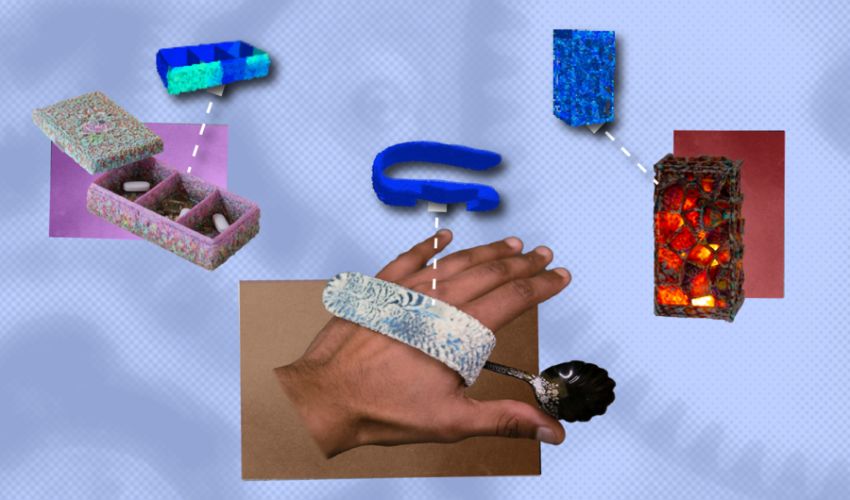
If you’ve ever tried printing an AI-generated 3D model, you know that the experience can come with some obstacles: the 3D model may have an undesirable “AI bumps” (small, irregular imperfections or protrusions), details that are not feasible for your 3D printer to achieve, and, critically, mechanical stability oversights.
There has been lots of buzz around creating AI-generated models that are viable for 3D printing. For instance, Backflip, an AI model generator from the creators of Markforged, is promising AI 3D model generation built for 3D printing. More recently, MeshyAI announced the launch of Creative Lab, a platform for generating 3D printable models. Now, researchers from the Massachusetts Institute of Technology (MIT) Computer Science and Artificial Intelligence Laboratory (CSAIL), along with researchers from Google, Stability AI, and Northeastern University, have developed the “MechStyle” system. The purpose of this system is to make real-world objects with AI, creating functional items, while also exhibiting the user’s intended appearance and texture.
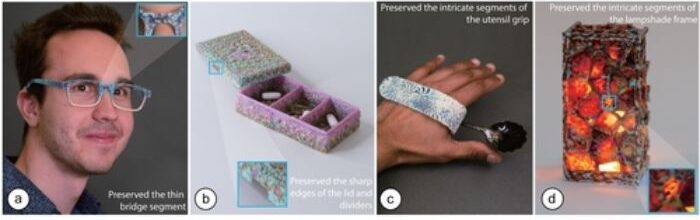
Parts adapted with the MechStyle system (Image credit: Faruqi et al.)
How Does MechStyle Work?
It works a little differently from other AI 3D model generators. Instead of beginning with a text, image, or video prompt, the MechStyle process begins with a 3D model, either one that users upload themselves or a preset asset of objects like vases and hooks. Then, they can prompt the tool with text or images to create a personalized version. The geometry will therefore be modified by a generative AI model, while MechStyle simulates how those changes will impact particular parts. In this way, MechStyle ensures vulnerable areas remain structurally sound. Essentially, it creates an AI-enhanced blueprint that users can 3D print and use in the real world.
More from the desk
Six other notes from the rest of the bench.
 Applications3D Printed Skull Played “Pivotal” Role In Murder ConvictionSherlock Holmes, Hercule Poirot, Columbo…3D printing? In a story that seems pulled straight from the latest detective novel, additive manufacturing has been used as a way to get a conviction for a murder in the United Kingdom. A 3D printed…
 NewsVoices AMplified RAPID TCT 2023: Hearing From the AttendeesRAPID + TCT 2023 has wrapped up! After 3 exciting days in Chicago, the largest conference on additive manufacturing in North American has closed its door after a successful edition with over 400 exhibiting companies and over 9500 attendees from…
 NewsCOBOD printer used for India’s first 2-Story 3D printed buildingL&T Construction has announced that it has developed India’s first 3D printed two-story building. The building was created using a COBOD printer and is the second Indian 3D printed house, the first was a single storey house also built by…
 ApplicationsStewart-Haas Racing Partners with 3D Systems for Enhanced Mustang Dark HorseStewart-Haas Racing has continually sought innovative methods to enhance their vehicles’ performance in the highly competitive NASCAR series. In line with the emerging trend of leveraging additive manufacturing within motorsports, Stewart-Haas Racing has announced their col
 Printers3D scan directly into your Sony with the Xperia XZ1 and XZ1 CompactWhat if your phone could become your new 3D scanner? This is what the Japanese manufacturer Sony wants to offer with their new phones, the Xperia XZ1 and the XZ1 Compact. These two new phones will have the ability to…
 NewsNewly Developed 3D Printed Electrolytes Allow for Better Energy StorageIn Australia, a team of researchers at UNSW in Sydney claims to have successfully 3D printed solid-state polymer electrolytes in custom shapes from a desktop 3D printer. This would allow for energy storage in small electronic or medical devices, or…