News
How the Maker Community reacted to PPE Shortages
Following COVID-19’s evolution from epidemic to pandemic, fear of PPE shortages in hospitals quickly became a reality for many countries across the world which has yet to subside. The 3D printing industry reacted quickly. In the last year we’ve seen…
- 3 min read
- News
- Six more stories
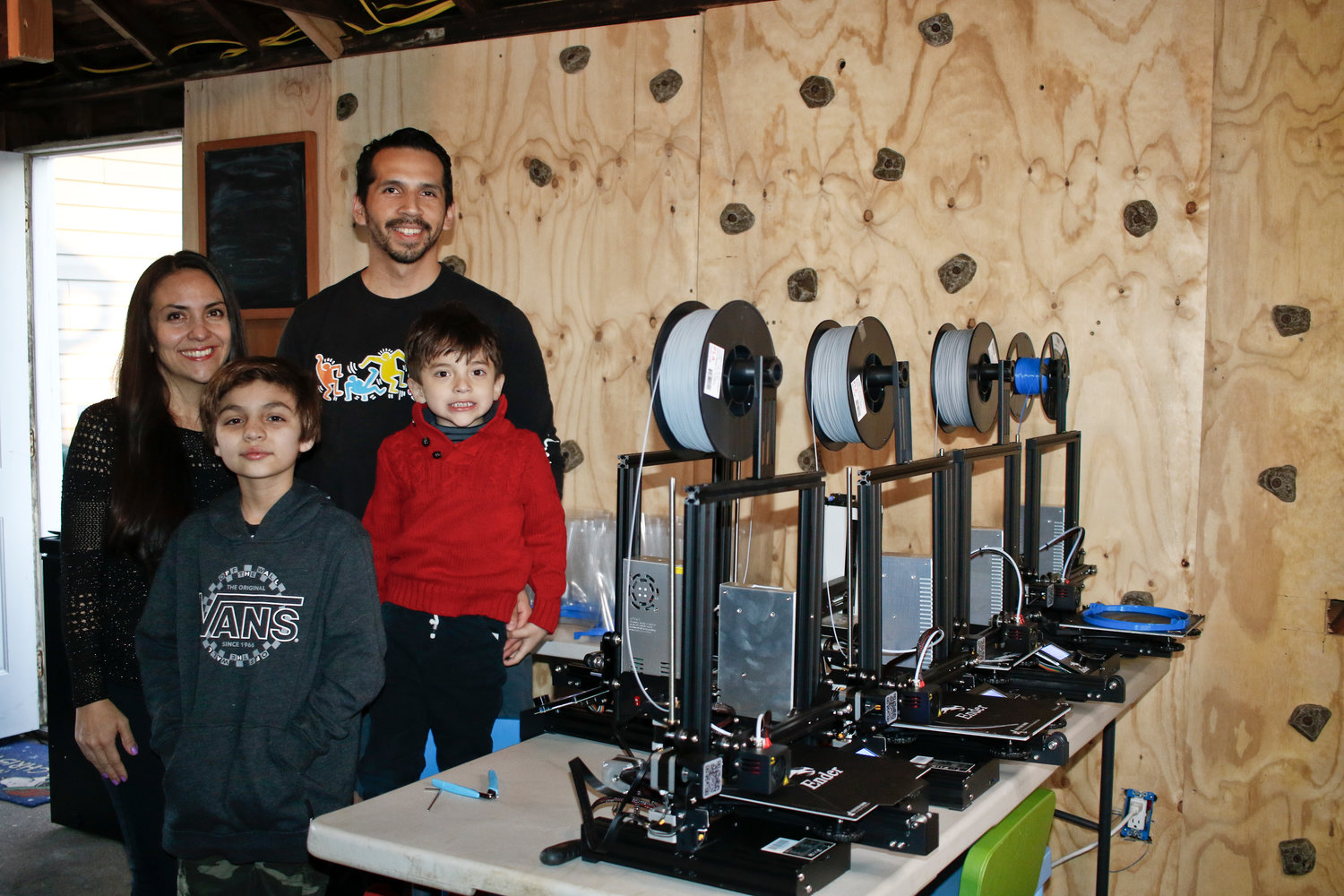
Following COVID-19’s evolution from epidemic to pandemic, fear of PPE shortages in hospitals quickly became a reality for many countries across the world which has yet to subside. The 3D printing industry reacted quickly. In the last year we’ve seen several additive manufacturing companies responding to this shortage with a variety of exceptional innovations. It was not, however, companies alone which came to the rescue. There were several grassroots initiatives spawning from the maker community which not only responded quickly but mobilised in large numbers. Across the world makers were turning their homes, schools and workplaces into makeshift PPE factories.
Last year, volunteer maker communities banded together. A report by Open Source Medical Supplies (OSMS) and Nation Of Makers (NOM) recorded over 42’000 citizen responders and 1’869 local response groups across 86 countries, delivering over 48.3 million units of medical supplies, worth over $270 million, 32.4% of which were 3D printed. This was enabled by several non-profit organisations who developed methods to connect makers and supply them with designs and instructions for medical grade PPE. OSMS has created an open source design library and guidance to support local groups in effectively organizing fabrication and distribution efforts to meet the local demand for COVID-19 supplies. All designs are medically reviewed, you can find the library here. OSMS also compiled research on what kinds of PPE should be used in what circumstances in order to minimise risk of infection. This has allowed volunteer makers to optimise PPE.
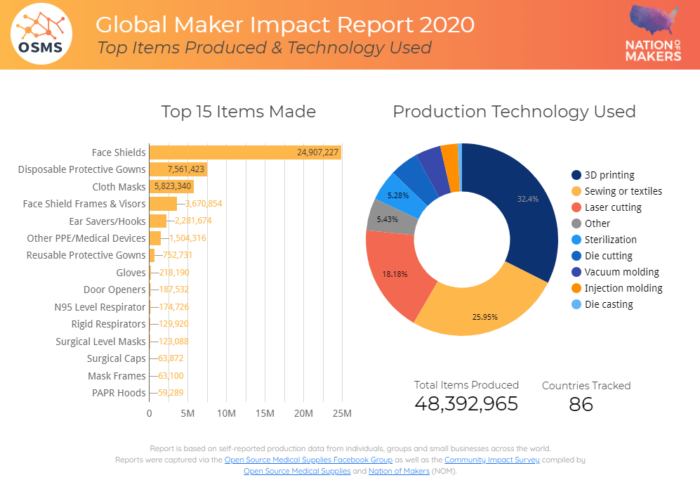
Global Maker Impact Report 2020 (Credit: Open Source Medical Supplies & Nation of Makers)
Why is PPE so important?
PPE, or Personal Protective Equipment, is essential for the protection of health care workers from exposure to coronavirus. PPE includes masks, respirators, face shields, gloves, goggles, gowns, and other equipment. Without PPE our first line of defence against the COVID-19 is made vulnerable. In May 2020, the Federal government set a goal to obtain 300 million N95 masks for front line health workers. By mid-November this goal was not even halfway achieved, with only 142 million masks secured. National Nurses United, the US’s largest union of registered nurses, released a survey at the end of November reporting that only 16.% of nurses in hospitals said they had universal PPE in the emergency department. Moreover, by November roughly 70% of facilities had completely run out of one or more types of PPE for the third month in a row. These statistics only serve to prove that the global supply shortage has worsened rather than improved. There has been a market failure. Governments have been unable to meet the demand with current supply chain methods. Ali Raja, an emergency-room doctor who co-founded Get Us PPE, the nation’s largest nonprofit founded by emergency physicians to give donated PPE to organisations that need it, said “the disconnect between what’s purported to be in the stockpile and the needs on the front-line is astounding.”
More from the desk
Six other notes from the rest of the bench.
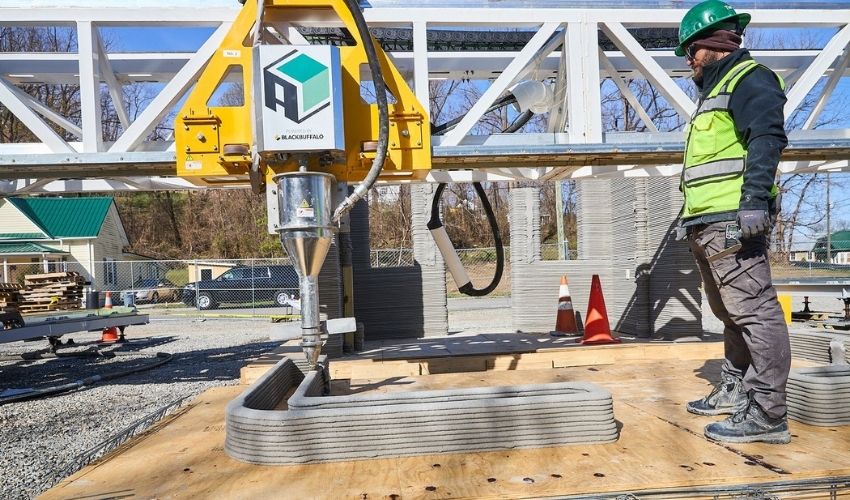 NewsAlquist 3D Has Announced Plans for the ‘Largest 3D Printed Home Building Project in the World’ in VirginiaAlquist 3D recently announced that it would be building 200 new 3D printed homes in Virginia. The Virginia-based company aims to lower the cost of housing and infrastructure in economically troubled communities with the so-called Project Virginia, which it claims…
 NewsThe Nativity Scene Gets a 3D Printed TwistThe nativity scene is one of the most traditional symbols of Christmas across the world, and it has been reimagined this year! Italian startup Jirama has decided to innovate this most historic and religious symbol using additive manufacturing. The company…
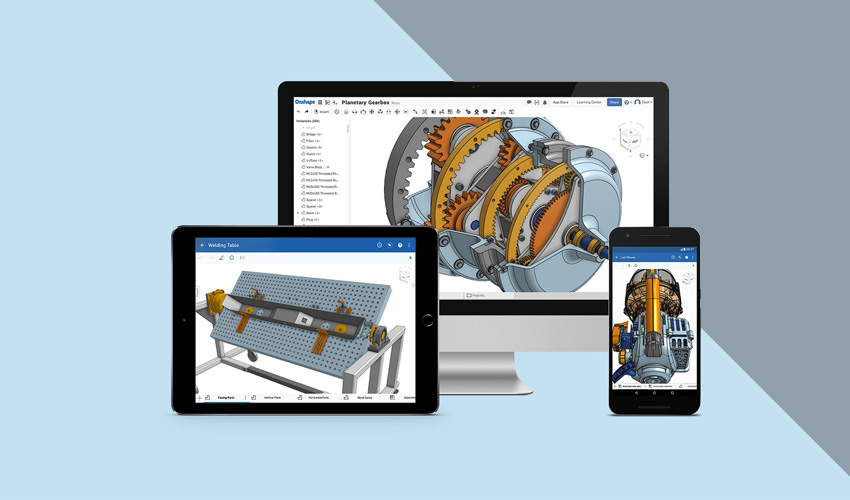 SoftwareOnshape: All You Need To Know Before Getting StartedOnshape is a cloud-based computer-aided design (CAD) software. Using web-based servers, software users can collaborate on a single model, editing and interacting at the same time. The program is intended for many industries looking to design products, machine parts, industrial&he
 ApplicationsApplication of the Month: Lamborghini Uses 3D printing for the SC63 Hypercar at the 24 Hours of Le Mans 2024The use of 3D printing in motor racing has become increasingly common. The ability to rapidly produce, customize and select the most appropriate materials for each application has led many automakers to adopt this technology. In Formula 1, for example,…
 ApplicationsNASA’s 3D Printed Circuits Reach New Heights in Space ExplorationIn recent years, the field of additive manufacturing, also known as 3D printing, has been rapidly gaining popularity across various industries. Its ability to offer customization, innovative design, and improved performance has led to its widespread adoption in diverse fields. Am
 NewsResearchers develop 3D printing with sound waves3D printing has evolved in recent years. We know of examples such as the 3D printing liquid and 4D printing etc. Now Harvard researchers present us with their newest progress; 3D printing with sound waves. Based on acoustic or acoustic levitation they have been able to create&hel