Applications
Harvesting the Moon: Transforming Regolith Into Electronics
Lunar regolith—the loose dust and rock covering the Moon’s surface—is far more than just dirt. It is comprised of approximately 40-45% oxygen. Since 2019, the company Metalysis has collaborated with both the UK and European Space Agencies to extract this…
- 3 min read
- Applications
- Six more stories
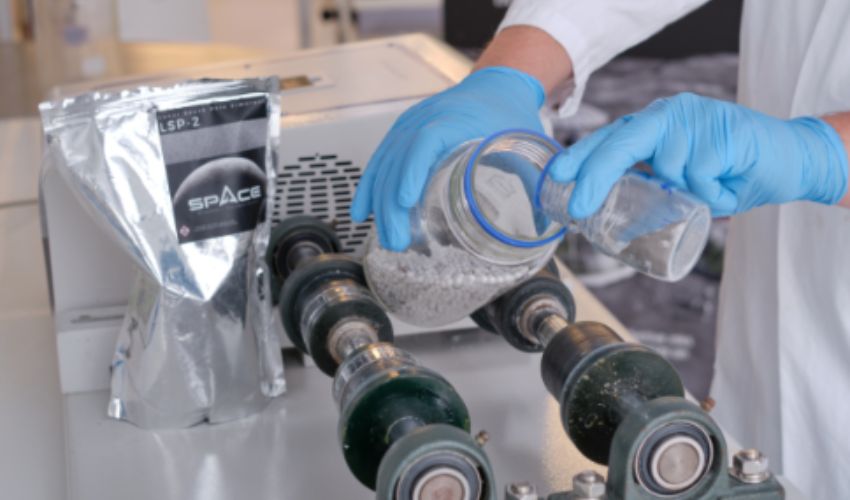
Lunar regolith—the loose dust and rock covering the Moon’s surface—is far more than just dirt. It is comprised of approximately 40-45% oxygen. Since 2019, the company Metalysis has collaborated with both the UK and European Space Agencies to extract this oxygen, a vital resource for rocket propulsion. However, the utility of regolith does not stop at oxygen production. Once the oxygen is removed, a mixture of conductive metal alloys remains. While companies like Space Copy and Luyten are exploring regolith for construction 3D printing, a new initiative aims to transform these metal-rich residues into inks for printing electronic circuits, and powders for printing larger objects.
Metalysis, a leader in reducing regolith into its component elements, utilizes a patented method known as molten salt electrolysis. In this process, a calcium chloride electrolyte is heated to between 800 and 1000°C. When voltage is applied between the electrodes, oxygen is liberated from the material, leaving behind metal alloys.

The researchers will utilize the magnetic properties of the regolith.
“The technology is applicable to nearly 50 elements in the periodic table, and it is feedstock agnostic – so it can process lunar regolith,” Dr. Ian Mellor, MD and chief scientist at Metalysis said. “Our immediate focus terrestrially is upon high charge tantalum powders and aluminium scandium alloys for the electronics sector.”
More from the desk
Six other notes from the rest of the bench.
 NewsStarting young with 3D Printing Summer CampsA natural part of any summer holiday around the world is summer camps. They come in all shapes and sizes covering everything from various sports, sciences and scouts etc. Now a new trend has popped up for kids to try…
 GuidesHow to recruit and be recruited in the 3D printing sector: Experts give their advice!The supply and demand for jobs in the additive manufacturing sector is growing rapidly and both companies and candidates must prepare for the changes underway. According to the 2018 The Future of Jobs report, new jobs related to Industry 4.0…
 PrintersFrom Big to Small: How the Toucan Scanner is Redefining 3D ScanningNot long ago, anyone interested in 3D scanning had to accept a few trade-offs. If you wanted to capture a model of an object, you needed your scanner, a computer or smartphone and a tangle of cables to connect them.…
 NewsTop 5 Videos: Emirates, GE & More!This week’s Top 5 Videos contains a variety of interesting videos from companies, and researchers. These range from new printing processes, to plans to build 3D-printing drone armies that can build shelters for those affected by natural disasters. Remember, a…
 NewsHP Launches its First Industrial Filament 3D PrinterWhen you think of HP, you immediately think of its powder-based Multi Jet Fusion technology, used to produce series parts across many industries. This year at Formnext, the company surprised everyone by unveiling its first filament 3D printing platform. Called…
 NewsWhat Were the Key 3D Printing Trends in 2025?As the end of the year approaches, we at 3Dnatives are taking a step back to analyze what has truly defined the additive manufacturing industry in 2025. It is already clear that this has been a year of technological maturity,…