Applications
L’Oréal 3D Prints Human Skin in Partnership With University of Oregon
Researchers at the University of Oregon have partnered with scientists from the renowned French skincare company L’Oréal to pioneer the first successful development of an artificial skin model closely resembling natural human skin. This collaborative effort aims to address
- 3 min read
- Applications
- Six more stories

Researchers at the University of Oregon have partnered with scientists from the renowned French skincare company L’Oréal to pioneer the first successful development of an artificial skin model closely resembling natural human skin. This collaborative effort aims to address the need for more accurate testing methods for cosmetics and skincare products, as well as to explore potential medical applications.
The artificial skin, which closely mimics the complexity and structure of natural human skin, is the result of a novel 3D printing technique invented by Paul Dalton, a professor at the university’s Phil and Penny Knight Campus for Accelerating Scientific Impact. This innovative method allows for the creation of multilayered skin-like cell colonies in a period of just 18 days.
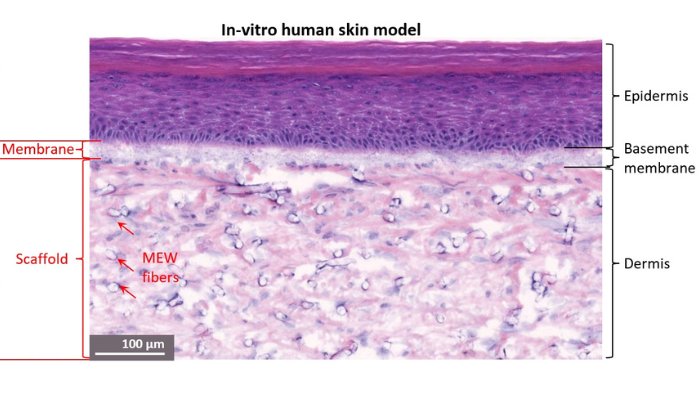
The two-layered artificial skin in-vitro. (Photo Credits: Paul Dalton)
A Two-Layer Approach To Realistic Skin
In the past, replicating human skin has been exceptionally challenging due to its diverse array of cell types and complex extracellular matrix. This matrix is crucial in facilitating cell communication and overall function, presenting significant hurdles in achieving accurate mimicry. However, unlike prior methods, Dalton’s technique can achieve unprecedented realism and functionality.
More from the desk
Six other notes from the rest of the bench.
 NewsParhelion, the 3D Printed Mural That Combines Art and AcousticsThe use of 3D printing in interior design enables the creation of customized, durable and highly functional pieces. Furthermore, AM gives designers the freedom to experiment with shapes, textures and colors impossible to achieve using traditional methods. This is what…
 News3D Printing Brings a Sea Monster to LifeYou might have seen the recent story about the discovery of the giant fossil that was extracted in the UK in the beginning of December 2023. The skull of a pliosaur, an ancient marine reptile from the Jurassic period, was…
 NewsTop 12 3D printing videos of 2018It’s been a year full of news in the 3D printing industry. New machines hit the market ready to be tested, legal issues was debated, and the preparations for going into space has moved forward. A lot of it has been covered…
 PrintersYoav Zeif Talks About the Current State of the AM Market, U.S. Tariffs and the Launch of Stratasys’ Neo®800+ 3D PrinterWhat does 2025 hold for the world of additive manufacturing? Amid geopolitical challenges, technological evolutions and new market balances, the 3D printing industry is gearing up for what is likely to be a critical year. To analyze emerging trends and…
 MaterialsMeltio Has Launched New Materials, Allowing for Parts With Guaranteed Properties for a Broader Range of IndustriesMeltio, an international manufacturer of metal 3D solutions based in Spain and the US, has announced that it is launching four new materials, Stainless Steel 17-4PH, Tool Steel H11, Nickel 625 and Invar, as part of its metal wire materials…
 ApplicationsAddion Has Designed Ultra-Realistic Eye Models to Help Prepare for Ophthalmological SurgeriesAustrian 3D printing service Addion GmbH, which specializes in the production of 3D printed medical devices, is using Stratasys PolyJet technology to design ultra-realistic surgical eye models to better prepare for critical operations. The multi-material, multi-color additive man