News
3D Printing Brings a Sea Monster to Life
You might have seen the recent story about the discovery of the giant fossil that was extracted in the UK in the beginning of December 2023. The skull of a pliosaur, an ancient marine reptile from the Jurassic period, was…
- 3 min read
- News
- Six more stories
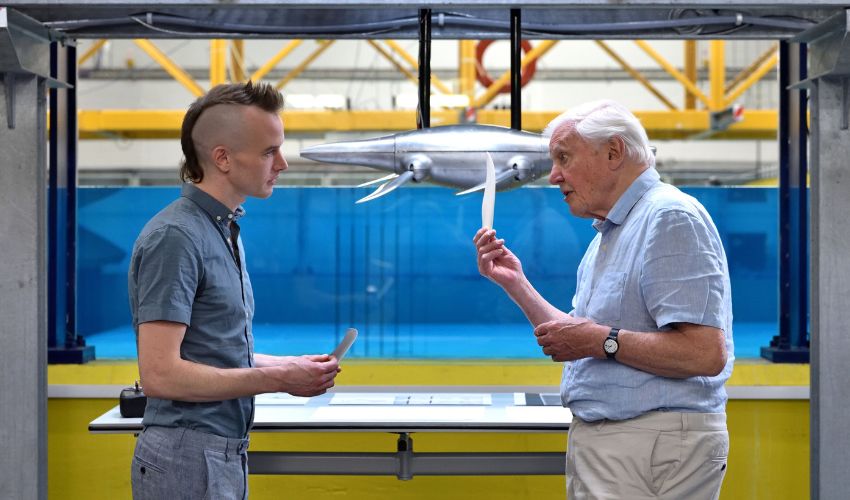
You might have seen the recent story about the discovery of the giant fossil that was extracted in the UK in the beginning of December 2023. The skull of a pliosaur, an ancient marine reptile from the Jurassic period, was first found on the cliffs of Dorset’s Jurassic Coast, a world heritage site consisting of Triassic, Jurassic and Cretaceous cliffs, by amateur fossil hunter Phil Jacobs. Indeed, the discovery was documented in the show “Attenborough and the Giant Sea Monster” which aired on the BCC on January 1st and followed famed naturalist Sir David Attenborough as he investigated this fossil. But did you know that 3D printing was also used to help understand and visualize this so-called sea monster?
To understand how 3D printing was used, it is first important to understand why exactly this discovery was so important. The two-meter skull which includes 130 teeth is one of the biggest and most complete specimens of its type, and it would have never been discovered if the snout had not been happened upon by chance when it fell onto the beach. Pliosauroidea, which are more commonly referred to as pliosaurs and nicknamed the ‘Tyrannosaurus rex of the seas‘, were apex predators in the Jurrassic and Cretaceous periods. But a lot of mystery surrounds these gigantic creatures, especially in terms of how they moved given their size, hence the title sea monster.
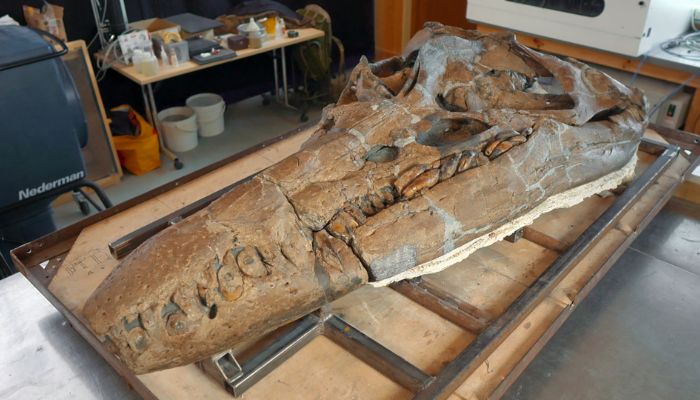
The skull fossil of the pliosaur (photo credits: BBC Studios)
Making the Giant 3D Printed Sea Monster
Pliosaurs had a powerful bite (as obvious in the picture of the skull fossil), generating 33,000 newtons of force. An incredible amount considering that the living animal with the most powerful bite today is the saltwater crocodile, which only generates 16,000 newtons, and humans can only generate 700 newtons. It also was fast and moved thanks to four powerful flippers. These flippers are where scientists have been stumped, as it was unclear how they could be used to propel the enormous creature through the water. Enter Dr. Luke Muscutt and James Hogg.
More from the desk
Six other notes from the rest of the bench.
 NewsWhat Were the 3D Printing Trends in 2024?2025 is just around the corner, but with 2024 now ending, it is time once again for us at 3Dnatives to reflect on the past year. This time last year, many signs of what was to come were already present:…
 NewsAMUG 2022: A Round Up of all the News From the EventAMUG 2022 is officially over! The annual AM conference “for users – by users” took place this year from April 3rd to 7th in the Hilton in Chicago, Illinois. Once again, attendees were treated to packed days full of conferences,…
 NewsThe Complete Guide to Multi Jet Fusion (MJF) 3D PrintingWhen it comes to additive manufacturing, it is safe to say that it is definitely not one size fits all. Though of course the basis of the technology, developing layer by layer, stays constant, the way of doing this certainly…
 NewsNexa3D and Stratasys Both Complete AcquisitionsIt seems that it is time once again for another round of acquisitions in the additive manufacturing sector. After a year that has been relatively quiet compared to last year, this week we have seen a flurry of activity. First…
 NewsTOP 5 Videos: 3D Printed Titanium BikeThis week we found the top 5 videos about 3D printing and the way additive manufacturing is changing production. The technology has infiltrated many sectors, from medical to automotive: check our selection of the week to keep up with the innovations! If you enjoy these, you&helli
 PrintersNew affordable and fast full-color FDM 3D printer from OVEOVE and Memjet have come together to offer a fast, full-color FDM 3D printer. The two companies, OVE, a Polish 3D printing startup and Memjet, a Californian provider of inkjet technology both leveraged their expertise for the creation of this…