Applications
Lockheed Martin Announces Partnership With Sintavia For Metal Additive Manufacturing
Metal additive manufacturing finds its place in aerospace and defense in the creation of spare parts and prototypes in a short time, which can be useful for the management of supply chains. Companies all over the world are recognizing the…
- 3 min read
- Applications
- Six more stories

Metal additive manufacturing finds its place in aerospace and defense in the creation of spare parts and prototypes in a short time, which can be useful for the management of supply chains. Companies all over the world are recognizing the value of this technology and investing accordingly. In the latest example, Lockheed Martin and Sintavia have announced a collaboration to further metal 3D printing technology within Lockheed’s products.
Lockheed Martin is an aerospace, arms, defense, information security, and technology corporation based in America, which employs around 155,000 people worldwide. They are now partnered with Sintavia, one of their additive manufacturing suppliers. Sintavia is a digital industrial company who offer design and manufacturing technology with a focus on sustainability. They offer heat transfer systems, propulsion systems, and power generation. As the largest pure-play additive manufacturer of advanced propulsion systems for flight and launch OEMs, Sintavia has a great deal of industry expertise and experience to offer to Lockheed Martin.
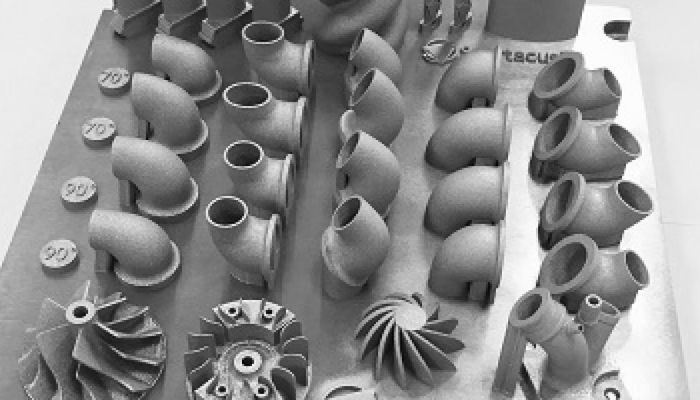
Metal additive manufacturing is used for aerospace to create prototypes and spare parts. (Photo credit: Farinia Group)
This collaboration will explore a number of additive manufacturing technologies, including laser powder bed fusion (LPBF), electron beam-directed energy deposition (Electron Beam DED), and friction stir AM. Lockheed Martin hopes to harness these technologies for the improvement of metal additive manufacturing for aerospace, building on the initiative ‘AM Forward’ from the White House. This project aims to improve small- and medium manufacturing, boost the job market, and enhance supply chains. Other initial participants are GE Aviation, Honeywell, Raytheon, and Siemens Energy.
More from the desk
Six other notes from the rest of the bench.
 MaterialsCould Flame-Retardant Bioplastics Soon Be Used in AM?Materials used in electrical engineering or electronics must conform to high demands. This is especially the case since these materials must have properties such as flame resistance. It is well known that in this case plastics meet the necessary flame…
 GuidesStartup of the month, Aspect Biosystems: bioprinting human tissuesOur startup of the month is Aspect Biosystems, a Canadian specialist in bioprinting. Aspect Biosystems has developed a unique technology that allows the creation of customized human tissues for different applications such as drug development, regenerative medicine, disease unders
 Printers3Dnatives Lab: Our Test of the MakerBot Replicator MiniAfter an announcement made at CES in 2013 by the CEO of MakerBot for their new generation of personal 3D printers, we at 3Dnatives labs have decided to tackle the Replicator Mini. This 3D printer is an entry-level model from this American manufacturer. Before…
 Applications3D printing accelerates supercar design and productionIn the automotive industry, additive manufacturing has established itself as a technology for prototyping and tooling applications. Car manufacturers can create prototypes to check fit and form before going further in the design process, and they can also create low-cost…
 NewsThe World’s First 3D Printed Fiberglass PoolAmerican pool company San Juan Pools recently unveiled what it claims to be the first-ever 3D printed fiberglass pool. In a late segment of the TV morning show Fox and Friends, the pool was presented for the first time on…
 NewsWEBINAR: Proven on the Production Floor: Why the Raplas PR 700 Works in a Real Manufacturing EnvironmentFor manufacturers considering an investment in industrial 3D printing, the transition from laboratory testing to high-stakes manufacturing can be a significant hurdle. While prototypes may perform well in controlled environments, scaling production often brings new challenges, su