Printers
Industrial VS Desktop FDM Printers: Is Industrial Worth the Investment?
For years, a massive divide separated industrial and desktop FDM printers, defined by differences in accuracy, material compatibility, and cost. Today, desktop manufacturers are aiming to narrow that gap, and a new generation of “prosumer” machines from companies like
- 3 min read
- Printers
- Six more stories
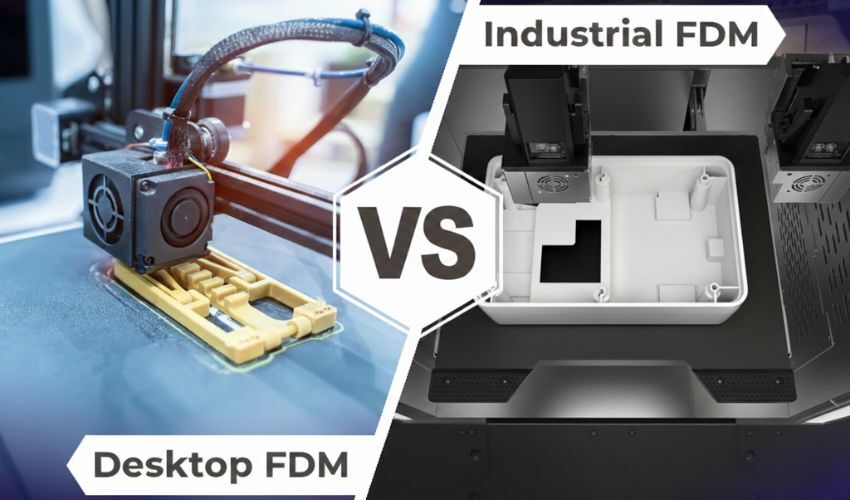
For years, a massive divide separated industrial and desktop FDM printers, defined by differences in accuracy, material compatibility, and cost. Today, desktop manufacturers are aiming to narrow that gap, and a new generation of “prosumer” machines from companies like Bambu Lab and Prusa has democratized features once exclusive to the industrial sector, including high-speed motion systems, automated calibration, and reliable dual extrusion. So, what continues to set industrial machines apart? In this article, we compare architecture, thermal control, materials, software, and pricing to help you understand what makes an industrial machine worth the investment.
Technical Characteristics
Systems Architecture
One of the primary ways industrial and desktop FDM printers differ is in their construction. Industrial printers are constructed with significantly heavier and more rigid frames designed to eliminate mechanical noise. Industrial machines should not experience vibration issues and require no stabilizers to print tall, thin geometries. Plus, the vibration can create microscopic imperfections that drastically weaken a part, particularly in the Z-direction (vertical strength).
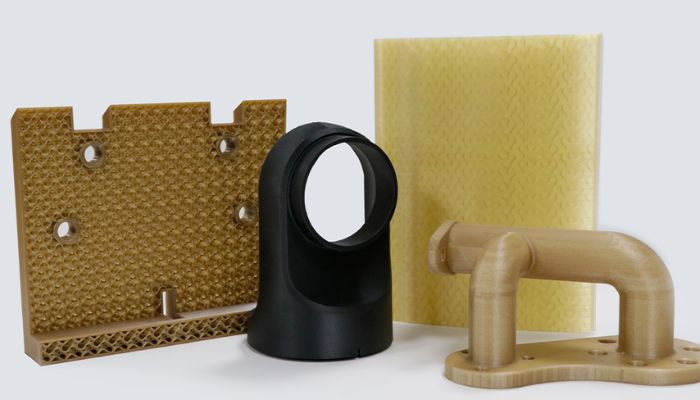
Parts printed in PAEK (Photo Credits: INTAMSYS).
Beyond the chassis rigidity, industrial and desktop FDM printers can vary in their calibration and motion system (which determines the precise movement of the print head and build plate). The motion systems in industrial machines are designed for high precision and low maintenance. Due to their robust size and construction, industrial machines maintain their calibration over long periods, whereas desktop printers may require frequent user intervention and recalibration to maintain accuracy. The average precision (dimensional accuracy/tolerance) for a standard desktop FDM 3D printer is typically ±0.5 mm, while high-end industrial FDM printers often achieve tolerances around ±0.2mm.
More from the desk
Six other notes from the rest of the bench.
 NewsTop 5: Siemens Looks into AM for a Circular EconomyIn our top 5 for this week, we look at a video from Siemens which shows how their users see the link between additive manufacturing and a circular economy. Additionally, in another video, Siemens shows its new partnership with American…
 NewsU. S. Marine Corps is Investing in 3D Printing InnovationWithin the field of additive manufacturing the various branches of the United States military have often been at the forefront of incorporating 3D printed devices and manufacturing techniques into their literal and figurative arsenals. From military buildings to naval ship&hellip
 News#3DQuiz: Have You Been Following the Latest Additive Manufacturing News?From new 3D printing processes and improved materials to unconventional application possibilities and company mergers – the world of additive manufacturing never sleeps, as we all know. And there was a lot going on in the last quarter as well!…
 GuidesNagami, exploring the design of the future with new technologiesNagami is a design studio based in Ávila, Spain that has become known worldwide in recent months for the presentation of Zaha Hadid Architects chairs at the Milan Design Fair or the Voxel Chair v1.0 in the Georges Pompidou Museum in…
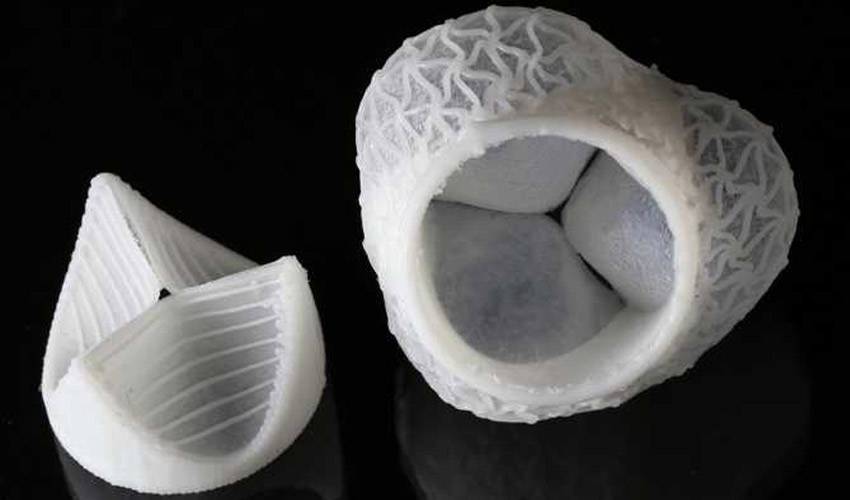 Applications3D Printed Heart Valves from SiliconeA team of researchers from ETH Zurich has teamed up with South African company Strait Access Technologies to create artificial 3D printed heart valves from silicone. These could serve as replacement valves for an aging population – they represent a…
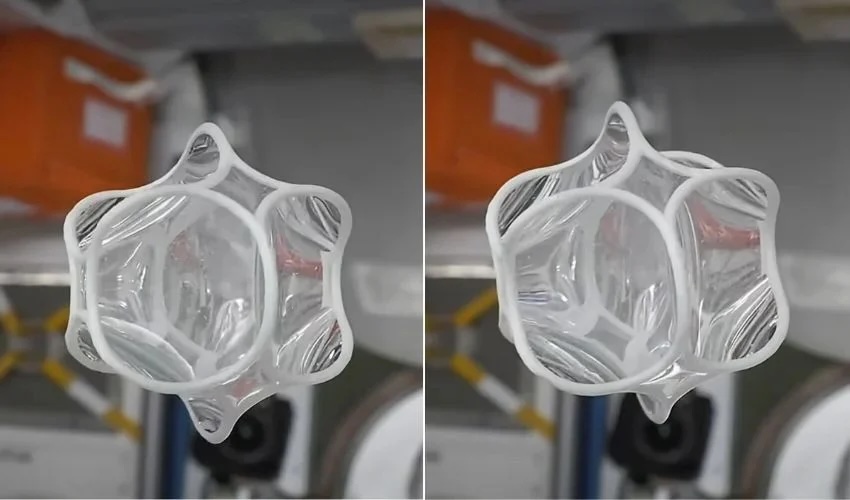 ApplicationsA New Geometric Shape Travels to the International Space StationA geometric model developed through a collaboration between the University of Oxford and the Budapest University of Technology and Economics has just become the focus of one of the most remarkable experiments ever carried out in space. These “soft cells”…