Applications
A New Geometric Shape Travels to the International Space Station
A geometric model developed through a collaboration between the University of Oxford and the Budapest University of Technology and Economics has just become the focus of one of the most remarkable experiments ever carried out in space. These “soft cells”…
- 3 min read
- Applications
- Six more stories
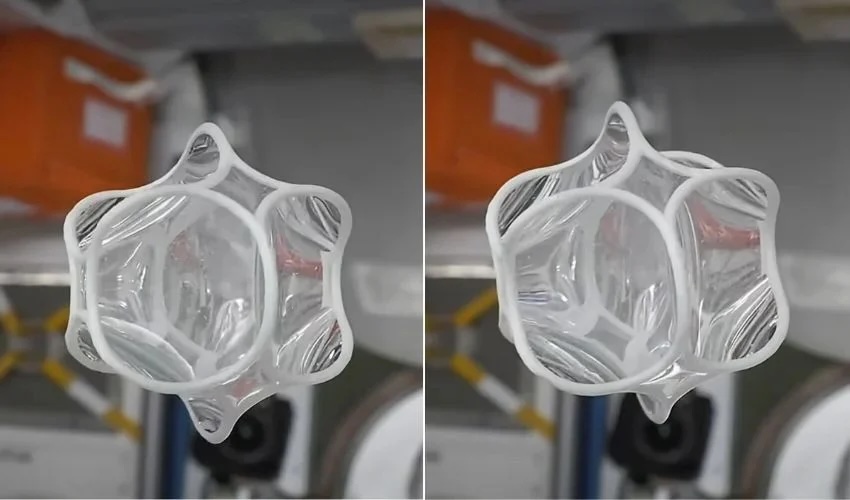
A geometric model developed through a collaboration between the University of Oxford and the Budapest University of Technology and Economics has just become the focus of one of the most remarkable experiments ever carried out in space. These “soft cells” are geometric forms capable of filling space without straight edges, and they also appear in biological structures. One of them, the f2 variant, was sent into space, and its behavior in microgravity surprised even the astronauts.
Soft cells were described in 2024 as a new class of geometric shapes that fill space without relying on sharp vertices. Their geometry resembles that of a polyhedron, but with one key difference: the faces do not need to be flat and the edges are not necessarily straight. In the f2 variant, the surfaces are “minimal,” similar to those formed when a soap film stretches across a wire frame, as shown in the image below.

The Geometric Shape Discovered in 2024
More from the desk
Six other notes from the rest of the bench.
 GuidesDigitizing the Smile: Ben Wynne on the Future—and Ethics—of Automated DentistryAnyone who has swapped traditional braces for clear dental aligners knows the appeal: aligners are much more comfortable and inconspicuous, compared to wires in your mouth. As this consumer preference for a more discreet orthodontic experience drives a massive market…
 NewsSerendix50, the 3D Printed House That Costs Less Than a CarThe incessant inflation of housing prices is a matter of concern for millions of people. It is becoming increasingly expensive both to buy a house and to live in it, so that young and not so young people continue to…
 NewsNano-Sized Rendition of Cornell’s McGraw Tower Marks Step Forward for 3D Printing TechnologyEarlier this month, a team led by staff photolithographer Ed Camacho at Cornell NanoScale Science and Technology Facility (CNF), in Duffield Hall created what is thought to be the world’s smallest rendition of Cornell’s iconic McGraw Tower. The tower is…
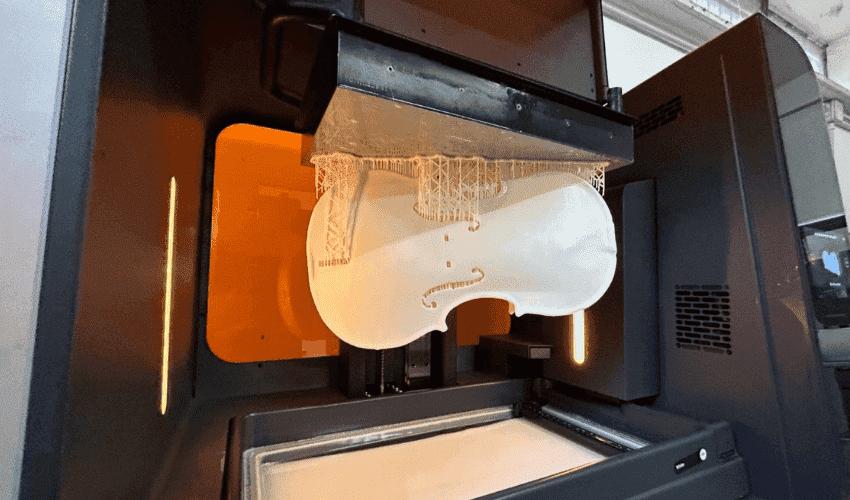 NewsThe 3D Printed Paganini Violin Will Bring History to Life for Music LoversNamed “The Devil’s Violinist,” Niccolò Paganini left an indelible mark on music history. Using his iconic Il Cannone violin crafted by Guarneri “del gesù,” he delivered intricate melodies with unmatched precision. His legacy endures, now to be illumi
 NewsConcr3de wants to 3D print the lost parts of Notre-Dame using its 3D technologyConc3de, the stone 3D printer manufacturer has suggested to use its 3D printing technology to rebuild the Notre-Dame gargoyles following the fire on April 15th. The Dutch company has experience in restoring historical heritage using 3D technologies, for example it…
 NewsResearchers From Stanford University Introduce New 3D Printed Solar PanelsScientists from Stanford University in California recently developed a new, 3D-printed optical concentrator for solar panels. This pyramid-shaped lens device called Axially Graded Index Lens (AGILE) was designed by engineering researcher Nina Vaidya and is able to increase the ca