News
Is industrial scale AM production limited by vendor lock-in?
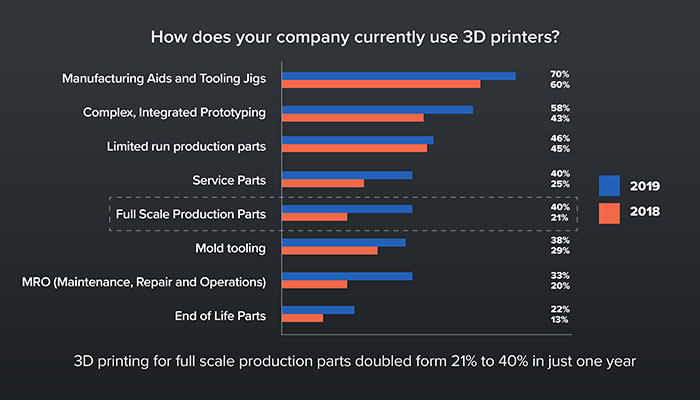
At the end of last year, we told you about Essentium’s study on the state of industrial scale 3D printing. According to findings, between 2018 and 2019, the number of manufacturers that were using 3D printing for full-scale production doubled…
- 3 min read
- News
- Six more stories
At the end of last year, we told you about Essentium’s study on the state of industrial scale 3D printing. According to findings, between 2018 and 2019, the number of manufacturers that were using 3D printing for full-scale production doubled – 40% in 2019 compared to 21% in 2018. Today, the company based in Texas has released some new findings that detail manufacturers’ take on the industrialization of 3D printing. More precisely, the company surveyed 162 managers and executives from large manufacturing companies across the world about their current experiences with 3D printing for production manufacturing in order to draw a clearer picture of their expectations.
The study reveals that virtually all manufacturing executives surveyed (99%) believe an open ecosystem is important to advance 3D printing at scale. Additionally, there were two other trends expressed by manufacturers, the first being that they believe industrial scale AM has the potential to increase revenue for their business (85%), however that their flexibility has been limited by vendor lock-in (22%).
Credits: Essentium
It’s true that the industrial AM market has been dominated by closed systems where customers are locked into manufacturers’ hardware, processes and materials. As the technology obstacles around economics, scale, strength and speed of production have started to fall away, the number of manufacturers using 3D printing for full-scale production has grown, nevertheless many systems have remained closed. In terms of technologies, there are quite a few open FDM systems on the market, the same cannot be said for SLS and SLA solutions. Manufacturers are demanding open ecosystems to overcome system inflexibility and lack of material choice. According to the study, 50% of companies said they needed high quality and affordable materials to meet the growing demand for industrial 3D printed parts.
More from the desk
Six other notes from the rest of the bench.
 ApplicationsThe World’s First 3D Printed Composite E-ScooterE-scooters have been a controversial topic since their introduction in larger cities. Opinions are divided, especially when it comes to sustainability . Indeed, e-scooters can be environmentally friendly – especially if they replace car journeys or other forms of public tra
 MaterialsNASA’s 3D Printed GRX-810 Superalloy Could Make Stronger Parts for Airplanes and SpacecraftA year ago, NASA unveiled a new alloy that it claimed was more resistant and durable, potentially making it perfect for demanding aerospace applications. Called GRX-810, it was created through 3D printing and oxide dispersion, which would significantly improve its…
 NewsChina creates their first 3D printed bridgesThe School of Architecture and Urban Planning at Tongji University in Shanghai has created the first 3D printed pedestrian bridges in China. The two bridges were made of plastic and measure 11 meters and 4 meters long. With China’s latest…
 NewsPleko, the Spike Shoes 3D Printed Using Carbon FiberPleko is a new pair of shoes, made largely through 3D printing with composite materials. The structural part of the shoe, namely the insole, midsole, spikes and ribs, was designed with carbon fiber using selective laser sintering (SLS). The resulting…
 NewsA 3D printed Christmas tree made from recycled plasticHow was your Christmas? There is still a festive atmosphere in the streets, with all the illuminations, the decorated Christmas trees, the snow and the cold. And yes, Christmas is past but we still celebrate its magic and are (still) unpacking…
 NewsIs 3D Printing in Marketing a New Advertising Tool?Did you know that big brands such as Coca-Cola, Dior, McDonald’s, Louis Vuitton or Volkswagen use 3D printing in their advertising strategies? These are only some examples of companies that see additive manufacturing as a great ally in the marketing…