Applications
Improving Cardiovascular Surgical Outcomes with 3D Printed Grafts
What is the most dangerous disease in the world? Although most would point to cancer, it is actually heart disease that takes that role and even curing it can be deadly for sufferers of a variety of cardiovascular conditions. Thankfully,…
- 3 min read
- Applications
- Six more stories

What is the most dangerous disease in the world? Although most would point to cancer, it is actually heart disease that takes that role and even curing it can be deadly for sufferers of a variety of cardiovascular conditions. Thankfully, there may be a solution. A research team from Donghua University and Shanghai Jiao Tong University have published a study showing that 3D printed electrospun vascular grafts loaded with TMP (tetramethylpyrazine, a chemical compound found in the Japanese food nattō and fermented cocoa beans), could improve cardiovascular disease treatments by reducing thrombosis (occurring when blood clots block blood vessels and commonly seen due to immobility) and retrain aneurysmal dilation post-surgery.
According to the British Heart foundation, there are around 620 million people living with cardiovascular diseases across the world, an estimated 1 in 13 people. Not only that, but it is the leading cause of death, accounting for at least a third worldwide, while cancers are responsible for about one-in-five deaths. The treatment often includes vessel replacement due to severe stenosis, or total narrowing of arteries in the heart, but current standards still face challenges such as thrombosis. This is where these 3D printed electrospun vascular grafts are expected to make a significant difference.
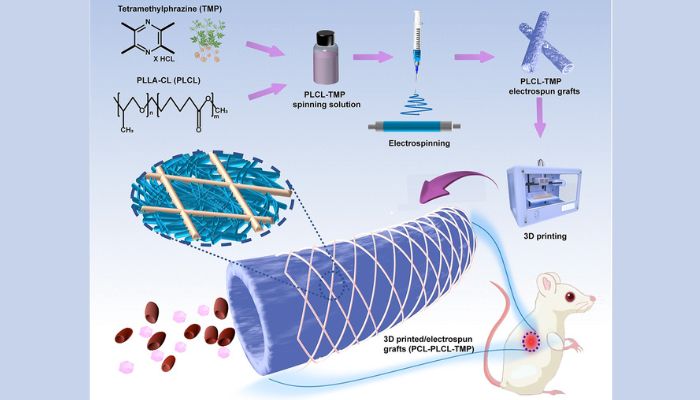
An illustration of the 3D printed electrospun vascular graft filled with TMP (image credits: Burns & Trauma)
Using 3D Printed Vascular Grafts to Treat the Heart
The grafts were made by combining electrospinning, an electrohydrodynamic process to create fibers, and an unspecified 3D printing process. They include an inner layer made of electrospun poly (L-lactic-co-caprolactone) (PLCL) nanofibers and an outer layer of 3D printed poycaprolactone (PCL) microfibers. A dual layer design was chosen for stability and flexibility. TMP, which was derived from the Chinese medicine Ligusticum chuanxiong, was then added for antiplatelet and anticoagulant properties.
More from the desk
Six other notes from the rest of the bench.
 NewsTop 5 Videos: Eating 3D Printed Food Tailored For Dysphagia PatientsWelcome to our compilation of this week’s most compelling 3D printing videos. We kick off this week’s edition with a taste test and exploration of 3D printed food, tailored for those suffering from dysphagia. Next, we’re given an in-depth look…
 NewsTop 5 Videos: Discover an Inside 3D Tour of FELIXprinters!For this week’s Top 5, join us as we tour FELIXprinters in the Netherlands! Get acquainted with the 3D printer manufacturer in our video, and then take a look at our exclusive interview with COBRA PUMA GOLF, a company that…
 PrintersImproving 3D Scans with AESUB SpraysThe German company AESUB has developed a variety of 3D scanning sprays that improve the quality of scans, giving them a clear, matte finish. There are currently two products available: AESUB Blue, a mattifying spray that evaporates just a few…
 PrintersObsidian: Kodama’s latest 3D printer for only $99The Kodama Kickstarter campaign, which ends in less than 24 hours, is already a huge success. After exceeding its initial target of $100,000 in less than 3 minutes, the company has so far managed to raise a total of $1.48…
 News#3DExpress: LFAM Robotic Printing Continues to Grow in UK With Rapid Fusion CenterIt’s time once again for the #3DExpress! This time, see how large-format robotic additive manufacturing continues to take the world by storm with the unveiling this week of a new 3D printing center by Rapid Fusion. Then, learn more about…
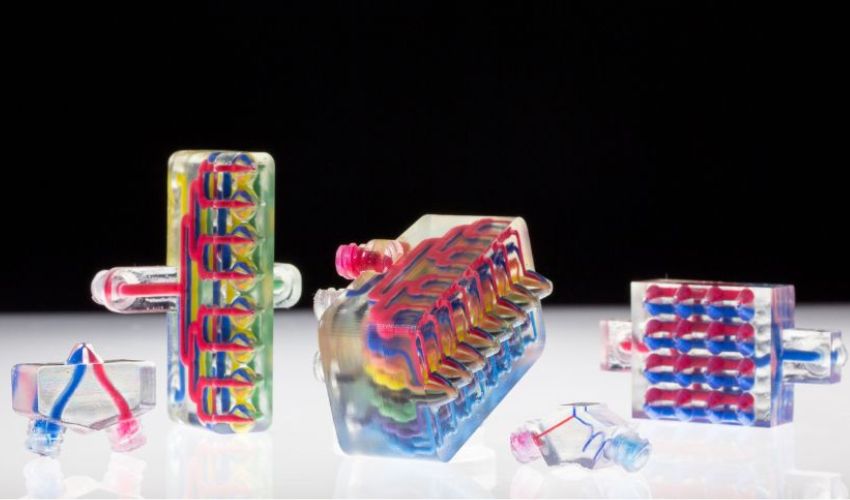 MaterialsAll You Need to Know About Multi-Material 3D PrintingMulti-material 3D printing is, as the name implies, 3D printing several materials in one continuous printing process. It is not the same as multi-color printing, where one material is printed in several color variations. Although the visual result of multi-material…