Materials
Creating illusory materials with multi-material 3D printing
Innovation is second nature to the additive manufacturing sector, and one recent project that illustrates exactly this is Illusory Material. Conceived by industrial designer Jiani Zeng and computational designer Honghao Deng during their time at MIT, the aim of this…
- 3 min read
- Materials
- Six more stories
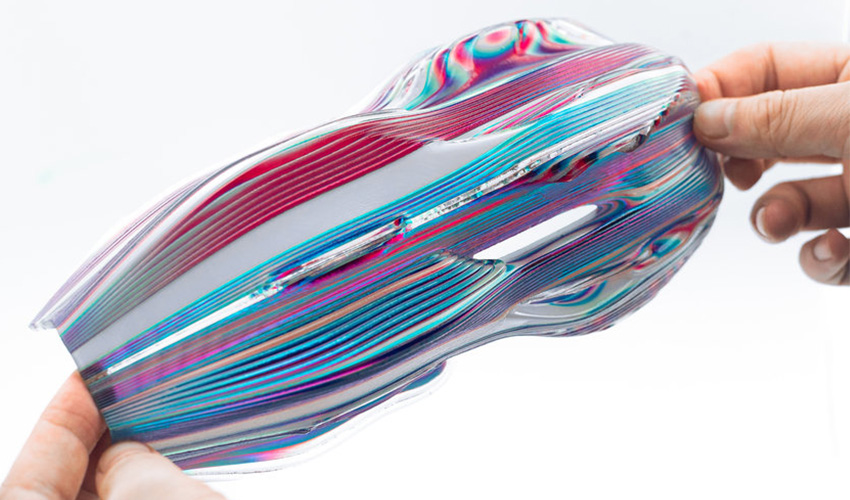
Innovation is second nature to the additive manufacturing sector, and one recent project that illustrates exactly this is Illusory Material. Conceived by industrial designer Jiani Zeng and computational designer Honghao Deng during their time at MIT, the aim of this project was to bring new possibilities to product design with the use of multi-material 3D printing. Not all 3D printing technologies can create parts with multiple materials, but one that does enable this is Material Jetting, developed under the name PolyJet and owned by Stratasys. Awarded the Strategy & Research Award of the Core77 Design Awards 2020, Illusory Material produced some truly beautiful pieces.
This is not the first time that Stratasys 3D printers have been used in innovative design projects. Additionally to redefining the look of various products, the two designers also wanted to create a dynamic design that could interact with users without the need for any electronic or robotic elements. They comment: “We propose to get away from surface obsession in object and industrial design, by adding another dimension to the material interface. By embedding information into three-dimensional matter, we introduce illusory material: a new material organization that responds directly to the user intervention or the environment. With multi-material 3D printing, we envision a future in product development where the design of surface detail, texture, reflexivity can finally be merged with the overall product composition from the beginning of the design process.”
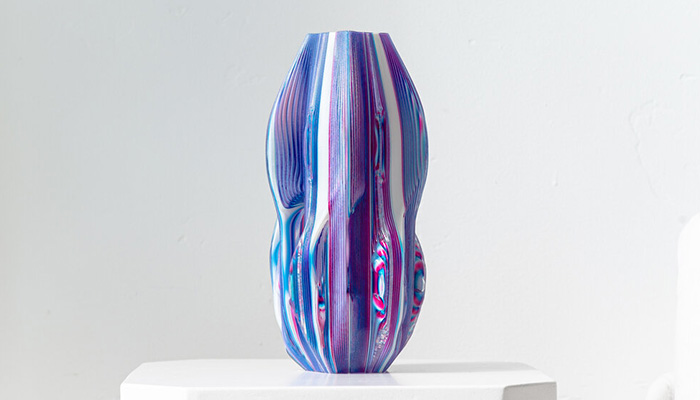
Daytime artifact and night lamp created using this method
The designers released multiple products, namely a minimal perfume bottle that reveals information from certain angles only, a daytime artifact and night lamp that displays different colors in different viewing angles, and an interactive lollipop. Every time, the design, from colors to shapes, changes according to the viewing angle, something very hard to achieve using traditional manufacturing techniques, but also 3D printing technologies! The two designers had to study optical effects by testing multiple lenticular arrays to arrive at a dynamic object. Then, they opted for Stratasys’ J8 series 3D printer to manufacture the parts because of its multi-material capabilities.
More from the desk
Six other notes from the rest of the bench.
 ApplicationsA new innovation in the 3D printing of ProstheticsAnother breakthrough in 3D printing, Northwell Healthcare has announced one of the first 3D printed land to water prosthetics called “The Fin”. This device offers amputees more ease when performing athletic activities, giving them the ability to take part in…
 NewsTop 5 Videos: Public library makes 3D printed face shieldsThis week we found the top 5 videos about 3D printing and the way additive manufacturing is changing production. The technology has infiltrated many sectors, from medical to automotive – check our selection of the week to keep up with the innovations! If you enjoy these, you&hell
 SoftwarePrint&Go Acquires Astroprint in Order to Improve User ExperienceThe additive manufacturing market is constantly changing. This can be shown by the fact that one of the most prominent trends in recent years includes the merging of organizations and the signing of collaboration agreements and even the purchase of…
 ApplicationsThe world’s lightest electric bike features 3D printed partsThere is a new record in the Guinness World Records book: Dennis Freiburg designed the world’s lightest electrically assisted bike (EAB). Weighing only 6.872 kilos (15.15 lb), it’s a real mechanical and technical feat that this German engineer managed to…
 NewsSee3D; Brings sight to the visually impaired with 3D printing3D printing has in many ways helped people and the development in various areas. From the implementation in different education systems to how it has helped in developing the medical sector. One organisation that has found a way to help people…
 NewsZero Gravity Bioprinter: Ready for the International Space StationThe additive manufacturing has become a great ally for the extraterrestrial conquest and for the technological development in space. There are multiple applications of 3D printing for arrival in space, but there is one that has stood out in recently:…