Materials
How Are Lithoz Ceramic Materials Revolutionizing Aerospace?
It is predicted that the ceramic 3D printing market will generate up to $4.8 billion worldwide in 2030. And one large and important customer for ceramic 3D printing is the aerospace industry. A notable player in the sector is Vienna-based…
- 3 min read
- Materials
- Six more stories
It is predicted that the ceramic 3D printing market will generate up to $4.8 billion worldwide in 2030. And one large and important customer for ceramic 3D printing is the aerospace industry. A notable player in the sector is Vienna-based Lithoz, which has focused on ceramic 3D printing for the aerospace sector, among others. Lithoz has succeeded in developing a manufacturing system based on lithography-based ceramic manufacturing (LCM). This makes it possible to increasingly use ceramics for aerospace applications. But what specific possibilities and areas of application does ceramic 3D printing and the materials developed for it have in this case? And how do they contribute to improving the requirements of aerospace to date?
Spaceships Take Off With 3D Printed Ceramic Parts
Faster, simpler and more cost-effective is the principle that many companies and organizations in the aerospace sector are pursuing. There is hardly any other sector like aerospace where the requirements and expectations for additively manufactured parts are as high. Probably the greatest challenges for its components include not only extreme loads but also heating and overheating. In particular, the fact that turbine blades move at such a speed that the heat generated by them is higher than that generated by the metal used to make them pushes conventional manufacturing processes to their limits. However, the individual components must not only be able to withstand excessive heat without problems, but also freezing cold. If one considers that the outside temperature in space can quickly drop to over – 200 °C, it quickly becomes clear: the Aersospace sector needs a forward-looking alternative for the manufacturing process. These different extreme conditions must not affect the performance of the parts in any way, as continuous stability and porosity are essential in space travel. The size for catalysts, for example, also plays a major role downstream: if the parts are manufactured too large, it can lead to unnecessary heat loss; if the parts are too small, it can lead to no maximum decomposition of the propellant. The result in both cases is reduced performance and increased cost.
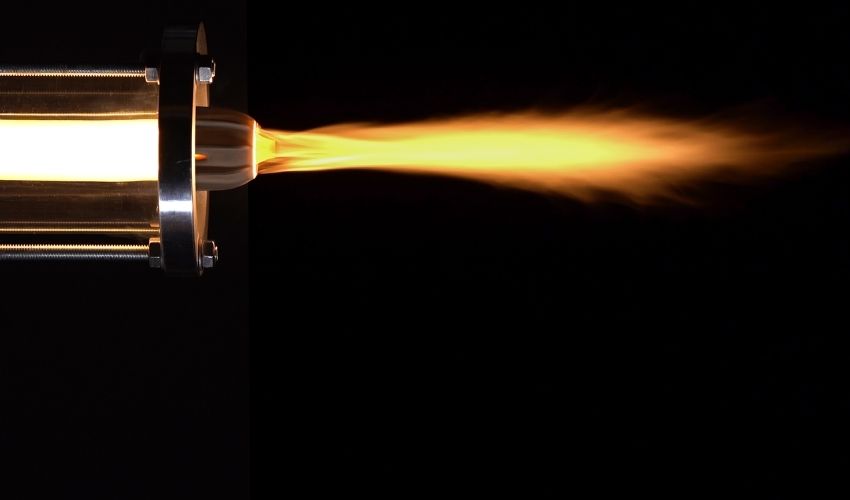
But how can ceramic 3D printing remove these obstacles? Ceramics are known for their properties such as heat resistance, mechanical performance, and also for their use in producing fine components of the highest quality. Additive manufacturing therefore enables the design of complex shapes while reducing costs and lead times – something that is not possible through conventional manufacturing. It can be quickly deduced that ceramic 3D printing is an ideal solution for an industry as demanding as aerospace. Lithoz has quickly positioned itself in this market by developing a silicon nitride (Si3N4) that shines with its optimal properties, such as tremendous strength even at high temperatures, excellent resistance to unexpected temperature changes, and also tremendous hardness. To prove these properties and test the material under extreme conditions, the Austrian company conducted a stress test with a nozzle made of Si3N4 – with excellent results.
More from the desk
Six other notes from the rest of the bench.
 News#3DExpress: Prusa Research Will Manufacture 3D Printers and Filaments in the USAIt is time once again for #3DExpress, where we tell you all about some of the most interesting tidbits of news from the week. To start with, Prusa Research will be setting up in Delaware and will thus be also…
 MaterialsSANDHELDEN Turns to Binder Jetting and ExOne for its Sustainable, Sand ProjectsSand binder jetting is increasing in popularity when it comes to end-use parts. This is due to a variety of factors. For one, binder jetting is one of the fastest additive manufacturing technologies and sand binder jetting, in particular, is…
 PrintersMIT 3D printing system reproduces realistic variations in glossinessRecently, MIT researchers developed a 3D printing system able of giving an object more salient features by reproducing its glossiness. Gloss remains a challenge to 3D print because hardware isn’t designed to deal with the different viscosities of the varnishes…
 NewsA 3D printed and recycled wood cabinWhat if we reuse wood waste to make small houses and other constructions? That’s the idea behind Ashen Cabin, a cabin imagined by the HANNAH design studio: using emerlad-ash-borer-infested wood (a species of beetle insect), the American company used 3D printing…
 PrintersLab 3Dnatives: Robo C2 3D Printer TestRobo 3D are an American manufacturer based in California who first came to the world’s attention in 2013 with the launch of their Robo C1 3D printer on Kickstarter. At the end of 2016, Robo 3D launched another Kickstarter campaign…
 NewsTOP 5 VIDEOS: 3D printed heart, tooling, 3D printing & mathematics …We found the TOP 5 VIDEOS of the week about 3D printing and the way additive manufacturing is shaping and changing our society. If you enjoy these, you can view even more 3D printing videos on our Youtube channel. Hope you’ll enjoy…