Applications
The World’s First High-Resolution 3D Printing Brain Phantom
We are increasingly encountering 3D printing in the medical field for the production of organs. For example, in the case of the researchers at the University of Wisconsin-Madison, who produced the first functional 3D printed human brain tissue. Now there…
- 3 min read
- Applications
- Six more stories

We are increasingly encountering 3D printing in the medical field for the production of organs. For example, in the case of the researchers at the University of Wisconsin-Madison, who produced the first functional 3D printed human brain tissue. Now there has been yet another example, as Viennese researchers have developed what they claim to be the world’s first high-resolution 3D-printed brain phantom. The researchers hope it will be useful for further research into neurodegenerative diseases such as Alzheimer’s, Parkinson’s and multiple sclerosis as well as for planning operations.
The breakthrough was achieved as part of a collaboration between the Medical University of Vienna (MedUni Vienna) and Vienna University of Technology (TU Wien). The model of the 3D printed brain, which the scientists also call a “brain phantom”, hardly resembles a real brain visually, as it is shaped in a cube and is significantly smaller. Inside, however, the model contains tiny water-filled microchannels that mimic cranial nerves and are only a fifth of the size of a human hair.
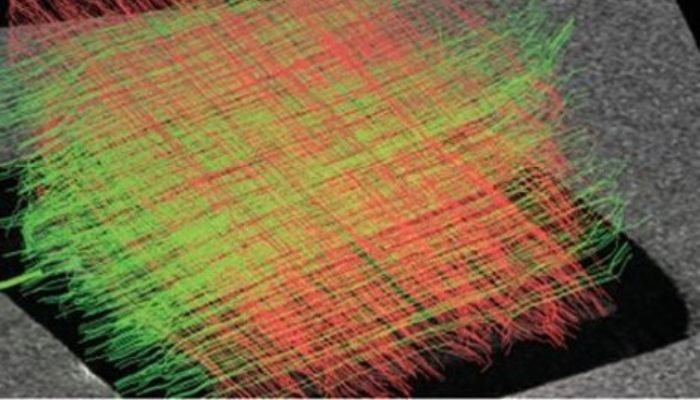
Photo Credits: MedUni Vienna
The purpose of the model is to imitate the structure of brain nerve fibers and to visualize them using diffusion-weighted magnetic resonance imaging (dMRI), a special form of MRI. MRI is used in particular to examine the structure and function of the brain, and dMRI can even be used to identify the direction of nerve fibers in the brain. The 3D-printed brain phantom will now help to optimize the dMRI procedure and test analysis and evaluation methods. This should prove useful, as the direction of the nerve fibers has been very difficult to determine up to now, due to the fact that nerve fibers moving in different directions overlap at crossing points of nerve fiber bundles.
More from the desk
Six other notes from the rest of the bench.
 NewsMedically approved emergency 3D printed ventilator goes into productionIn Spain, the first 3D printed respirator has just been developed and approved by medical experts. In order to support hospitals and intensive care units in the face of the current health crisis, the consortium comprising Consorci de la Zona…
 ApplicationsEngineers bio-print structures from sugarIt appears that bioprinting is gaining more ground as engineers at the University of Illinois have reportedly developed a new sugar-based biomaterial that could have a significant impact on medical engineering and cancer research. The team of engineers has opted…
 ApplicationsTesla Turns to 3D Printing to ‘Reinvent Carmaking’As concerns about the environment have grown, so has the market for electric vehicles. Often considered to be more eco-friendly thanks to the fact that they do not need gas to function, in 2023 most car manufacturers have their own…
 NewsTop 5 Videos: RAPID + TCT 2024 Sneak Peek!Welcome to our compilation of this week’s most compelling 3D printing highlights. We kick off this week’s edition with our very own video, providing a quick sneak peek into the exciting RAPID + TCT 2024 event, which will be held…
 GuidesStartup of the Month: AnatomikModelingThis week’s startup of the month is AnatomikModeling, a company focusing on using 3D tech to help improve various conditions such as for congenital thoracic pathologies. Despite only being started two years ago, AnatomikModeling is an exciting new company that…
 PrintersThe Top Glass 3D Printers on the MarketGlass is one of the oldest materials on Earth, worked by humans more than 100,000 years ago. It was used to make tools and weapons, and over time, its applications multiplied. Looking around us today, glass is everywhere and exists…