News
GE awarded $14.3 million for 3D printed prototype that creates water from thin air
Lack of fresh, potable (drinkable) water is one of the biggest challenges facing millions on our planet today. This is especially evident in arid areas, many of which are now struggling even more as global warming drives temperatures up in…
- 3 min read
- News
- Six more stories
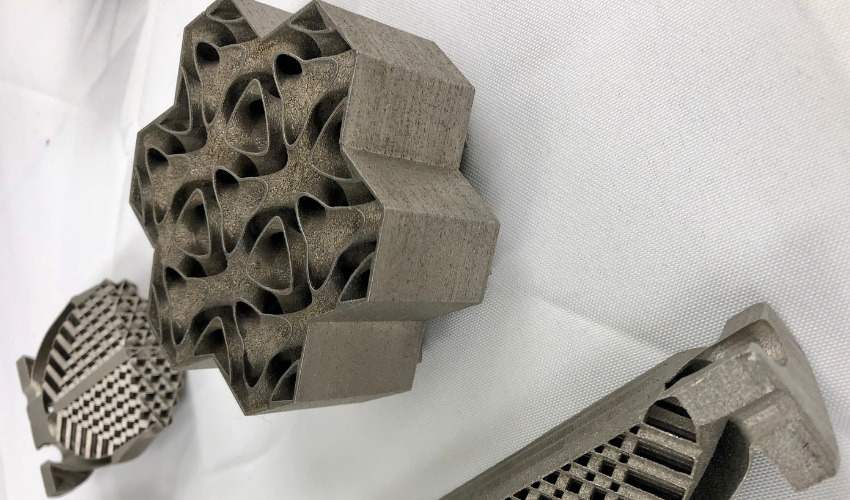
Lack of fresh, potable (drinkable) water is one of the biggest challenges facing millions on our planet today. This is especially evident in arid areas, many of which are now struggling even more as global warming drives temperatures up in desert regions. This issue is also of particular concern to a potentially surprising group, the US military. To address the problem, the Defense Advanced Research Projects Agency’s (DARPA) awarded General Electric Company (GE) $14.3 million to lead a four-year project as part of their Atmospheric Water Extraction (AWE) program. The goal is to design a prototype that would literally produce water out of thin air. Named AIR2WATER, the project will be created using a mixture of additive manufacturing, new material innovations and thermal processes.
According to statistics from the World Wildlife fund, “1.1 billion people do not have access to water and approximately 2.7 billion experience instances of water scarcity.” It is a problem that is expected to worsen in the coming years as temperatures rise and new areas experience desertification. It is also of great concern to the U.S. military, as it can be a logistical nightmare to transport clean, safe water to troops in the field as well as humanitarian missions in the area. In fact, since it often involves both air and ground vehicle transport over long distances and complex terrain, the cost attributed to water transportation is about one third of the Department of Defense’s (DoD) budget. Additionally, acquiring water is a dangerous task, as 10-12% of USMC casualties in Iraq and Afghanistan were due to the moving of fuel and water, according to an AEPI Report. As such, finding ways to provide potable water is a high priority, hence the reason for the AWE program.
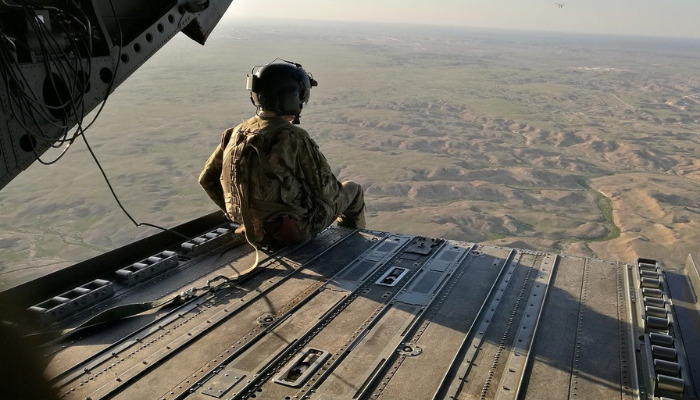
The device will be used to give soldiers access to potable water in arid areas
GE and the AIR2WATER Device
The potential solution is AIR2WATER, or Additively Manufactured, Integrated Reservoir to Extract Water using To Extract Water using Adsorbents and Thermally-Enhanced Recovery. For this $14.3 million project, GE will aiming to create a compact, light weight (able to be carried by soldiers for use at bases). It will be able to produce potable water through the use of sorbent (materials used to absorb or adsorb liquids or gases) materials absorbed through the air and by using a unique additively-manufactured heat exchanger. This will draw in heat over the materials in order to release water. The project will be accomplished with scientists and engineers from the University of California at Berkely, University of Chicago and University of South Alabama. The goal is that will be able to produce enough daily water for 150 troops.
More from the desk
Six other notes from the rest of the bench.
 GuidesHP on the Application and Scaling of MJF TechnologyWe are once again on the road to Frankfurt visiting Formnext in order to bring you the latest news from the additive manufacturing world. Of course, when visiting the halls of the expo, the HP booth is always an interesting…
 NewsThe Importance of 3D Printing in Industry 4.03D printing is one of the fundamental elements of Industry 4.0. But before considering the role of additive manufacturing, it is first necessary to understand what Industry 4.0 is. Industry 4.0, or the fourth industrial revolution, consists of the automation…
 NewsOdisei Music and its electronic 3D printed saxophoneIt’s not the first time we’ve talked about 3D printed musical instruments. Today, the inclusion of additive manufacturing in art and music is becoming increasingly noticeable. An example of this is Odisei Music, a young company that has designed and…
 NewsFirst Ever 3D Printed School to Open in MadagascarThe first ever 3D printed school is set to open its doors later this year. It may seem that the novelty of this feat is somewhat lessened by the dozens of additive manufacturing construction projects preceding it. But rest assured,…
 Guides30 entrepreneurs in 3D printingWe often report on the latest research, innovations, and developments within additive manufacturing. But what about the bright minds, the entrepreneurs in 3D printing that are actually behind it? There are hardly any limits when it comes to the creative…
 ApplicationsOnkos Surgical’s Pelvic Reconstruction System Receives FDA ClearanceThis week, orthopedic company Onkos Surgical announced the FDA 510 clearance of its My3D® Personalized Pelvic Reconstruction system, a solution that uses 3D printing technologies to produce custom-made medical implants, instruments, and models. The New-Jersey-based company, which