Applications
Onkos Surgical’s Pelvic Reconstruction System Receives FDA Clearance
This week, orthopedic company Onkos Surgical announced the FDA 510 clearance of its My3D® Personalized Pelvic Reconstruction system, a solution that uses 3D printing technologies to produce custom-made medical implants, instruments, and models. The New-Jersey-based company, which
- 3 min read
- Applications
- Six more stories
This week, orthopedic company Onkos Surgical announced the FDA 510 clearance of its My3D® Personalized Pelvic Reconstruction system, a solution that uses 3D printing technologies to produce custom-made medical implants, instruments, and models. The New-Jersey-based company, which specializes in finding innovative new solutions to treat physical limitations and malfunctions, created the system to enable the reconstruction of multiple parts of the human pelvis.
Ever since the medical sector discovered the abundance of possibilities that additive manufacturing has in store, the sector has been able to introduce many new ways to treat patients who had already given up hope. Among the many fields of medicine where new AM solutions are being developed, the 3D printing of prosthetics and implants probably has had the most positive impact on patients, who were suffering from any kind of physical deficit. Onkos My3D® Personalized Pelvic Reconstruction system is a promising new solution that is set to have enormous potential to better the lives of those burdened by issues in the pelvic area. Now the system has been evaluated and greenlit by the United States Food and Drug Administration (FDA), it is ready to be made available to be used as a treatment soon.
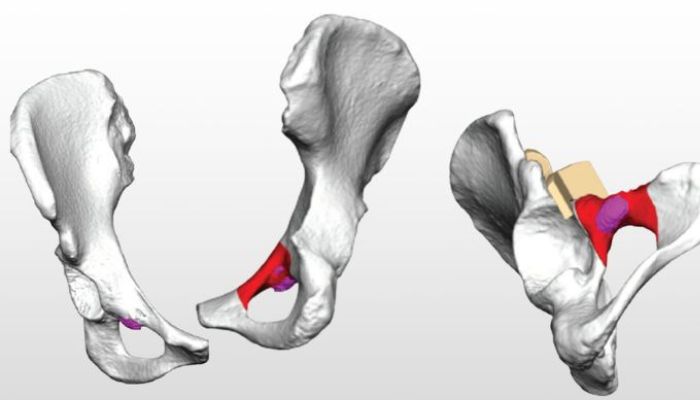
Human pelvic bones
Onkos Surgical is Creating Patient-Specific Implants
Basically, the MY3D PPR focuses on the 3D printing of patient-specific implants for acetabular- and advanced reconstruction in multiple regions of the pelvis. The use of AM technologies allows the implants to be designed and printed with unique features. Traditionally produced implants often lead to complications, because the models are produced in pre-determined sizes. Although the different sizes are suitable for different body types and fit at least to a certain degree, the uniqueness of every person’s individual anatomy may result in the implant causing problems. The 3D-printed alternative, however, is tailor-made and fits precisely. Included in the service provided by Onkos Surgical is access to its uDesign digital ecosystem. The cloud-based portal, which is HIPAA-compliant, allows surgeons to send patient images to Onkos, where they turn the anatomical images into 3D models, which can then be used for virtual surgical planning sessions.
More from the desk
Six other notes from the rest of the bench.
 ApplicationsProject Chaos: when an ultracar meets 3D printingSpyros Panopoulos is a Greek racing car enthusiast who has given his name to his company: he recently unveiled the new project he has been working on for the past two years. Project Chaos is a ultracar with very high…
 ApplicationsHow Can Metal Additive Manufacturing Overcome Obstacles for the Creation of Core Parts?As additive manufacturing continues to mature and grow, one trend that has become clear is the increased importance of metal AM in a number of sectors. More and more, OEMs are adopting metal AM technologies as a way to create…
 NewsAleph Farms can produce slaughter-free meat in SpaceAleph Farms is an Israeli startup that has developed a method to produce cultivated beef steaks. This method mimics the natural process of muscle-regeneration occurring inside the cow’s body, but under controlled conditions. One week ago, the startup successfully 3D…
 NewsAvoiding Defects in Laser Powder Bed FusionResearchers at Carnegie Mellon have discovered a way to avoid defects and increase the durability and resistance to corrosion of metal parts produced by Laser Powder Bed Fusion (LPBF). The research was primarily focussed on understanding how and why structural…
 SoftwareAll You Need to Know About CreoCAD (or computer-aided design) is an essential component of the digital workflow of additive manufacturing. As is in the name, it involves the use of computer software to create, modify, or analyze a design before it is ready to be…
 SoftwareAll You Need to Know About TurboCAD for 3D PrintingThe world-class TurboCAD software is based on computer-aided design (CAD). The CAD system was developed by San Francisco-based IMSI/Design and features a powerful design palette with a wide range of functions that allow users to create 2D and 3D drawings.…