Materials
Everything You Need to Know About 3D Printing Zirconia
Zirconia, or zirconium dioxide (ZrO2), is a crystalline ceramic material renowned for its excellent resistance to impact and wear, as well as for its aesthetic qualities. Most often machined, notably for dental applications, zirconia can also be 3D printed to…
- 3 min read
- Materials
- Six more stories
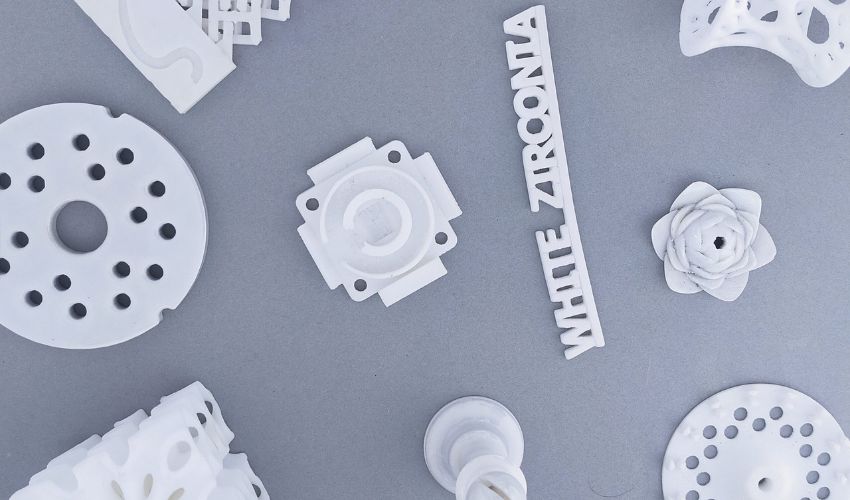
Zirconia, or zirconium dioxide (ZrO2), is a crystalline ceramic material renowned for its excellent resistance to impact and wear, as well as for its aesthetic qualities. Most often machined, notably for dental applications, zirconia can also be 3D printed to create more complex shapes. But which additive manufacturing processes are compatible? What specific features need to be taken into account? What are the advantages of 3D printing zirconia? We tell you all about it!
Zirconia is obtained by heating compounds of zirconium to very high temperatures. Zirconium is a chemical element discovered in 1789 by the chemist Martin Heinrich Klaproth, and it was first isolated as a metal in 1824. The process of calcining zirconium yields zirconia, which is of great interest to many industries. It is a particularly fracture-resistant ceramic, with good biocompatibility and excellent aesthetics. It is often used to design dental prostheses. Zirconia is resistant to chemicals, liquids, gases, high temperatures and corrosion.
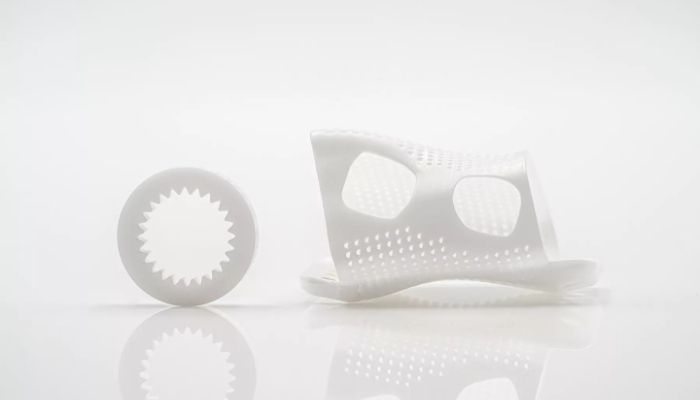
3D printed pieces with the LithaCon 3Y 210 material from Lithoz (Photo Credits: Lithoz)
3D Printed Zirconia
When we talk about additive manufacturing and zirconia, we find many similarities with aluminum oxide and alumina. Zirconia comes in the form of a powder that can be used in several printing processes. Let’s start with extrusion. Here, the powder is enclosed in plastic filament, meaning that it is an indirect process. The part that comes out of the 3D printer is therefore not final, because the piece has to go through debinding and sintering stages to remove the plastic. It must be cleaned thoroughly and then passed through an oven to consolidate the zirconia particles, thus obtaining the material’s final properties. Sintering prevents the formation of defects and small cracks on the parts, reinforcing the material.
More from the desk
Six other notes from the rest of the bench.
 NewsCzech Nuclear Power Relies on 3D Printing to Maintain Supply ChainHow can major companies which operate in multiple countries and source parts by global trade ensure that they have a consistent and reliable supply of these goods? How about 3D printing spare parts themselves? ČEZ is a utility and biggest…
 SoftwareThe Benefits of Home Assistant for Controlling Your 3D PrinterA century ago, few could have imagined a world where you can unlock your front door with a smartphone or ask Alexa or Siri to play music and control the lights. Today, these technologies are part of everyday life, ushering…
 MaterialsMIMETE on Producing Atomized Metal Powders for Additive ManufacturingMaterials for additive manufacturing are increasingly varied and vast, and depending on the target technologies and applications they can be used in a number of different forms. Materials research is also an increasingly important focus for manufacturing companies some of…
 ApplicationsApplication of the Month: Customizing Police Vehicles With SLS 3D PrintingPolice vehicles are not like other cars. Although they may look much like normal vehicles on the outside, apart from their lettering and sirens, they are very different on the inside. In fact, patrol cars are specially equipped to carry…
 ApplicationsX-Plorer: The 3D Printed Jet Engine Made of 965 partsDeveloped by a group of engineering students named JetX, this functional 3D printed jet engine is one of the finalists of the Student Grant 3D Hubs competition. The competition is held to discover who can make the best project displaying…
 PrintersThe Top Compact, Industrial FDM 3D PrintersDespite the growth in other additive manufacturing technologies in other years, fused deposition modeling continues to dominate a large share of the market. This can be seen not only with a corresponding rise in commercial, lower-cost solutions in recent years,…