News
ETH Zurich Will Use Robots to Make a 3D Printed Cultural Site
ETH (Swiss Federal Institute of Technology) Zurich is very active in the field of additive manufacturing. This is shown not only by the numerous partnerships but also by the long list of spin-offs, among which some companies, such as 9T…
- 3 min read
- News
- Six more stories
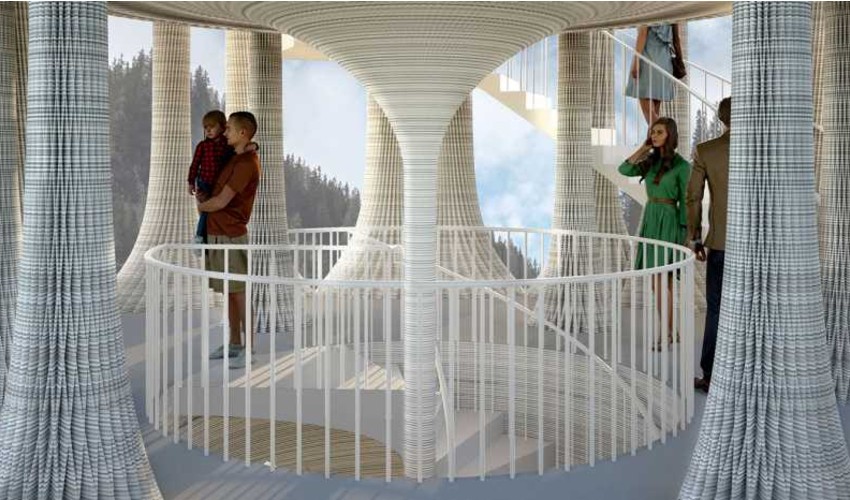
ETH (Swiss Federal Institute of Technology) Zurich is very active in the field of additive manufacturing. This is shown not only by the numerous partnerships but also by the long list of spin-offs, among which some companies, such as 9T Labs, are dedicated to 3D printing. Now, the technical university has partnered again and is thus engaged in a brand new 3D printing project: Together with the Swiss foundation Origen, they will be making a cultural site made of concrete which will be 3D printed in spring 2022.
Specifically, this is a 75-foot (23-meter) high tower that is being built in the village of Mulegns on the Julier Pass. The charming little village currently only has 16 inhabitants – a concern that is close to the heart of Giovanni Netzer, director of the Origen Foundation. He wants to bring life back to the little village and preserve its culture and history. After reopening a hotel, he is now planning the White Tower project with the help of architects and engineers from the ETH, who have drawn up the design and are planning the construction method. The art site will be made of 3D-printed, organically shaped white concrete columns and will have four floors, ranging from four to eight meters high. At the top of the tower will be a dome where performances can take place.
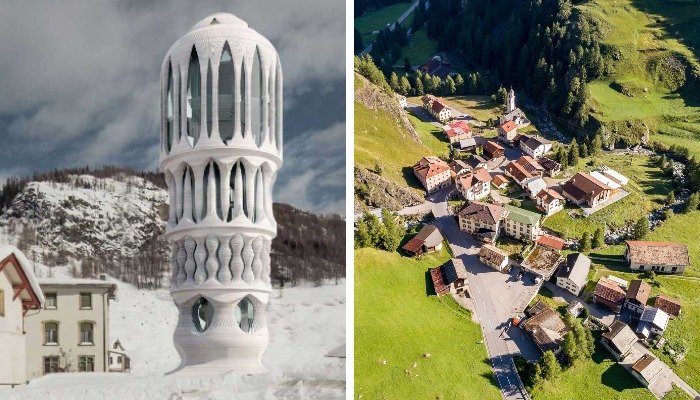
The 3D printed cultural site will be in the small village of Mulegns (photo credits: Hansmeyer/Dillenburger)
3D printing as a construction method
In order to be able to create the complex geometries of the tower and to use the concrete exactly where it is needed for the supporting structure, the project team opted for additive manufacturing as the preferred construction method. In fact, at about 75 feet (23 meters), the planned cultural site is one of the tallest 3D printed structures ever built by robots. There are several factors to consider when planning such a work of art in 3D: ETH professors must work on the right concrete mix, as well as the structural integrity and the connections of the printed concrete elements. Two advantages of the 3D-printed tower are that the construction uses less raw materials overall, as there is no need for formwork, and that the concrete elements can be separated from each other, so that the cultural site could be dismantled and rebuilt somewhere else.
More from the desk
Six other notes from the rest of the bench.
 Materials3D Printing Steel: Everything You Need to Know!Steel is a well-known metal in the industrial production and 3D printing sectors. It is an alloy based on iron (Fe) and other elements, mainly carbon (C), but also materials such as zinc (Zn) or silicon (Si). These alloys modify…
 ApplicationsMIT Engineers 3D Print Electrospray Engine Ideal for Small SatellitesHave you heard of electrospray engines? These propulsion systems involve applying an electric field to a conductive liquid, generating a high-speed jet of tiny droplets capable of propelling a spacecraft. Such miniature motors are particularly suitable for small satellites, known
 News3D Printed Eiffel Tower Made From Ocean Waste Marks Olympics in CzechiaOn Friday, July 26th, 2024, the Paris 2024 Summer Olympic Games officially opened! And since then we have seen incredible feats of prowess from athletes the world over in about 40 sports. But of course, not everyone can make it…
 PrintersDiscovery 3D Printers and the Benefits of Large Format Additive ManufacturingToday, the additive manufacturing solutions available on the market are used as an additional tool in the many companies’ activities. More and more users see 3D technology as a production process that complements the techniques of their factories and workshops,…
 NewsCarpenter Additive, the new end-to-end AM solutions business unitCarpenter Technology Corporation has announced that it is launching a new business unit dedicated to advancing its additive manufacturing segment, Carpenter Additive. The company is a leader in high-performance specialty alloys and this new division will build upon its existing&h
 GuidesThe Personalities Who Shaped The Additive Manufacturing Market In 20222022 was an important year for the world of additive manufacturing. However, due to many uncertainties resulting from the health crisis of recent years as well as economic consequences of the war between Russia and Ukraine, it was also a…