Applications
MIT Engineers 3D Print Electrospray Engine Ideal for Small Satellites
Have you heard of electrospray engines? These propulsion systems involve applying an electric field to a conductive liquid, generating a high-speed jet of tiny droplets capable of propelling a spacecraft. Such miniature motors are particularly suitable for small satellites, known
- 3 min read
- Applications
- Six more stories
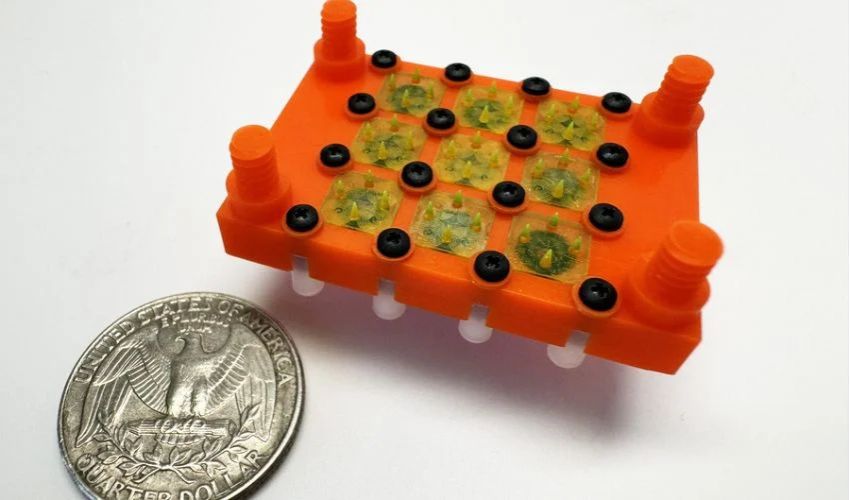
Have you heard of electrospray engines? These propulsion systems involve applying an electric field to a conductive liquid, generating a high-speed jet of tiny droplets capable of propelling a spacecraft. Such miniature motors are particularly suitable for small satellites, known as CubeSats, which are used in academic research. Furthermore, electrospray engines can use fuel more efficiently than conventional chemical rockets, making them particularly suitable for precise movements in orbit.
Traditionally, electrospray engines are manufactured using expensive and time-consuming semiconductor cleanroom fabrication, which limits the range of applications and the number of manufacturers. To circumvent this problem, MIT engineers developed an electrospray motor made entirely using 3D printing.
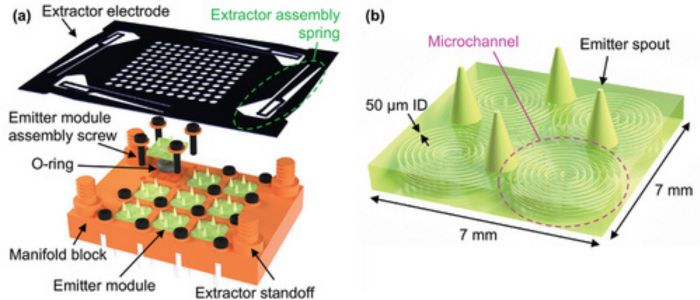
3D CAD models of the electrospray thruster design explored in this study: a) exploded view of assembled thruster made of a manifold block, an array of emitter modules, and an extractor electrode (during the experiments, the central emitter module was replaced with a non-functional module to ensure uniform emitter operation across the other eight emitter modules); b) close-up of an emitter module composed of an array of four emitters, each fed by a long, narrow, and winding capillary.
How do electrospray engines work? Well, they have a reservoir of propellant that flows to a series of emitters via microfluidic channels. A strong electrostatic field is applied to the tip of these emitters, which triggers an electrohydrodynamic effect. Then, this shapes the liquid into a cone-shaped meniscus that ejects a stream of high-speed charged droplets from its apex, generating thrust.
More from the desk
Six other notes from the rest of the bench.
 NewsWorld’s first 3D printed community project is officially underwayWe previously told you about New Story and ICON’s mission to create the world’s first 3D printed community as a means to combat homelessness. At the time, the exact location of the project had not been revealed. The project is…
 News3D Printing Used in Redesign of Terrazza Aperol in MilanOne of Milan’s iconic nightlife spots has been redesigned thanks to additive manufacturing. This is Terrazza Aperol, overlooking Piazza Duomo, which serves as the setting for an interior design project that blends aesthetics, sustainability, and technological innovation. Behind t
 Guides#3DStartup: OsseoLabs’ AI-Led Surgical Intelligence Platform and Material3D printed implants have already demonstrated huge potential in the surgical space. These implants are customized for patients, can reduce operating times by hours, and improve overall operational success. Today, we’re featuring a company entering that space: OsseoLabs. A f
 PrintersHow Does 3D Scanning Improve Carrot Harvesting in France?Agri Techni Concept is a French company that specializes in the manufacturing of agricultural and forestry machines. Based in Sore, a part of the Landes region, it develops solutions that adapt to the harvesting of carrots and potatoes. For several…
 ApplicationsMarines Have Successfully Demonstrated 3D Printing In-Flight for the First TimeIt is no secret that the U.S. military is increasingly turning to 3D printing for a number of interesting applications in the defense sector. Indeed, in the past few years, we have seen a number of projects including the use…
 PrintersLab 3Dnatives: UP Box 3D Printer TestSince being recently unveiled, the UP Box is one of the most anticipated desktop FDM 3D printers at the moment. While TierTime‘s previous 3D printers were widely acclaimed by the community, will their new models live up to the hype?…