News
EPFL is Developing an Elephant Robot Using 3D Printing
Researchers at the École Polytechnique Fédérale de Lausanne (EPFL) in Switzerland have introduced an impressively versatile yet lightweight robotic technology: an elephant robot made with 3D printing. The 3D-printable lattice structure is made from simple foam, but it can be&hell
- 3 min read
- News
- Six more stories
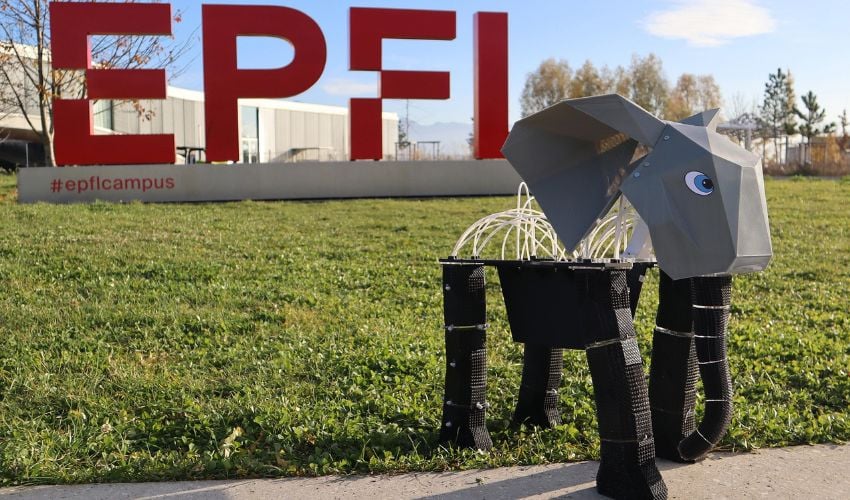
Researchers at the École Polytechnique Fédérale de Lausanne (EPFL) in Switzerland have introduced an impressively versatile yet lightweight robotic technology: an elephant robot made with 3D printing. The 3D-printable lattice structure is made from simple foam, but it can be precisely programmed to simulate both soft and rigid tissues from a flexible trunk to stiff joints like the hip or knee. True to its name, the adorable elephant robot can, among other things, pick up flowers with its trunk, move like a real elephant, and looks simply cute.
The secret to the robot lies in its so-called cells—tiny units of the lattice whose shapes and positions can vary. The EPFL researchers used two basic models: body-centered cubic (BCC) and the X-cube. By continuously blending these structures and additionally rotating or shifting individual cells, they create an almost infinite range of mechanical properties. A lattice cube with four cells offers about 4 million configurations; with five cells, the number grows to over 75 million. “This approach enables the continuous spatial blending of stiffness profiles and allows for an infinite range of blended unit cells. It’s particularly suited for replicating the structure of muscular organs like an elephant trunk,” said PhD candidate Benhui Dai about the project.
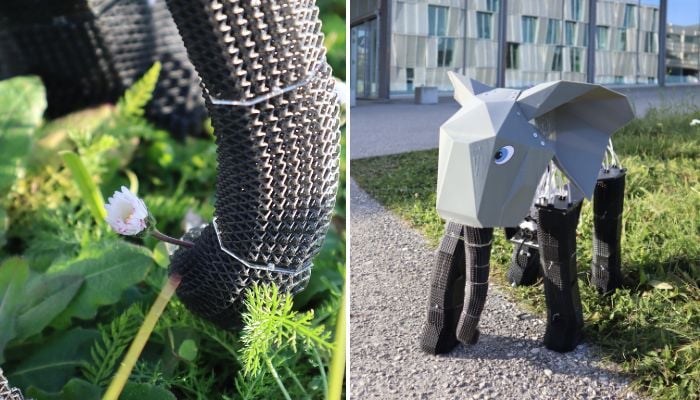
The elephant robot’s trunk can, among other things, grasp a flower.
The Interplay Between Flexible and Rigid Printed Parts
Using this flexibility, the roboticists were able to build a mechanically diverse elephant robot. Certain segments of the trunk consist of spiral, twisting, and bending sections that enable soft, flowing movements, while other parts are deliberately made stiffer, much like bones or tendons. This kind of technology is especially valuable in medical engineering, for example in the manufacturing of prosthetics. Several joint types were replicated: sliding planes (similar to the bones in the foot), uniaxial bends like those in the knee, and complex biaxial movements like toe joints.
More from the desk
Six other notes from the rest of the bench.
 PrintersCould Wi-Fi Be Used to Detect Human Locations?One of the technologies which has been become increasingly sensitive over the years has been 3D scanning technologies, notably LiDAR, or Light Detection and Ranging. From its origins of just barely being able to detect a shape and certainly nothing…
 GuidesCurifyLabs and the Automated Production of Personalized Medicines through 3D PrintingCurifyLabs is a Finnish healthcare company specializing in the development of solutions for the production of personalized medicines in pharmacies and hospitals. Thanks to 3D printing and the inks it has developed, the company offers a complete package for producing…
 NewsCultArm3D, an Automated Robotic Arm That Can Scan Cultural Objects in 3DFraunhofer Institute for Computer Graphics (Fraunhofer IGD for short), the leading world’s leading organization for application-oriented research, has developed a mobile 3D scanner called CultArm3D that can produce precise 3D models of exhibits of various sizes at the touch
 NewsGraphene Improves Properties of Copper Powder used in Additive ManufacturingIn Sweden, Uppsala University and the company Graphmatech have worked together to develop a rather unusual copper powder in order to create denser 3D printed parts. Using a laser fusion process, the researchers modified the metal’s surface with graphene. Thanks…
 NewsTop 5 Videos of the Week: 3D printing glass with new technique…This week we found the top 5 videos about 3D printing and the way additive manufacturing is shaping our society. The technology has infiltrated many sectors, from medical to automotive! Check out our selection of the week to keep up with the innovations! This week we…
 Applications“Hands for Ukraine” Project Creates 3D Printed Prostheses for Ukrainian War AmputeesAdditive manufacturing has often demonstrated its capabilities in the manufacture of prostheses of all kinds, and has played a big part in helping people in need. With the devastating aftermath of the war in Ukraine, where an estimated 10,000 people…