Applications
DoD Is Expected to Spend Even More on Additive Manufacturing for Defense
The American Department of Defense (DoD) has been one of the biggest drivers of growth for additive manufacturing adoption for military applications. This has been shown through many different use cases in the American military in particular and it has…
- 3 min read
- Applications
- Six more stories

The American Department of Defense (DoD) has been one of the biggest drivers of growth for additive manufacturing adoption for military applications. This has been shown through many different use cases in the American military in particular and it has further been proven by a new report. Titled “Additive Manufacturing in Military and Defense 2024” and coming from Additive Manufacturing Research, the study estimates strong growth for military and defense spending in coming years in the United States.
Authored by Tali Rosman, who previously worked at Stratasys and XEROX and oversaw the first metal 3D printer installed on a U.S. Navy ship, the report seeks to seek to analyze and forecast opportunities for 3D printing in the military and defense sectors. The core of the work sheds light on the increased spending from the DoD on additive manufacturing in defense, both from previous years and in the future. Indeed, while a 2023 version of the report noted $300M in direct DoD spending for the year, in 2024 that has already increased to $800M. This growth is expected to steadily increase, eventually reaching an estimated $2.6B in 2030.
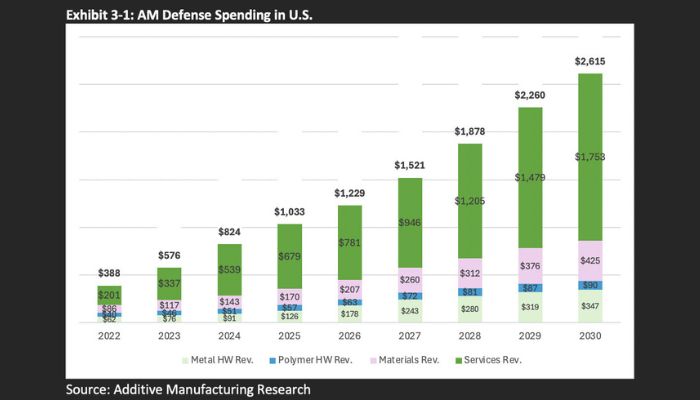
A graph showing the expected growth of the AM defense sector, including a breakdown by technology (photo credits: Additive Manufacturing Research)
The report delved into the reasons behind the expected 166% growth per year in this field. To do so, Rosman looked at the DoD budget with a forecast for spending with leading types of 3D printing. These including powder bed fusion, directed energy deposition, metal binder jetting and bound metal deposition. All of which have already been used for applications in the American military. As can be seen in the graph above. It seems that the area with the most expected growth will be in 3D printing services, followed by material, then metal hardware and polymer hardware.
More from the desk
Six other notes from the rest of the bench.
 NewsUniversity of Alberta Researchers Improve 3D Printability of Pea Protein3D printing can be used to overcome some of the key challenges facing the food industry. For example, specific shapes, flavors and consistencies can create special foods for children or people with swallowing problems, or to achieve an individual nutrient…
 MaterialsThe Complete Guide to 3D Printing CompositesIn recent years, composite 3D printing has grown rapidly in popularity. In a composite material, at least two different materials are joined together with separate purposes. One material serves as the matrix and is intended to maintain the structure, while…
 NewsStudy Examines Costa Rica-Based Oil Paintings Using 3D TechnologiesA multi-disciplinary study has taken advantage of 3D modeling and printing technologies in order to study two large-format oil paintings currently held in Costa Rica. Researchers observed their state of conservation and obtained key information about the artistic process and&hell
 GuidesPrecious Plastic values recycling plastic waste with new technologiesPrecious Plastic is a community that started in the Netherlands with the main goal of fighting “plastic pollution”. For this, they created a network of workspaces where all the tools and machines give a second life to plastics, either directly…
 NewsRedwire acquires Made In Space to transform global space economyMade In Space is a pioneer in in-space manufacturing and assembly technologies. Last October, we covered its announcement to send the first commercially-developed plastic recycling facility to the International Space Station (ISS). Named the Braskem Recycler, this machine convert
 NewsThe Best 3D Prints to Celebrate the 2026 World CupThe wait is officially over: the World Cup kicks off today! As the world’s biggest football tournament gets underway, it’s time to bring that electric stadium energy into your home and show off your team pride like a true maker. We’ve…