News
What Are the Different Methods for Surface Finishing in 3D Printing?
Additive manufacturing has experienced tremendous growth in recent years, evolving from a niche technology to an increasingly industrial method allowing for everything from prototyping to the production of end-use parts. However, despite 3D printing’s benefits, notably in t
- 3 min read
- News
- Six more stories
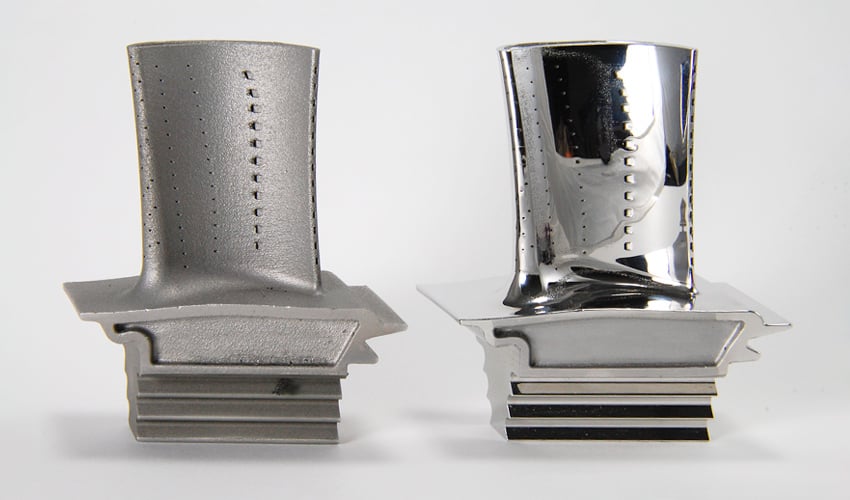
Additive manufacturing has experienced tremendous growth in recent years, evolving from a niche technology to an increasingly industrial method allowing for everything from prototyping to the production of end-use parts. However, despite 3D printing’s benefits, notably in terms of design freedom and customized production, the technology alone is not capable of creating professional-quality finished parts. Often, various post-processing processes are required to obtain high-quality final models. This involves a number of different steps.
For example, we previously gave an introduction to post-processing in additive manufacturing as well as a closer look at the importance of cleaning 3D printed parts. In addition to this, it is also essential to address the roughness of such parts depending on the material and technology used. Therefore, today we want to delve into yet another aspect in this complete guide to surface finishing in 3D printing. This type of treatment is often necessary in order to change the appearance of the raw part, smooth surfaces, adjust its size and shape or improve its service life.
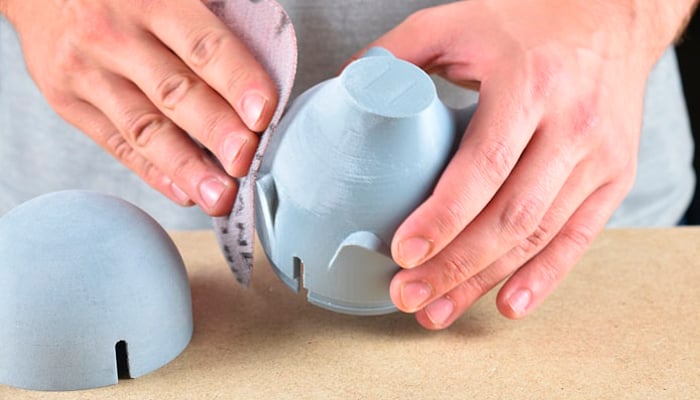
The sanding, one popular method of surface finishing for 3D printing parts, can be done manually, although automatic tools are also available.
Surface Sanding
In 3D printed parts, especially those created by extrusion methods, layer lines and other possible imperfections are often visible. To remove these surface defects, one of the most commonly used methods is sanding. This system involves the use of a rough material such as sandpaper of different grit sizes to remove the coating lines and provide a uniform finish free of imperfections. It is very useful if any type of subsequent coating is to be applied to the surface, as the surface will need to be smooth for optimum application.
More from the desk
Six other notes from the rest of the bench.
 ApplicationsAutonomous In-Space Manufacturing Moves Closer to RealityBased in Massachusetts, COSM Advanced Manufacturing Systems announced that it will begin working on the final development of electron beam metal 3D printing systems for a variety of future in-space, lunar and Martian applications. The work is funded by a…
 PrintersCrane WASP; a modular 3D printer for the construction industryThe Italian 3D printer manufacturer WASP quickly specialised in the Fused deposition modeling and now offers a wide range of machines of any size. We remember their 3D delta printer measuring 12 meters in hight and was 7 meters wide, the BigDelta,…
 NewsDubai Launches World’s First Certification Program for the 3D Printing Construction SectorThe additive manufacturing construction sector has been growing exponentially due to its fast completion time and lower labor costs, with projects cropping up all over the world. Concrete 3D printing in particular has seen marked development in its construction practices…
 ApplicationsINTENSE M1 Mountain Bike Integrates 3D Printing for Unmatched PerformanceFor downhill mountain bikers, conquering large drops and navigating unpredictable terrain requires lightweight, durable biking equipment. INTENSE’s M1 has long been a leader in the pack, but has recently taken a step forward to further innovate their bicycles. Through a&hel
 ApplicationsBMW M Visionary Materials Seat Wins Sustainability Prize Thanks to 3D PrintingThe automotive industry is steadily moving towards greater sustainability and 3D printing is playing a crucial role in this transition. This is because additive manufacturing enables companies to produce more environmentally friendly, lighter and more efficient components. This i
 NewsIris van Herpen Uses 3D Printing to Merge Fashion and Contemporary ArtSince November 29, the Musée des Arts Décoratifs in Paris has been hosting a new exhibition dedicated to the work of designer Iris van Herpen. Recently, our team was lucky enough to visit it and learn more about the hundreds…