News
What is the Difference Between SLA and MSLA 3D Printing?
Within resin 3D printing there are a number of different manufacturing methods. Processes like SLA, DLP or MSLA are all available, differing depending on which light source or process by which the photopolymer solidifies is used. In addition, many large…
- 3 min read
- News
- Six more stories
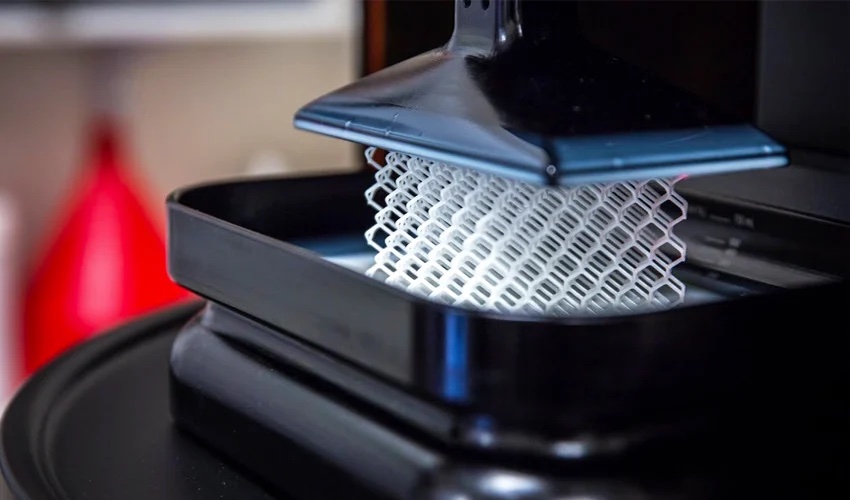
Within resin 3D printing there are a number of different manufacturing methods. Processes like SLA, DLP or MSLA are all available, differing depending on which light source or process by which the photopolymer solidifies is used. In addition, many large companies in the industry have also developed their own resin additive manufacturing solutions, with slight modifications that allow them to be patented as proprietary technologies. This is the case of BCN3D with its VLM 3D printing process, Prodways with MovingLight, or Carbon with DLS. However, today we want to focus on two specific methods which are SLA and MSLA. And though they may sound familiar, in fact that are extremely different. We took a closer look at how each one works, what their similarities are and, finally, how they differ from each other.
On one hand, stereolithography (SLA) technology uses a laser that solidifies the resin layer by layer in the 3D printer tank. Once the layer is finished, the build plate descends again to make way for the next one. Thus, the process is repeated until the final piece is obtained. On the other hand, the so-called Masked Stereolithography Apparatus (MSLA) is a modified form of SLA 3D printing. Although it is based on the same principle of light curing the resin using a light source, the method is somewhat different. Specifically, instead of using a laser beam to trace the layers, MSLA printers use a larger ultraviolet light source which is then selectively masked with an LCD screen to create the design.
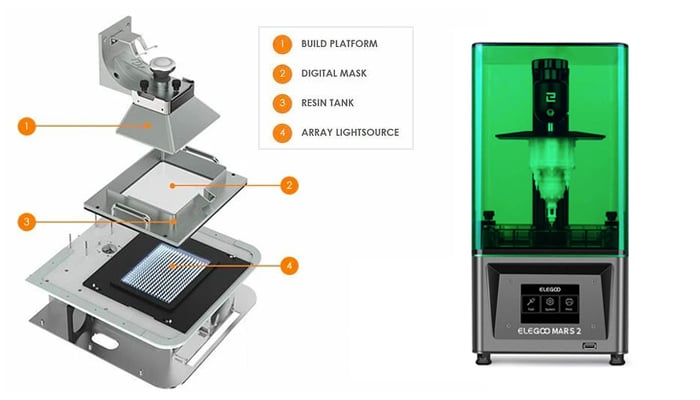
The makeup of an MSLA 3D printer is different than its SLA counterpart
Characteristics of SLA and MSLA Technologies
As we can see, the main difference between SLA and MSLA 3D printing is the light curing process for the resin and the light source. Therefore, the composition and elements of the 3D printers will vary from one machine to another. As the exposure of the layer to UV light is different, it also affects the printing speed and production times. While traditional SLA 3D printers rely on the number of layers and the amount of material in each layer to be laser cured, MSLA technology relies solely on the number of layers being printed. This difference in operation means that MSLA solutions have a speed advantage on each layer, especially when printing multiple objects at once.
More from the desk
Six other notes from the rest of the bench.
 Applications3DExpress: South Korean Aerospace Company INNOSPACE Launches New AM DivisionYet again, additive manufacturing is poised to help rockets take flight. In this week’s 3DExpress, read about aerospace company INNOSPACE launching its new advanced manufacturing division, footwear company Koobz’s $7.2 million investment round, a partnership between A
 NewsAda Hefetz Is Using 3D Printing to Transform Wedding DressesCould you imagine a bride in a 3D printed wedding dress? It may come as a surprise, but in fact the idea is already a reality. Israeli designer Ada Hefetz has launched a new line of wedding dresses made using…
 ApplicationsLamborghini Sian Roadster features 3D printed partsOne of the sectors that benefit the most from 3D printing technologies is the automotive industry. Additive manufacturing is often associated with affordability and speed, so many car manufacturers use this technology to produce car parts cheaper and faster. Meanwhile,…
 ApplicationsScientists in Canada are Developing a Bioink that Simulates Lung Tissue3D bioprinting continues to evolve as a promising tool in the field of personalized medicine. With this in mind, researchers at McMaster University in Ontario have developed a new bioink that mimics the mechanical and structural properties of lung tissue.…
 NewsMIT has 3D printed shape-shifting pastaMany of you are familiar with the innovations made in 3D printed food, such as with chocolate and cake molds, an exciting innovation for the foodies around the world. But now MIT’S Tangible Media Group is bringing us the next…
 PrintersNew 3D Printer To Benefit Russia’s Nuclear IndustryIn Russia, a groundbreaking 3D printer has been introduced, promising to revolutionize the country’s nuclear industry with additive manufacturing. Rosatom – Additive Technologies (RusAT), a subsidiary of Russian nuclear fuel manufacturer TVEL and part of the state nuc